

Published 12 October 2026. An evergreen product-mechanics explainer, prompted by current coverage; no new Indian rule is being announced.
An ETF with “2x” in its name can look like a faster route to a household goal. Before comparing its long-term return with an ordinary index fund, find the period attached to that multiplier. For a daily-reset product, the target starts again each trading day.
Mint’s report published on 12 October 2026 at 6:08 am IST prompted this question. The explanation below uses regulator guidance and our own calculations, rather than the report’s loss estimates or examples.
Start with the time period in the objective
The US SEC staff’s investor bulletin, dated 29 August 2023, explains that most leveraged ETFs reset daily. A 2x daily fund seeks twice the benchmark’s daily percentage move, including downward moves. It does not promise twice the benchmark’s return across your entire holding period.
FINRA’s explanation, dated 28 July 2022, adds a useful distinction: some geared products have other target periods, such as a month. Read the actual objective; the product name alone is insufficient. Even buying and selling within one day may not match a close-to-close target period.
Our example: the index returns exactly to its starting point
Use 100 as the starting value of both a hypothetical benchmark and an ideal 2x daily-reset ETF. These are normalised values, not rupee prices or a forecast.
On the first day, the benchmark gains 10%, reaching 110. The ideal fund gains 20%, reaching 120.
On the second day, the benchmark falls from 110 to 100. That is a decline of exactly 1/11, or about 9.09%—not 10%. The fund therefore loses exactly 2/11 of its new value of 120. It ends at about 98.18.
After two days, the benchmark is flat and the fund is down about 1.82%. The fund met its assumed daily target on both days. The difference comes from applying each day’s return to a changed base.
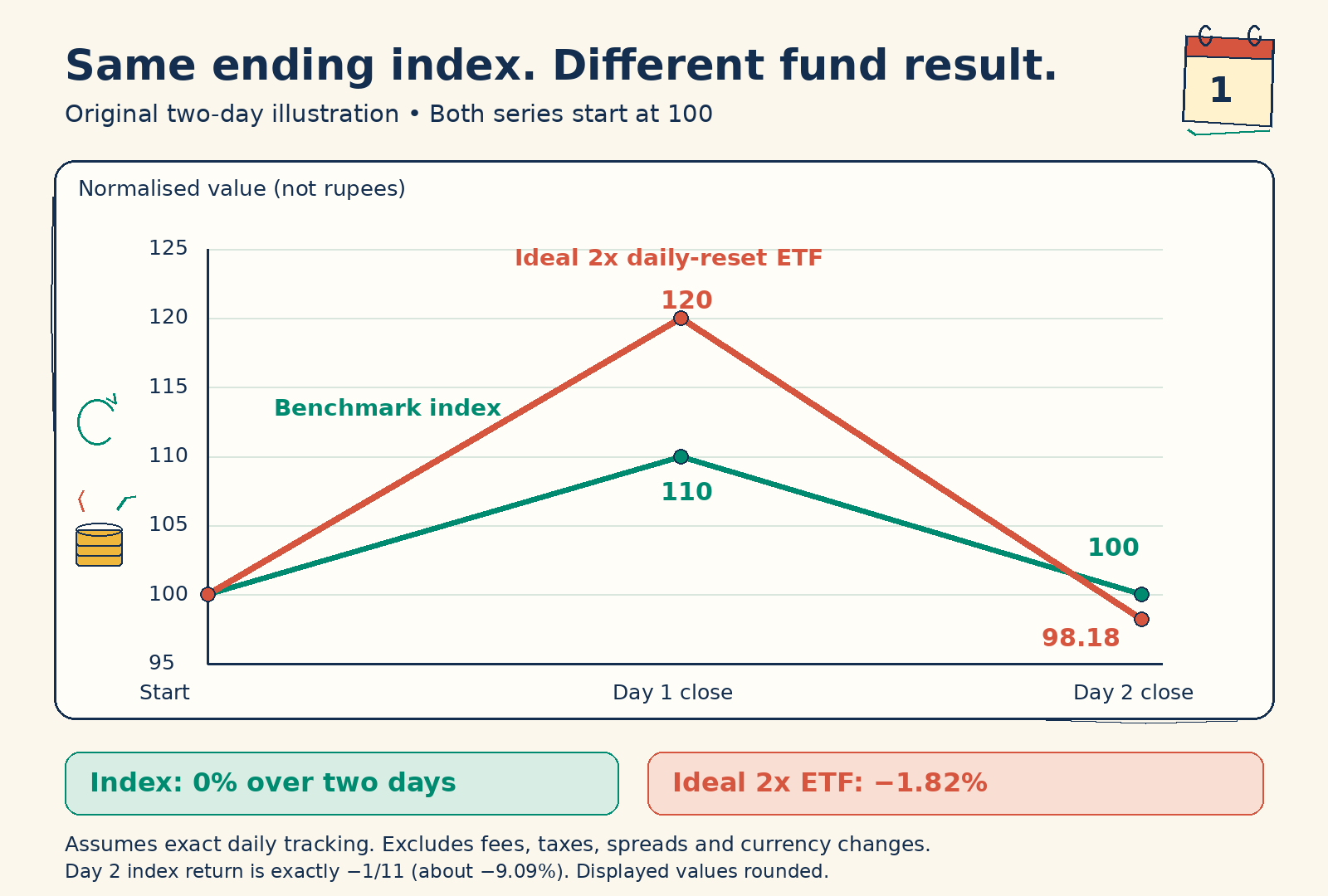
The calculation assumes perfect daily tracking and excludes fees, taxes, trading spreads and currency changes. Rounding is only for display; the arithmetic uses exact fractions. Real fund outcomes can differ.
Compounding can help as well as hurt
It would be wrong to conclude that daily leverage always creates a loss. In a second original illustration, two consecutive 10% benchmark gains turn 100 into 121, a 21% increase. The ideal 2x fund turns 100 into 144, a 44% increase—more than twice 21%.
Both illustrations follow the same rule: multiply each day’s benchmark return by two, then compound the fund’s resulting daily returns. The path matters. A favourable example is not a promise about the next path.
Put the product into your household plan before putting money into it
Our practical suggestion is to write a short product note before deciding. Record the exact benchmark, multiplier, target period and reset convention from the prospectus. Beside them, write the money’s purpose and the date you need it. A retirement goal measured in decades and a product objective measured in a day require a deliberate explanation of how they fit together.
Then examine the prospectus’s costs, principal risks and method of obtaining exposure. The SEC staff notes that leveraged funds can use derivatives and may fail to achieve even their daily objective. A single-stock version also does not provide the diversification of a broad basket.
If you already hold one, avoid treating a loss as proof that you should add more money. First reconstruct the fund’s daily target and your own holding period; then review whether that exposure still serves the goal. A purchase price is not a plan.
For an Indian household considering an overseas product, this article explains mechanics only. It does not establish that a particular ETF is available or permissible through a given route, or determine its Indian tax treatment. Those questions require separate, current checks for the investor and product.
The SEC source is US staff education, not an Indian regulation or a new legal requirement. FINRA’s source is also US investor education. No effective date for an Indian rule is asserted here. Source pages checked on 12 October 2026; no separate update date was visible on the Mint report. This is general education, not a product recommendation or personalised financial advice.