
The 50/30/20 rule splits your take home pay three ways. 50% to needs, 30% to wants, 20% to savings.
It is a good starting point. It also falls apart in a city where rent alone eats a third of your salary, so this calculator adjusts for what you actually pay.
The textbook rule, against your real rent
The rule assumes needs fit inside half your pay. Your rent decides whether that is true.
The adjusted column keeps your savings at 20% of your pay wherever possible, treats rent plus about 22% of pay as essentials, and leaves the rest for wants. It is a starting shape, not a budget you must follow to the rupee.
How to read this
The big number is what you could put away each month. The bar under it shows the shape of your pay. The panel at the bottom puts the textbook rule next to your own numbers. Where the two columns differ, rent is the reason.
Savings is protected first here. The calculator holds it at 20% of your pay for as long as the numbers allow, and lets wants absorb the squeeze instead. That order is deliberate. If wants take what is left after saving, you save. If savings take what is left after wants, you usually do not.
Why rent breaks the rule
The 50/30/20 rule came from a country where housing was rarely half of what a person earned. In Mumbai, Bengaluru or Delhi, rent of forty per cent of take home pay is ordinary. On that rent the needs bucket is already gone before you have bought food.
So the calculator does not force your needs into half your pay. It adds your actual rent to about 20% of your pay for everything else you cannot skip.
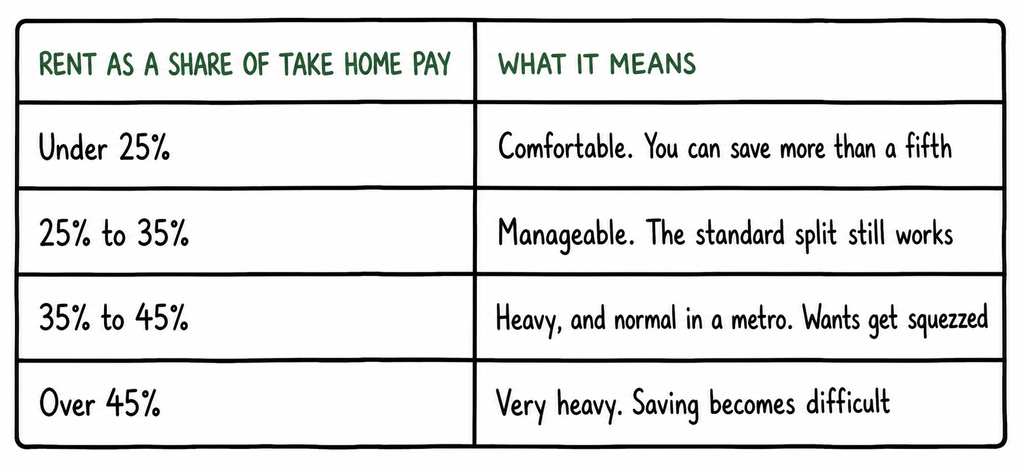
None of these are pass or fail marks. A high rent close to work can be worth it. The point is to see the trade rather than to make it by accident.
What counts as a need
A need is something that hurts to stop. Rent, food you cook at home, electricity, water, phone, travel to work, school fees, medicines, insurance premiums and every loan payment.
A want is everything else. Eating out, streaming, holidays, the newer phone, clothes beyond what you need. Most people put too much in the needs column. It is worth being honest, because a need you have mislabelled is a saving you never make. Two that catch people out. A loan payment is a need, because missing it has consequences. A subscription is a want, however small it feels.
If the numbers do not fit
Plenty of people run this and find there is nothing left. That is information, not failure. Only three things can move. Your rent, your other spending, or your income. Rent is the largest single item, so it is the one worth looking at first. A flatmate, or a place twenty minutes further out, changes more in one decision than a year of small economies. If rent cannot move, do not try to reach 20% in one jump. Save two per cent of your pay. Then five. A small amount that continues beats a large amount you abandon in March.
Where the savings should go first is the easy part. Build the buffer before you invest anything, and the emergency fund calculator will size it for you. After that, the SIP calculator shows what a monthly amount could grow into, and turning a distant goal into a monthly number works backwards from something you are saving towards.
This calculator is for learning. It is not personal financial advice. The 50/30/20 rule is a rough guide, and the adjustment used here is one reasonable approach rather than a standard. Your own split will depend on your family, your city and your commitments. For advice about your own situation, speak to a SEBI-registered investment adviser.