
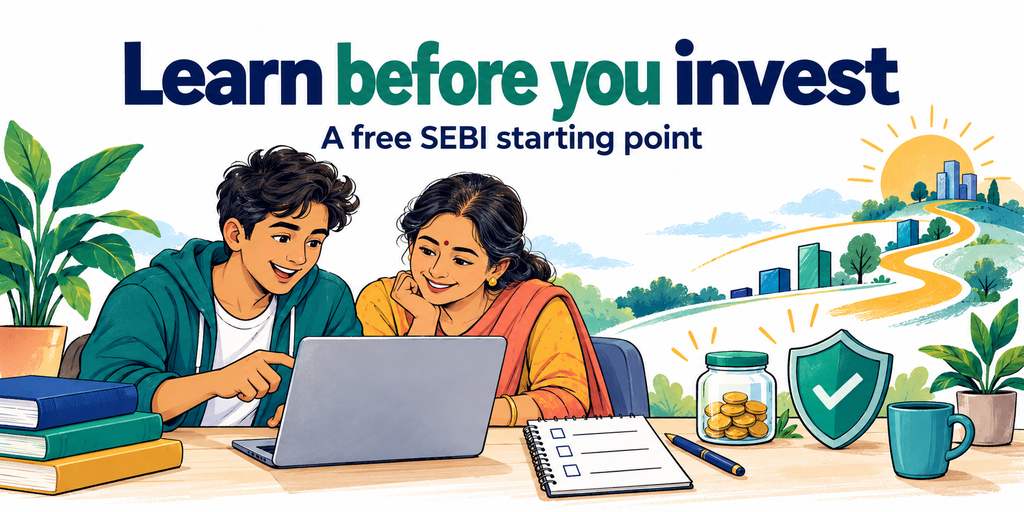
A first investment often begins with a product name: a stock, a mutual fund or a small SIP. A better first step is to understand what you are buying and what could go wrong. SEBI’s newly launched “Samajh Se Investing Simple” campaign gives Indian households a free place to start.
What is new?
SEBI announced the campaign on 5 October 2026 under Project Jagrook, alongside a student-focused MUST initiative. The official campaign page, last updated 4 October, offers seven free learning modules and links to a SEBI–NISM investor-awareness test. This is education, not a new investment scheme or a change to tax rules.
A useful way to begin
- Start with the purpose. Write down what the money is for and when you may need it. A college fee due next year calls for a different level of risk from retirement savings decades away. SEBI’s risk guide says investments should match your time horizon and risk tolerance; money needed soon should avoid volatile or illiquid assets.
- Work through the lessons. On the official campaign page, begin with “Understand Before You Invest” and “Choose Regulated Investment Products.” Learn the risks, costs and access rules of a product before choosing one. The page says the modules are free and available in your language, at your pace.
- Check what you know. The page links to the SEBI Investor Awareness Test on NISM’s site. It covers basics such as budgeting, inflation, market risks, diversification and investor rights. The test requires registration; it is a learning tool, not a recommendation to buy a product.
- Check before paying. If a securities-market intermediary asks for a UPI payment, the campaign links to SEBI Check, which can compare a UPI ID or QR code with verified account records. A match helps check payment details. It does not promise returns or establish that a proposed investment suits you.
For example, a student planning to invest ₹1,000 a month can first decide whether that money may be needed for fees or living costs. Then they can compare the risks of a stock and a diversified mutual fund, learn how each works, and only then consider an account or payment. Starting with a small amount does not remove investment risk.
What the campaign cannot decide for you
SEBI’s lessons can improve the questions you ask. They cannot tell you which product fits your income, debts, emergency savings or goal date. Its campus initiative is aimed at investor education; it is not a promise of a job, certification or investment return for students. Use the official SEBI address rather than a forwarded link, and treat any message asking for immediate payment with care.
Sources: SEBI press release, 5 October 2026; SEBI campaign page, updated 4 October 2026; SEBI investment-risk guide; SEBI–NISM investor-awareness test; SEBI Check. The campaign materials are educational and are not personalised investment advice.