
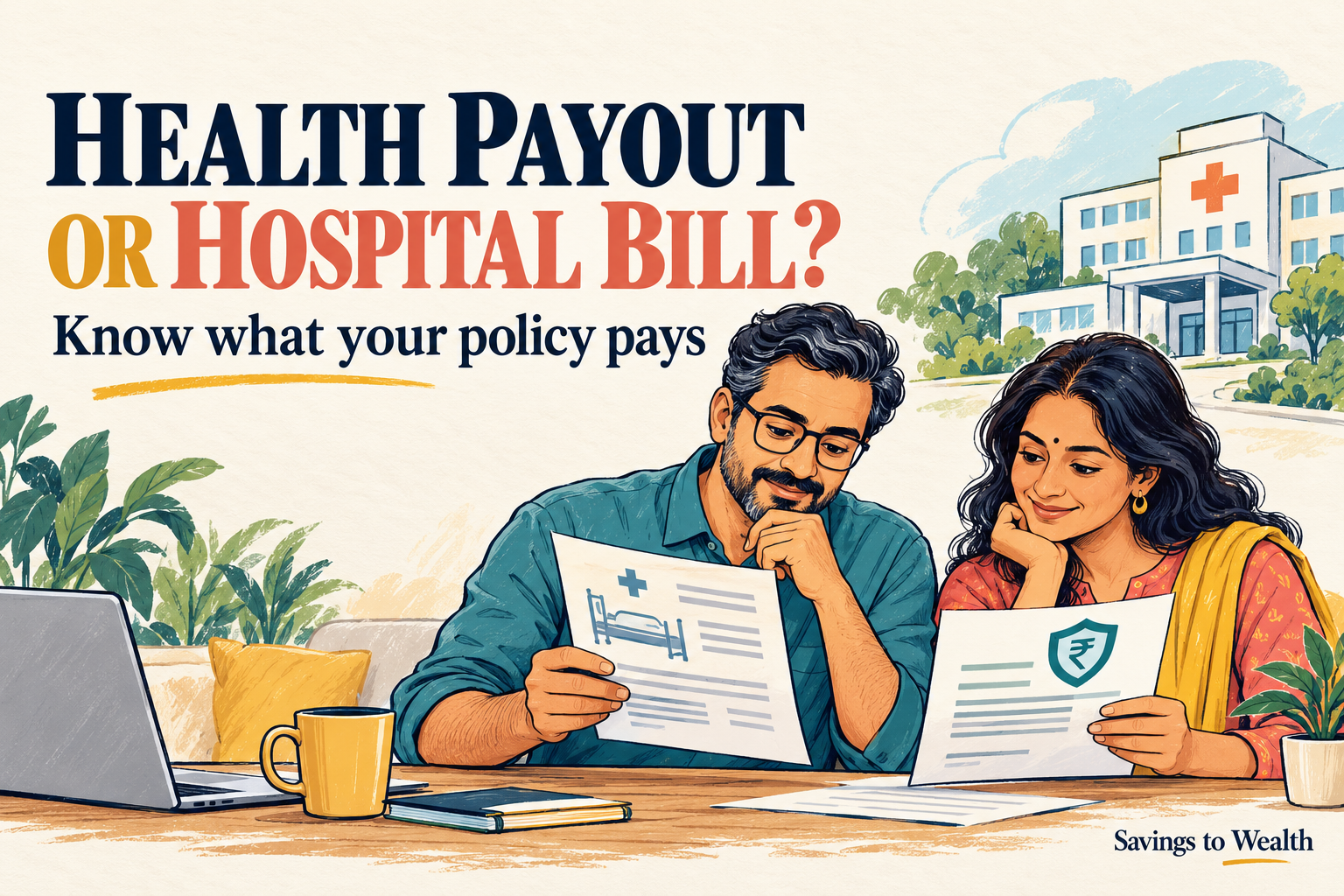
A hospital stay can create three different money problems: the
treatment bill, the cost of travel and help at home, and income lost
while recovering. One insurance policy may not solve all three.
LIC’s new health-plan announcement makes this distinction worth
checking before buying. Its official
release dated 13 October 2026 describes Health Shield (Plan 907) as
fixed-benefit protection, with daily hospital cash and specified surgery
and critical-illness payouts. New Cancer Cover (Plan 908) pays fixed
benefits for specified cancer diagnoses, irrespective of actual
treatment costs.
LIC says these products will be available for purchase from
19 October 2026. As of 14 October,
this is an announced future sale date, not a statement that you can
already buy them.
The practical question is simple: does the policy pay an
eligible medical bill, or an agreed amount when a defined event
occurs?
Separate
the hospital invoice from the household cash gap
An indemnity health policy pays eligible medical expenses within its
cover and contract conditions. A benefit policy pays the contractual
amount when its insured event qualifies. IRDAI’s health-insurance FAQ
explains this difference.
For a household, these are different jobs. Medical-expense cover is
aimed at the eligible treatment bill. A fixed cash benefit can help with
other financial pressures, but the payment is governed by the policy’s
event definitions and benefit schedule.
For example, a family might need to pay for a caregiver, travel for
follow-up treatment or an unpaid period away from work. Ask which of
these gaps you want the additional premium to address. Do not treat
every policy carrying the word “health” as interchangeable.
A larger
bill need not produce a larger cash benefit
Consider a hypothetical daily-cash policy, not a
quote for either new LIC product. Assume it pays ₹2,000 for each
eligible hospital day, five days qualify, and no other benefit is
triggered.
The payment would be ₹2,000 × 5 = ₹10,000. If the
hospital bill were ₹1.8 lakh, that daily benefit would still be ₹10,000.
If the bill were ₹4.2 lakh, the same five qualifying days would still
produce ₹10,000.
Actual policies can have minimum-stay requirements, day limits,
waiting periods, exclusions and additional benefits. The illustration
isolates only the daily-cash calculation. It shows why a daily benefit
must not be read as a promise to settle the entire bill.
Likewise, a diagnosis-based benefit depends on the specified medical
definition and contractual payout. The word “cancer” on a brochure is
not enough to establish that every diagnosis or stage qualifies.
Use
the announcement to prepare questions, not to make a rushed
purchase
LIC’s press release gives headline features and directs readers to
the sales brochures. It does not answer every question needed for a
household purchase decision. This article is a guide to assessing the
payout structure, not a product recommendation or a comparison of
premiums.
Before considering either plan, request the current brochure, policy
wording and Customer Information Sheet. Use them to check:
- The trigger: What exact hospital stay, surgery,
illness or diagnosis makes a claim payable? Which definitions and
exclusions apply? - The amount: What is paid for each qualifying event?
Is a benefit a fixed sum, a percentage of the applicable sum assured, a
daily amount or a series of payments? - The sequence: Does an earlier claim reduce a later
benefit? What happens to coverage after a major payout? - The time limits: What waiting period, minimum stay,
survival condition, maximum number of days or payment duration
applies? - The family terms: Who is actually insured? Are
limits shared or separate, and what happens when a dependent’s
eligibility changes? - The continuing cost: What premium must be
sustained, for how long, and what happens if payment stops?
Ask the insurer to point to the relevant clause rather than accepting
a verbal summary.
Test
the proposed purchase against two real household needs
Write down the medical-bill protection you already have, including
employer cover, and the gaps in that protection. Separately estimate a
realistic recovery cash gap: lost income plus necessary non-medical
spending, less the money already available for it.
Then ask how the proposed benefit would respond to your chosen
example. Would it be payable at all? How much would arrive, and when?
Would it fill the gap you identified?
Do not cancel existing medical-expense cover on the assumption that a
new fixed-benefit plan does the same job. A household may find value in
an additional cash benefit, but that conclusion should follow from the
actual contract, premium and need.
The useful test is not “How many policies do I own?” It is
“Which expense or cash shortfall would each policy actually help
me meet?”
Educational information only; not personalised insurance,
medical, tax or investment advice. All rupee examples are hypothetical.
Product terms, underwriting and claim eligibility must be checked in the
final documents applicable when purchasing.
Sources and dates
- LIC’s
official three-plan announcement, dated 13 October
2026; purchase availability stated as 19 October
2026. This article focuses on the two health products. - IRDAI health-insurance
FAQ, questions 2 and 4: regulator education on indemnity and benefit
policies and purchase checks. No publication date is displayed in the
retrieved FAQ; it refers to the 29 May 2024
health-insurance master circular. Retrieved 14 October
2026.