International-investing apps make it possible to buy fractional US shares with a small dollar amount. That convenience can hide an important detail: the advertised percentage is not always the percentage you actually pay.
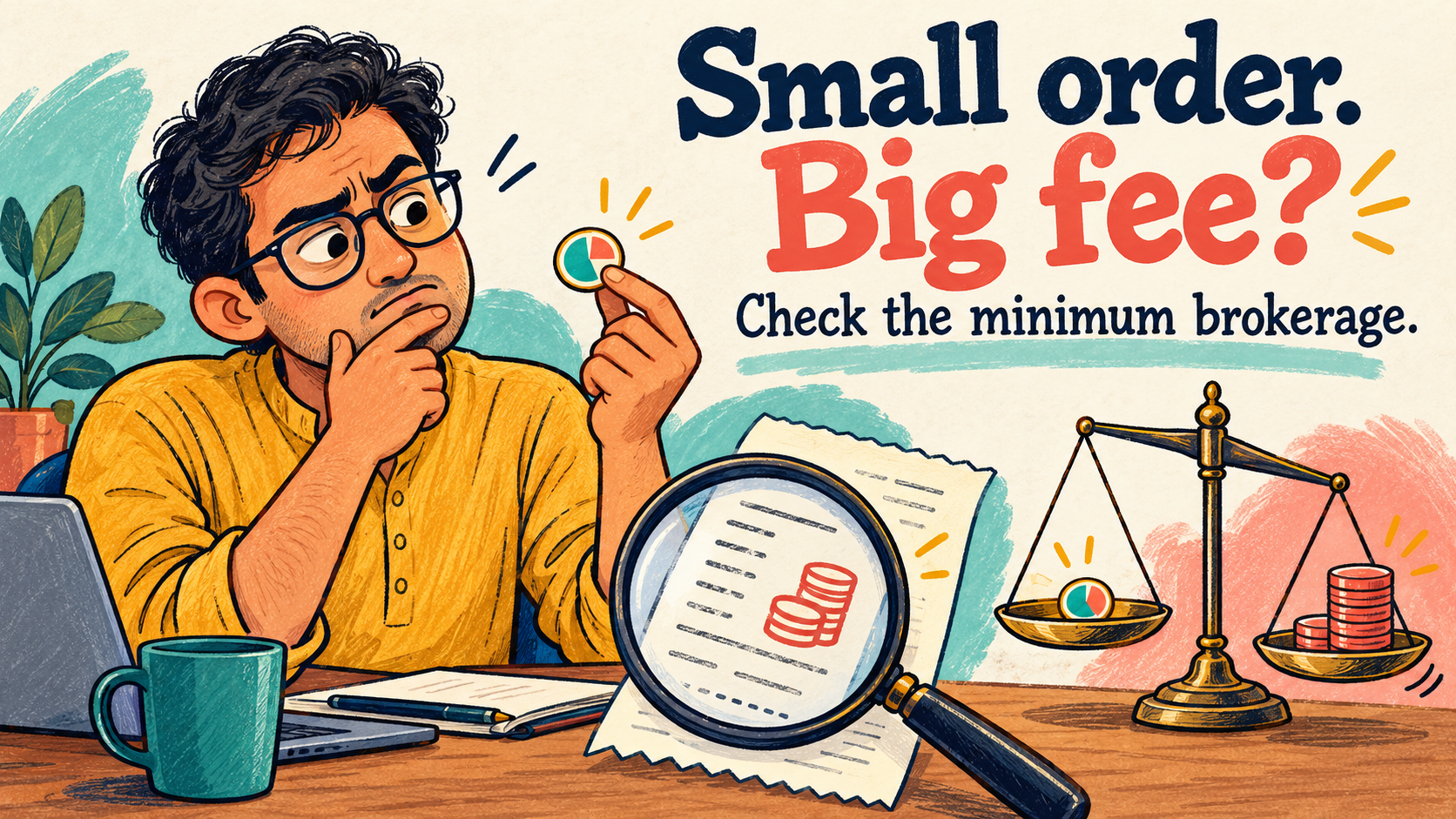
A minimum brokerage charge creates a floor. When an order is small, that floor can dominate the trade. The practical question is therefore not only “What is the brokerage rate?” but also “What will this order cost at the amount I normally invest?”
The minimum fee changes the percentage
The following official pricing pages were checked on 31 October 2026. They do not show stable publication dates; treat these as a dated pricing snapshot, not permanent tariffs:
- Zerodha says brokerage is 0.1% of trade value, subject to a minimum of $0.01 and a maximum of $10 on both buy and sell orders, plus GST on brokerage.
- Groww lists 0.1% or $1 per executed order, whichever is higher. Its help centre says an investor can place an order for as little as $1.
- Upstox currently lists 0.1% per transaction with a $1 minimum, and says brokerage is free for the first 30 days after global investing is enabled.
These are pricing-page terms, not a ranking of platforms. Product availability, onboarding eligibility, route, service levels and charges can change.
Consider one buy order, ignoring for the moment currency conversion, taxes and regulatory charges:
- On a $1 order, the stated brokerage works out to $0.01 at Zerodha, $1 at Groww and $1 at Upstox after its introductory period. That is an effective brokerage rate of 1%, 100% and 100%, respectively.
- On a $100 order, it becomes $0.10, $1 and $1: effective rates of 0.1%, 1% and 1%.
- On a $1,000 order, it becomes $1, $1 and $1: effective rates of 0.1%, 0.1% and 0.1%.
The striking $1 example is not a claim that anyone should place such an order. It shows why a low minimum investment and a low-cost order are different things.
Frequency can matter as much as the annual amount
Suppose an investor plans to deploy $1,200 over a year. Twelve $100 buy orders would produce $1.20 of stated brokerage at Zerodha, $12 at Groww and $12 at Upstox after the introductory period. One $1,200 order would produce $1.20, $1.20 and $1.20, respectively.
This does not mean everyone should wait and invest once a year. Batching money changes when it reaches the market and can create cash drag or market-timing risk. The useful lesson is narrower: if a fee has a high minimum, order size and order frequency belong in the calculation.
The minimum starts to change the headline percentage below $10 per order at Zerodha and $1,000 at both Groww and Upstox. Zerodha’s quoted $10 cap starts to matter above $10,000 per order. The current Upstox page used here does not specify that earlier $25 cap.
Brokerage is only one layer
A platform that looks cheapest in a brokerage-only example may not be cheapest for a particular household. Before choosing a route, price the full journey:
- Currency conversion: Check the exchange rate or spread applied when rupees become dollars and again when money returns to India. A small difference in the FX rate can exceed the brokerage on a larger order.
- Funding and withdrawal: Ask whether the bank, platform, intermediary or correspondent bank can charge for remittance, deposit or withdrawal.
- Statutory charges and GST: Brokerage may attract GST. US regulatory fees can apply on sells, and platform pages may list other turnover or regulatory charges separately.
- Both sides of the trade: Brokerage can apply when buying and again when selling. A one-way illustration is not the lifetime cost.
- Tax and recordkeeping: Keep remittance confirmations, contract notes, dividend statements, sale records and exchange-rate evidence. Foreign assets and income can create Indian return-reporting obligations.
There is also a route-specific protection question. Upstox, for example, states on its global-investing page that the investor-protection, dispute-resolution and grievance-redressal mechanisms available for trading on recognised exchanges in the IFSC are not available for global-market investments through that service. Read the account and custody disclosures rather than assuming all overseas routes are identical.
LRS and TCS are separate from brokerage
The Reserve Bank of India’s Liberalised Remittance Scheme FAQ states that a resident individual may remit up to US$250,000 per financial year for permitted current- and capital-account transactions. This is an overall LRS ceiling, not a separate allowance for each investment platform.
Tax collected at source (TCS), where applicable to a remittance, is a separate cash-flow item rather than brokerage. Upstox’s current disclosure says it is collected at remittance under the prevailing income-tax rules and is creditable in the income-tax return. Ask the remitting bank for the current treatment and account for total LRS usage across providers; this article does not calculate a tax liability or TCS amount.
A five-minute order-size check
Before enabling a global-investing account:
- Write down the amount and frequency you realistically expect to invest.
- For that amount, calculate brokerage ÷ order value × 100.
- Add the disclosed FX, funding, withdrawal, GST and regulatory costs.
- Read who holds the assets, which jurisdiction applies and what grievance route is available.
- Compare the result with a larger, less frequent order—without ignoring the timing trade-off.
Bottom line
Fractional shares solve the problem of a high share price. They do not automatically solve the problem of a minimum fee. For a small recurring investment, the brokerage floor can matter more than the headline rate; for a larger investment, currency conversion and the remittance path may matter more.
Choose an order size only after calculating the effective percentage for the way you actually plan to invest. Upstox also currently lists a $100 minimum deposit, which is different from its $1 minimum investment/order amount. Funding a wallet and placing a fractional-share order are separate thresholds. And treat every pricing page as time-sensitive: the figures above were checked on 31 October 2026 and can change.
This article is general financial education, not a recommendation of any broker, platform, security or investment route. Overseas securities involve market, currency, jurisdiction, custody, tax and regulatory risks. Check current official terms and obtain professional advice where appropriate.
Discovery note
The topic was prompted by Moneycontrol’s comparison, “Zerodha vs Groww vs Upstox: Which platform offers the cheapest way to invest in global stocks?”, first published on 22 October 2026 at 8:55 AM IST. The analysis, examples and structure above were independently developed from the linked official pricing and regulatory sources.