
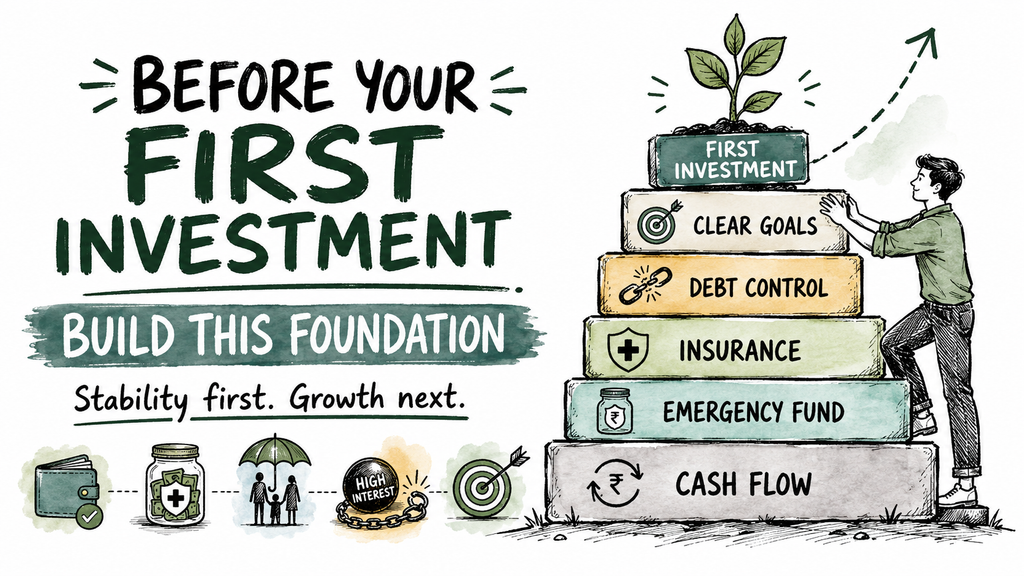
So you’ve finally decided to do it. You’re earning decent money, you keep seeing your friends’ SIP notifications popping up on WhatsApp, and you know in your gut that just keeping cash in your savings account isn’t going to cut it anymore.
But then reality hits. Which app do you download? When do you start? How much is “enough” to invest? And worst of all – what if you lose it all?
I get it. The barrier to getting started isn’t really about finding an app. It’s about not knowing what should come before you invest.
Here’s what I’ve seen happen too many times: Someone opens a trading app, picks their first fund, invests ₹10,000, feels proud for about a month. Then life happens. The car breaks down. The AC stops working. And suddenly – panic. They need that ₹10,000 back. So they sell their investment at the worst possible time, lose money, and swear off investing forever.
This doesn’t have to be you.
The truth is boring, but it works: you need a foundation before you invest. Not because it’s exciting. But because it keeps you calm when markets fall, and it lets you actually build wealth instead of constantly rescuing yourself.
Let’s build it, step by step.
1. The Emergency Fund: Your Financial Airbag
Picture this: You’ve invested ₹50,000 in a mutual fund. You’re feeling good about it. Then, six months later, your laptop screen cracks. Or your bike needs a clutch replacement. Or your kid’s school fees are due unexpectedly.
What happens?
If you don’t have emergency cash, you panic-sell your investment – probably at a loss because markets are down that week. Your ₹50,000 becomes ₹42,000. You rescue yourself, but you also wasted months of compound growth and mental peace.
This is why emergency funds come first.
How much exactly? Most people say 3 to 6 months of expenses. Sounds vague, right? Let’s make it real.
If your monthly household expenses are ₹50,000 – rent, groceries, bills, transport – then you need ₹1,50,000 to ₹3,00,000 sitting around. If it’s ₹80,000 monthly, you’re looking at ₹2,40,000 to ₹4,80,000.
And honestly? Start with 3 months if 6 sounds overwhelming. You can build it up. Most people do.
Where do you put it? This is the key thing people get wrong. They keep it in their regular savings account earning 3 – 4% per year. That’s leaving money on the table.
Instead:
- Liquid funds let you withdraw your money within 24 hours, and they’re earning you 5 – 6% right now. These are basically made for emergency fund money.
- Some banks are offering 6 – 7% on savings accounts with monthly withdrawal limits – still beats 3%.
- Money market funds are another option, equally accessible.
The whole point? Keep it separate, keep it accessible, and let it earn something while it waits. When the AC breaks, you pull it out. No drama, no market timing stress.
2. The Debt Conversation: Why Your Loan Is Eating Your Wealth
Before we even talk about investing, we need to talk about this.
You’re paying:
- 36 – 42% interest on credit card debt
- 12 – 15% on personal loans
- 8 – 10% on car loans
Meanwhile, the “safe” investments earn 6 – 8% per year. Do the math. If you’re paying 36% on a credit card bill while trying to earn 12% in a mutual fund, the credit card is winning. Every single month.
Here’s the honest rule: Pay off high-interest debt before you go aggressive with investing.
Let me give you a real scenario. Say you make ₹75,000 a month, spend ₹50,000, and have ₹1,50,000 sitting on a credit card. Can you invest while paying down the debt? Technically yes. But should you? Not if you’re serious about actually building wealth. The math doesn’t favor it.
Now, home loans and education loans? Those are different. These are “good debt” – the interest rates are usually 6 – 8%, which might be lower than what your investments earn. You can invest while paying these down. Just make sure your budget doesn’t break.
One more thing: If your company gives you a match on retirement contributions – like 1% employer match on EPF – take it immediately. Don’t skip free money just because you’re paying down debt. That’s leaving money on the table.
3. Goals: The Thing Everyone Skips (And Regrets)
Here’s what messes people up the most: They start investing without actually knowing why.
“Everyone does SIPs,” they think. So they set up ₹5,000 monthly. No real reason. No actual goal. Then the market drops 10% in year two, panic hits, and they sell. But if they’d known they were investing for retirement 25 years away, that 10% drop wouldn’t keep them up at night. It’d just be noise. Your goals are everything. They determine how much risk you take, what you invest in, and whether you’ll actually stick with it.
Think about your life right now. What do you actually need money for?
- In the next 1 – 3 years? Maybe a car, a wedding, a vacation. These aren’t “invest aggressively” years. You need these funds safe – fixed deposits, bonds, liquid funds. Market swings don’t matter if you need the money soon.
- In 3 – 10 years? Maybe your kid’s education, maybe a house down payment. You can handle some ups and downs. Balanced funds work here – mix of stocks and bonds.
- In 10+ years? Retirement, long-term wealth. Here, you can actually benefit from volatility. More aggressive funds make sense.
Without this clarity, you’ll chase whatever sounds good. Your friend’s stock tip. Crypto. Your brother-in-law’s “sure thing.” And you’ll probably lose. So before you invest a single rupee, sit down and ask yourself: What am I actually saving for? When do I need it?
4. Risk: The Honest Conversation
Here’s where people fool themselves.
You might feel okay with risk. You’re young! You can afford losses! But then real money starts disappearing from your portfolio, and suddenly you’re not so brave anymore.
There’s a difference between what you think you can handle and what you actually can handle.
Think about it:
- Do you have just one source of income, or multiple streams?
- Do you have kids, dependents, a mortgage?
- Can you actually sleep at night if your investments drop 20%? Or will you panic-sell?
- If your job disappeared tomorrow, could you survive 6 months on savings?
These questions matter way more than your age or how much money you have.
Here’s a quick self-check:
If your portfolio fell 20% tomorrow, would you panic and sell? Or would you just leave it alone? If your income stopped, could you live for 6 months without touching your investments? Do you have people who depend on your money? How many years until you actually need this money?
Based on your honest answers, here’s where you probably land:
- Conservative type: You care more about not losing money than earning lots. Maybe you have dependents, irregular income, or a short timeline. Stick with fixed deposits (5 – 6%), debt funds (6 – 7%), balanced funds (6 – 8%). You sleep well at night.
- Moderate type: You can handle some turbulence. Your job is stable, you’ve got time (5+ years), and your budget has breathing room. Balanced funds (8 – 10%) or maybe 60% bonds + 40% stocks works fine.
- Aggressive type: You’re young, your income is stable, you’ve got 15+ years, and you don’t lose sleep over volatility. Index funds (earning around 10 – 12%) or aggressive equity funds (11 – 13%) are your playground.
The key? Be honest with yourself. Don’t pick aggressive because it sounds exciting. Pick what actually matches your life.
5. Okay, Now Actually Start
You’ve done the hard work. Emergency fund? Check. Debt situation? Handled. Goals clear? Yes. Risk profile honest? Absolutely.
Now comes the easy part. You need three things:
First, a brokerage account. Click the image below to open an account with the respective providers – take your pick. It takes about 10 minutes. You’ll need your PAN, Aadhaar, and bank details. Cost? Zero. Minimum to invest? ₹100 or ₹500, depending on the platform.



Second, decide your starting amount. Here’s the beautiful part about India’s market – you can start with ₹500 per month. Not flashy, but it works. Compound interest doesn’t care if you’re investing ₹500 or ₹5,000. It just cares about time.
Third, pick your first investment. If you’re new to this, don’t overthink it:
- Nifty 50 Index Fund (₹500/month minimum) tracks India’s top 50 companies. It’s diversified, low-cost, boring in the best way. Good for long-term wealth.
- Balanced Fund (₹1,000/month) mixes stocks and bonds. Less volatile, less drama, good for people who want some stability.
- Liquid Fund (for emergency overflow) earns 5 – 6%, super accessible. If your emergency fund is getting too big, park the extra here.
Let me give you a real example. Raj – early 30s, ₹80,000 monthly income. He built a ₹2,40,000 emergency fund slowly (3 months of ₹80,000 spending). Took him a year and a half. Then he tackled ₹3,00,000 credit card debt. Paid it aggressively over 18 months.
Then he started investing:
- ₹3,000/month in a Nifty index fund for retirement (25+ years away – he can be aggressive here)
- ₹2,000/month in a balanced fund for his daughter’s education (12 years away – needs some stability)
That foundation took two full years to build. But now? Every single month, ₹5,000 is working for his future. He’s calm. He sleeps well. He’s not panic-selling when markets fall. That’s the goal.
Ready for the Next Step?
Your foundation is built. You understand why this matters. Next, we’ll talk about asset allocation – which is just a fancy way of saying “how to split your money between different types of investments so it actually works for you.”
But for now? Remember this: A solid financial foundation isn’t thrilling. It’s not a stock tip that doubles your money or a hot new investment app. It’s building emergency funds, paying down debt, knowing your goals, and being honest about risk. But it’s the difference between investing and gambling. Between building wealth and hoping something works out. Between staying calm when markets crash and panic-selling at a loss. Start here. Build it slow. Your 35-year-old self will thank your 25-year-old self for starting today.
Important Disclaimer:
This is educational content. Full stop. It’s not investment advice, tax advice, insurance advice, or financial advice.
The ideas here are general. They’re based on common financial sense that works for a lot of Indian middle-class folks. But your situation is unique. Your numbers are different. Your goals are different.
Before you invest, actually:
– Talk to a financial advisor who knows your full picture – not just reading an article.
– Think hard about your personal risk tolerance, your actual timeline, and your real goals.
– Read the fund prospectuses, check expense ratios, understand how the funds actually work.
– Know the risks. Equity funds can fall. Debt funds have interest rate risk. Index funds track the market – both up and down.
– Talk to a tax professional about the tax impact of your investments. This stuff matters.
Past returns don’t mean future returns will be the same. Everything can fall. Everything can go up. Invest accordingly.
© 2026 Savings to Wealth. All rights reserved.