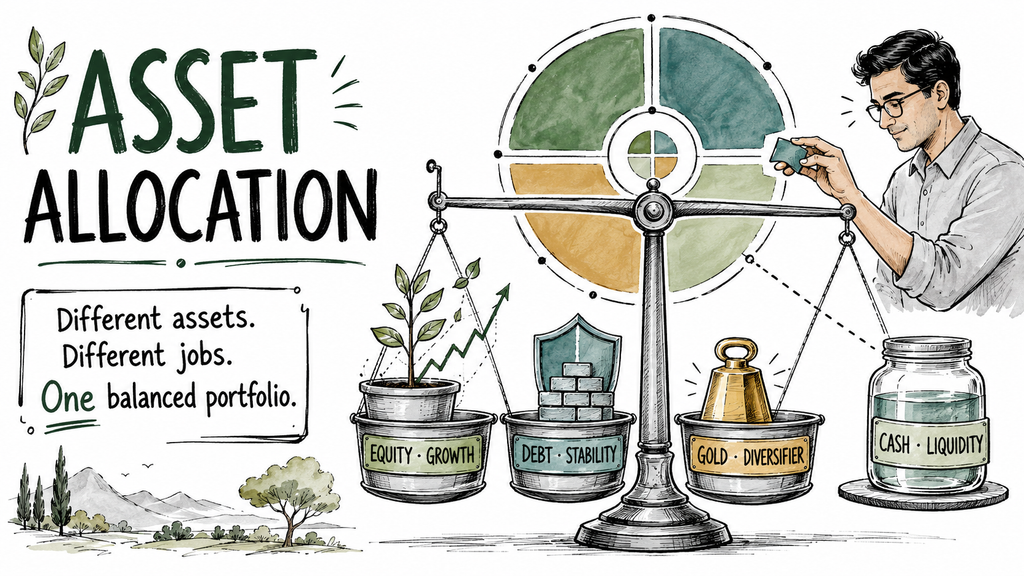
Ask most people how their investments are doing and they’ll tell you about a fund. “My small-cap is up 30%.” “This one’s been flat all year.” Ask them what share of their money sits in equity versus debt, and you usually get a pause.
That pause is the whole problem.
Here’s something I see constantly. Someone owns eleven mutual funds and feels well diversified. But nine of them are equity funds holding many of the same companies. When the market falls 20%, all eleven fall together. What they had wasn’t diversification. It was eleven different names for the same bet.
Asset allocation is the fix. It is the least exciting part of investing, and it quietly does more work than everything else you’ll fuss over.
Let’s go through it properly.
1. What Asset Allocation Actually Means
Asset allocation is simply how your money is split across types of assets that behave differently from each other. Equity. Debt. Gold. Cash. The important words there are behave differently. Owning fourteen equity funds is not allocation, because they all rise and fall on the same news. Owning equity and debt is allocation, because when one has a terrible year the other usually doesn’t. If everything you own moves in the same direction on the same day, you don’t have a portfolio. You have one bet wearing several costumes.
You’ll often hear that asset allocation explains 90% of investment returns. That figure gets repeated more confidently than it deserves — the original research was about the variability of returns in large institutional portfolios, not about how much money you personally end up with. But the direction is right, and the practical version is simpler:
Your mix decides how much your portfolio falls in a bad year. How much it falls in a bad year decides whether you stay invested. And staying invested is the thing that actually builds wealth. Fund selection is a rounding error next to that.
2. The Buckets, and the Job Each One Does
Every asset in your portfolio should have a job. Most confusion comes from expecting one to do another’s work.
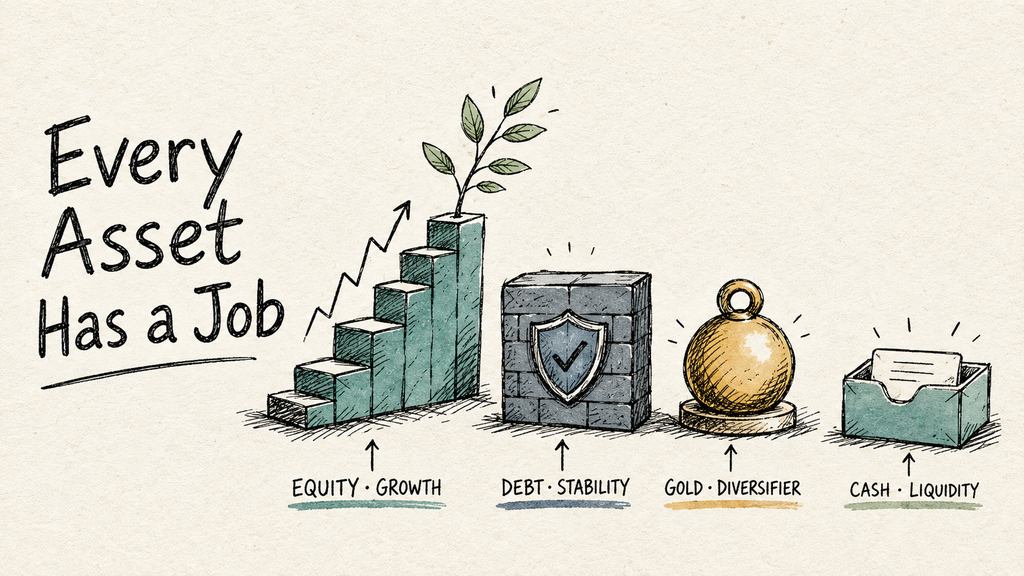
- Equity – ownership in businesses. Stocks and equity mutual funds. Over long stretches it has been the main engine of growth. It also falls hard, fast, and without warning. Its job is growth, and it needs time to do that job.
- Debt – lending your money out. Fixed deposits, PPF, EPF, government bonds, debt mutual funds. Returns are modest and far steadier. Its job is not to make you rich. Its job is to not fall when equity does, so you’re not forced to sell shares at the worst moment.
- Gold – behaves unlike either of the above, and often holds up when confidence in markets or currencies wobbles. It generates no income and produces nothing. Its job is to be a stabiliser, not an engine.
- Cash – your emergency fund and near-term spending. This is not an investment and shouldn’t be counted as one. If you haven’t built this yet, that comes before all of the above.
Read that list again with one question in mind: are you holding debt because it’s supposed to be boring and stable, or because you’re quietly hoping it will perform like equity? If it’s the second, you’ve given it the wrong job, and you’ll be disappointed for years.
3. Finding Your Mix
You’ve probably heard the rule: keep 100 minus your age in equity. At 30, that’s 70% equity. At 55, 45%. It’s a reasonable starting point and a poor finishing point, because age is only one of the things that matters. Three others matter more:
- When you need the money. This is the big one. Money you need in three years has no business being in equity, whatever your age. Money you won’t touch for twenty years can absorb a lot of turbulence.
- How stable your income is. A salaried employee with a steady job can hold more equity than someone whose business income swings wildly – because the second person may need to pull money out precisely when markets are down.
- How you actually behave in a crash. Not how you imagine you’d behave. How you actually did behave the last time your portfolio dropped 25%.
That third one deserves emphasis. Risk tolerance isn’t what you tell yourself on a calm Sunday afternoon. It’s what you do at 2pm on a red day when your portfolio is down ₹4,00,000 and every headline says it will get worse. A 70% equity allocation you abandon in a panic is far worse than a 50% allocation you hold onto. The best mix on paper is worthless if you can’t live with it.
Consider how differently these three situations play out:
- 28, salaried, stable job, investing for a retirement that’s three decades away, no large expense in between. This person can carry a high equity share, because they have the one thing that makes equity work — time.
- 45, single income, child’s college fees due in four years. The retirement money and the college money are two different problems. The college money shouldn’t be in equity at all, regardless of what the rest of the portfolio looks like.
- 62, retired, and the portfolio is the income. Here a deep market fall isn’t a paper loss to wait out — it’s a cut in this year’s spending. The priorities invert.
Same country, same markets, same funds available. Completely different right answers. This is why there’s no single correct allocation, and why anyone who gives you one without asking about your life is guessing.
4. Rebalancing: The Habit That Makes It Work
Choosing an allocation is the easy half. Keeping it is where the work is.
Say you start with ₹10,00,000 split 70:30 — ₹7,00,000 in equity, ₹3,00,000 in debt. Equity has a strong year and gains 25%. Debt does its quiet thing and gains 7%. You now hold ₹8,75,000 in equity and ₹3,21,000 in debt. Your portfolio has grown nicely to ₹11,96,000 — but your equity share has drifted to roughly 73%. Another couple of good years and you’re at 80% or higher. Here’s the trap: you never decided to take that much risk. The market decided for you. And you’ll discover exactly how much risk you’re carrying at the worst possible moment – during the correction that follows.
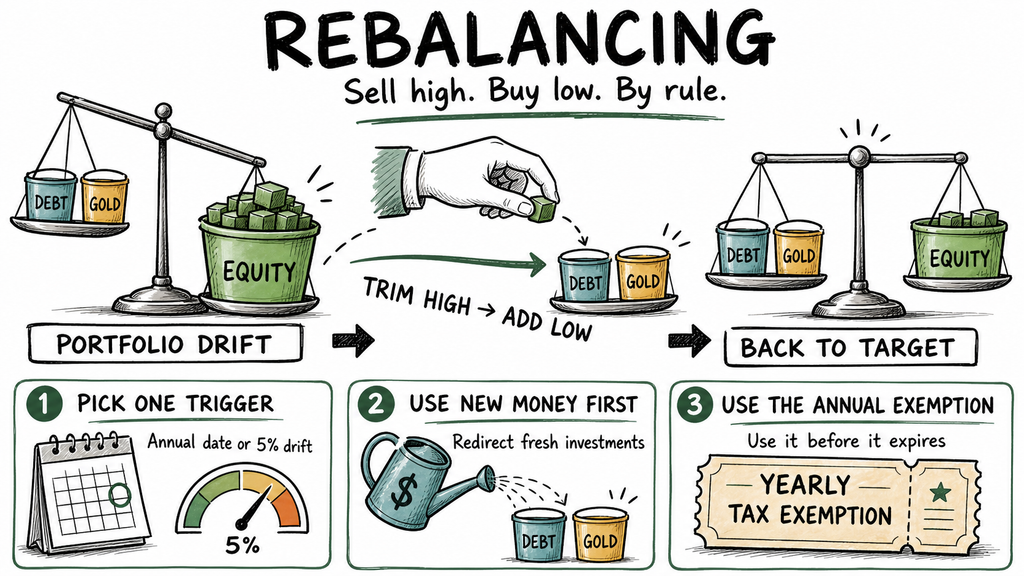
Rebalancing means periodically selling a little of what has grown and buying what has lagged, to return to your chosen mix. It feels wrong every single time. You’re trimming the thing that’s working and adding to the thing that isn’t. That discomfort is the point. It’s a rule that makes you sell high and buy low mechanically – which almost nobody manages to do on instinct.
How to actually do it, without overthinking:
- Pick one trigger and stick to it. Either a fixed date once a year, or whenever a bucket drifts more than about 5 percentage points from its target. Both work. Switching between them whenever it suits you does not.
- Rebalance with new money where you can. Instead of selling equity, point the next few months of fresh investment at whichever bucket is underweight. No selling, no tax event, no exit load.
- Use your annual exemption before you use anything else. More on that in a moment – it’s the cheapest rebalancing tool you have, and it expires every year whether you use it or not.
Now the part most people skip: selling to rebalance has a tax cost, and it isn’t the same across your buckets. As the rules stand for FY 2026-27:
- Equity funds and listed shares. Held twelve months or less, gains are short-term and taxed at 20%. Held longer, they’re long-term and taxed at 12.5% – and the first ₹1.25 lakh of long-term equity gains in a tax year is exempt.
- Debt funds bought on or after 1 April 2023. Holding period no longer helps you. Gains are added to your income and taxed at your slab rate, whether you held for three months or ten years.
- Gold ETFs. Held more than twelve months, gains are taxed at 12.5%. Below that, at your slab rate.
Add 4% cess on top of the tax, and surcharge if your income crosses the relevant thresholds.
Two useful things follow from that. First, the ₹1.25 lakh exemption is effectively a free rebalancing allowance. If you’re going to trim equity anyway, keeping the realised long-term gain within that limit costs you nothing in tax — and the allowance doesn’t carry forward, so an unused year is simply gone. Second, if you need to shift more than that, redirecting new money is almost always cheaper than selling.
The broader point: a rebalance that costs more in tax than it removes in risk isn’t a rebalance worth doing. Run the number before you press sell.
5. Where People Get This Wrong
Most allocation mistakes aren’t exotic. They’re the same handful, repeated:
- Counting funds instead of risks. Eleven equity funds is one bet. Two funds across equity and debt is a portfolio.
- Forgetting the EPF. If you’re salaried, your provident fund is probably a substantial debt holding already. Leave it out of the calculation and you’ll conclude you need more debt than you do — and end up far more conservative than you intended.
- Counting the house. The home you live in isn’t part of your investment allocation. You can’t sell two bedrooms to rebalance, and you have to live somewhere regardless.
- Chasing last year’s winner. Moving money into whatever performed best recently is allocation drift with extra confidence attached.
- Never rebalancing because trimming a winner feels like a mistake. It doesn’t feel like a mistake later.
- Setting it once and never looking again. The allocation that suited you at 25 with no dependants is not the one that suits you at 40 with a mortgage and a child.
- Calling five small-cap funds an aggressive allocation. That isn’t an aggressive allocation. It’s a concentrated bet on one slice of one asset class, and it will behave like one.
- Counting jewellery as your gold allocation. You paid making charges you’ll never recover, you’re unsure of the purity, and — be honest — you are never going to sell it to rebalance. It’s a family asset. It isn’t a portfolio holding.
- Rebalancing too often. Checking monthly and tinkering each time racks up costs and tax while adding nothing. Once a year, or on a real drift threshold, is enough.
- Never writing the target down. If you’ve never actually decided on 60:40 or 70:30, there’s no target to drift from — which means you can’t rebalance, only react.
Two of these cost far more than the rest, and both deserve more than a bullet point.
Your employer’s stock is not diversification
If you receive ESOPs or RSUs, it’s easy to let them quietly accumulate until they’re a third of everything you own. It doesn’t feel like a risky decision, because it never felt like a decision at all. But look at what’s actually concentrated. Your salary depends on that company. Your largest single holding depends on that company. If it runs into trouble, you can lose your income and a large chunk of your savings in the same quarter – precisely when you most need the savings. You don’t have to sell everything the day it vests. But do count it honestly as equity in your allocation, notice when it’s grown past a share you’d have deliberately chosen, and trim on a schedule rather than on a feeling about where the stock is headed.
Insurance-cum-investment policies aren’t an allocation
A great many people in India are told that a ULIP or a traditional endowment policy is “investment plus protection”, and count the full premium as part of their investing. The trouble is that such products rarely tell you clearly how much of your money is buying cover, how much is being invested, and how much is going in charges. You cannot rebalance what you cannot see. Long lock-ins mean you often can’t adjust the holding even if you wanted to, and surrendering early can mean taking a real loss.
Keeping the two jobs separate – insurance for protection, investments for growth – makes both easier to judge on their own merits. Whether an existing policy is worth continuing or surrendering is a genuinely case-by-case question, and one worth putting in front of an adviser who isn’t earning commission on the answer. Asset allocation will never give you a good story at a party. Nobody has ever impressed a room by announcing they rebalanced back to 65:35 in March.
But it’s the reason you’ll still be invested in ten years instead of having sold everything in a bad month and sworn off markets for good. And staying invested, unglamorously, for a long time, is the only version of this that has ever reliably worked.
Decide your mix. Write it down. Check it once a year. That’s most of the job.
This is educational content, not personal financial advice. Your goals, taxes and circumstances are yours alone — for decisions about your own money, speak to a SEBI-registered investment adviser. Tax rates quoted here are those applying to FY 2026-27 and can change with any Budget. Past returns don’t mean future returns will be the same. Everything can fall. Everything can go up. Invest accordingly.