
“I’ve started investing. I have four SIPs.”
You hear some version of this constantly, and there’s something quietly wrong with it. It treats the SIP as the thing being invested in as though a SIP were a product you could buy, with its own returns and its own risk.
It isn’t. A SIP is a payment instruction. It says take this much from my account on this date every month and buy units. That’s the whole of it. This distinction sounds pedantic until you see what it costs people. Someone runs a SIP into an aggressive small-cap fund for a goal three years away, and is genuinely surprised when it goes badly because SIPs were supposed to be the safe way to do this. SIPs are genuinely useful. They are the best habit most people will ever build with their money. But they’re useful for reasons that are worth understanding properly, and they cannot do several things that they’re widely believed to do.
Let’s separate the two.
1. A SIP Is a Habit, Not an Investment
Two people each put ₹10,000 a month into mutual funds. One picks a diversified equity index fund. The other picks a sector fund concentrated in one industry. Both are “doing a SIP”. Their outcomes may differ enormously, not because of the SIP, which is identical, but because of what the money is buying.
So when you’re deciding where to invest, the SIP isn’t the decision. These are:
- Which asset class the money goes into equity, debt, gold. This is the allocation question, and it does most of the heavy lifting.
- Which fund within that class, and what it actually holds.
- How long the money will stay there before you need it.
The SIP only decides how the money arrives. That matters more than you’d think but it’s a separate question from what you’re buying. We covered the allocation part in how asset allocation keeps a plan balanced, and it applies here unchanged.
2. What Consistency Genuinely Buys You
Three real advantages, and they’re worth more than they sound.
It removes the timing decision. Left to ourselves, most of us wait. We wait for a dip, then the dip arrives and feels too frightening to buy into, so we wait for things to settle, and by the time they’ve settled the price has gone. A standing instruction on the 5th of every month doesn’t have opinions about whether now is a good moment. It just buys.
It puts saving before spending. If the money leaves your account two days after your salary lands, you budget around what’s left. If you invest whatever remains at month-end, you will discover that very little remains, most months, forever.
It turns volatility from a threat into a mechanism. This is rupee cost averaging, and it’s the part worth seeing with actual numbers.
Say you invest ₹10,000 a month for five months, and the fund’s NAV moves around:
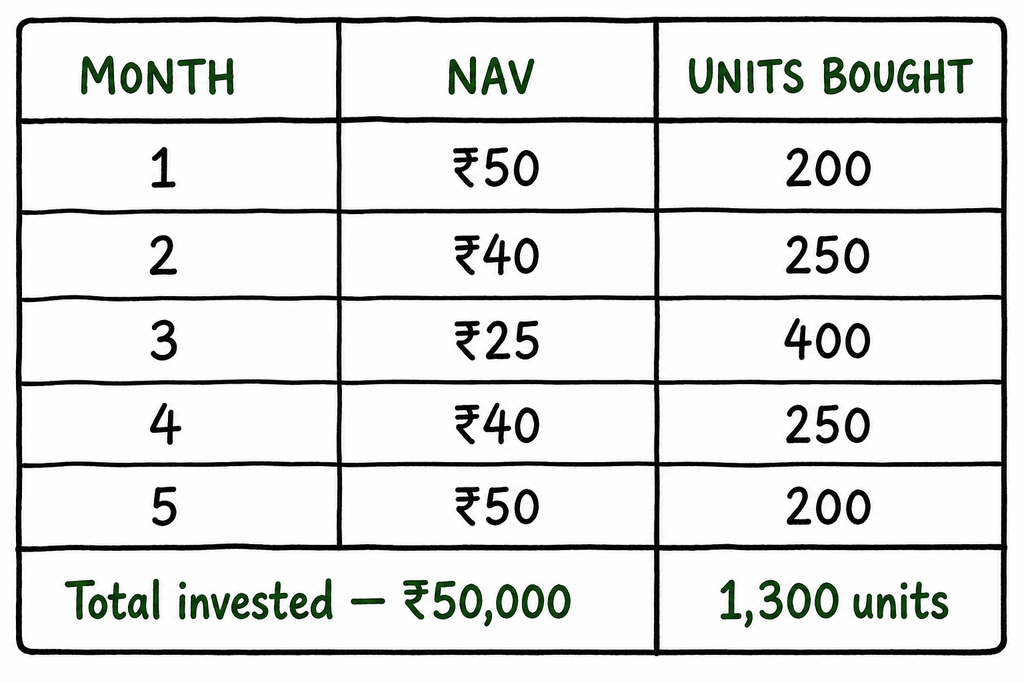
Your average cost per unit works out to ₹38.46 even though the average NAV across those five months was ₹41. The falling months bought you more units, and those extra units are doing the work. At the month-5 NAV of ₹50, your ₹50,000 is worth ₹65,000. Had you put the whole ₹50,000 in at the start at ₹50, you’d hold 1,000 units worth exactly ₹50,000. The market ended precisely where it began, and the SIP still made money. That’s not a trick. That’s what buying through a dip does.
3. Where Rupee Cost Averaging Gets Oversold
Now the part the sales material leaves out. Run the same ₹10,000 a month through a market that simply rises:
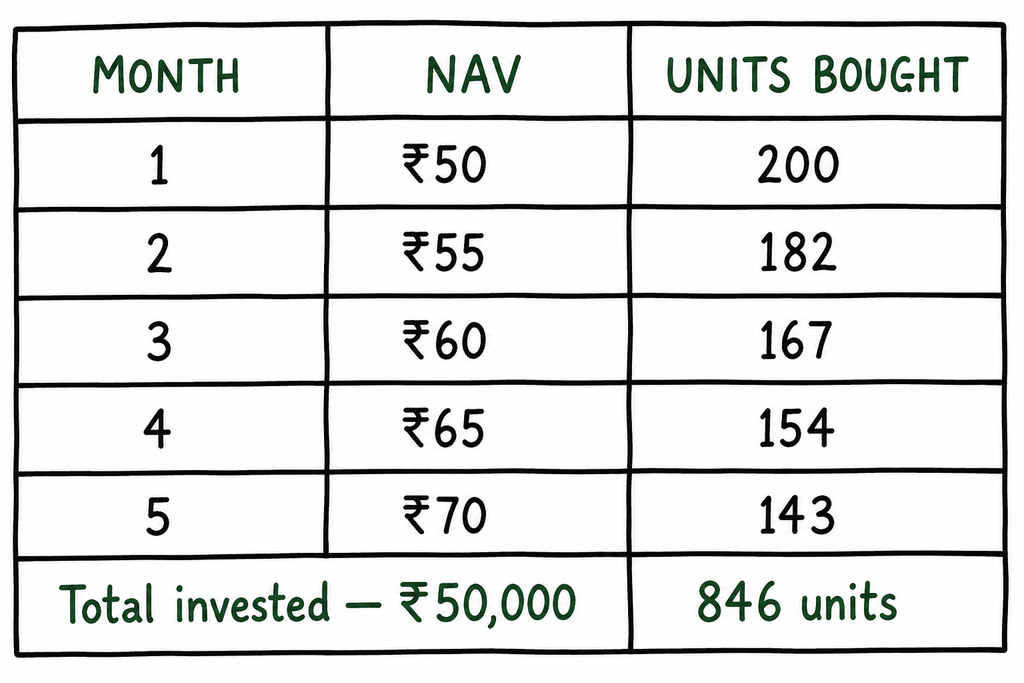
Same ₹50,000 invested, worth roughly ₹59,200 at the end. The lump sum at ₹50 would have bought 1,000 units worth ₹70,000.
The SIP is behind by nearly ₹11,000. This isn’t an argument against SIPs. It’s a correction to the claim that averaging always wins. It doesn’t. When markets rise steadily, investing everything earlier would have been better, because your money spent longer in the market. What a SIP actually gives you is a narrower range of outcomes. You give up some of the best case in exchange for a lot less of the worst case and, crucially, in exchange for not having to be right about timing. For most people, most of the time, that’s a very good trade. Just don’t mistake it for a free lunch.
So should I put a bonus in all at once?
It’s the fair question after that example, and the honest answer is that deploying sooner has tended to do better on average simply because markets have risen more often than they’ve fallen. But “on average” is cold comfort if you invest ₹5,00,000 on a Monday and watch it drop 20% over the next quarter. The real risk there isn’t only the money. It’s that you decide you’re bad at this and stop altogether.
A middle path most people can actually live with is to spread a large sum over a few months rather than choosing between one lump and a decade of instalments. Fund houses generally let you park the money in a liquid fund and move it across automatically in stages a Systematic Transfer Plan, which is really just a SIP funded from your own savings instead of your salary. You will probably give up a little expected return doing it that way. What you’re buying is a lower chance of a loss big enough and early enough to make you quit. Given what quitting costs, that’s usually a price worth paying.
There’s a related trap worth naming: the assumed return. Plans get built on “SIPs give 12%”, a number lifted from a calculator’s default setting. Indian equity has delivered attractive long-run returns, but it has also gone through multi-year stretches of very little. Build your plan on a number, then check what happens to it if reality comes in two or three percentage points lower. If the goal collapses under that test, the goal was never funded it was hoped for.
4. What a SIP Cannot Protect You From
- A bad choice of asset. Averaging into something that keeps falling and never recovers just buys more of a falling thing. Consistency amplifies your decision; it doesn’t correct it.
- A horizon mismatch. A SIP into equity for a goal two years out is still equity money on a two-year clock. The monthly schedule changes nothing about that.
- A fall right at the finish. This one is badly underrated. Averaging helps most in the early years, when each instalment is large relative to the total. Fifteen years in, one month’s SIP is a rounding error against the total so a 30% fall in year fourteen lands on almost everything you have, and no amount of averaging offsets it.
- Yourself. The most common way a SIP fails is that it gets cancelled.
That third point has a practical consequence. If you need the money at a particular time, start shifting it out of equity well before that date a few years out, in steps. This isn’t market timing. It’s acknowledging that a goal with a deadline can’t be left exposed to a crash you have no time to recover from. And the fourth point deserves its own section, because it’s the one that actually decides how this goes.
5. The Only Failure That Really Matters
Look again at the first example the one where the market fell to ₹25 and came back to ₹50. Month 3 is where that SIP made its money. NAV at ₹25, and ₹10,000 buys 400 units twice what it bought in month one. Now think about what month 3 actually feels like from the inside. Your investment is down by half. The news is relentless. Someone in the family is asking why you’re still putting money into this. Every instinct says stop, wait for things to stabilise, resume when it’s safer.
Stop the SIP in month 3 and you don’t just miss 400 units. You dismantle the entire mechanism, because buying when prices are low is the mechanism. A SIP that runs only while markets are pleasant is a SIP with its engine removed.
Which is why the practical work isn’t choosing a fund. It’s arranging your finances so that you’re never forced to stop:
- Build the emergency fund first. People who stop SIPs in a crash are often not panicking the car broke down and there was no other money. That’s the whole argument of building the foundation before you invest.
- Size the instalment so it survives a bad year. A comfortable ₹15,000 you maintain for a decade beats an ambitious ₹30,000 you abandon in month eight.
- Automate it for two days after payday. Before the money has a chance to become something else.
- Step it up once a year with your income, rather than starting new SIPs each time you get a raise. Raising an existing instalment by 10% is one instruction; six overlapping SIPs is a portfolio you can’t see clearly.
- Don’t confuse more SIPs with more diversification. Eight SIPs into eight similar equity funds is one bet paid for in eight instalments.
- Review the fund once a year, not the SIP. The instruction shouldn’t change. What it’s buying is worth a yearly look.
One more thing, since it comes up constantly: a SIP into a mutual fund is not the same as a monthly premium on an insurance-linked investment plan. They can feel similar money leaving your account every month, described as investing. They are not similar at all, and the difference is covered in the previous article.
So: what can consistency do? It can stop you waiting for a perfect moment that never announces itself. It can make a market fall genuinely useful to you. It can turn investing from a decision you keep postponing into something that simply happens. What it can’t do is make a poor choice work, rescue a goal with the wrong time horizon, or protect you from a crash that arrives just as you need the money. Set it up. Size it so you can live with it. Then leave it alone particularly in the months when leaving it alone feels like the wrong thing to do.
This is educational content, not personal financial advice. Your goals, taxes and circumstances are yours alone. For decisions about your own money, speak to a SEBI-registered investment adviser. The figures above are simplified illustrations chosen to show a mechanism, not forecasts of what any fund will do. Past returns don’t mean future returns will be the same. Everything can fall. Everything can go up. Invest accordingly.