
Life insurance is sold in a confusing way. Most people end up with a policy they do not understand, that costs a lot, and that does not protect their family very well.
This article explains one product: term insurance. It is the simplest kind of life insurance. It is also the cheapest, and it is the one you are least likely to be offered.
There is a clear reason for that, and we will get to it.
1. What Term Insurance Is
Term insurance works like this.
You pay a small amount every year. If you die while the policy is running, the company pays your family a large amount. If you are alive when the policy ends, you get nothing back.
Two words are worth learning here.
- The premium is the money you pay each year.
- The term is how many years the policy runs. You choose it. Thirty years is common.
Now, that line about getting nothing back upsets people. It feels like waste. “I paid for twenty years and got nothing.”
But think about your car insurance. You pay it every year. If you never have an accident, you get nothing back. Nobody feels cheated by that. You paid so that you would be protected if something bad happened. The bad thing did not happen. That is a good year, not a wasted one.
Term insurance is the same idea. You are not saving money. You are buying protection for your family. And because you get nothing back, it costs very little.
2. Why It Is So Cheap
The insurance company is covering only one thing. The chance that you die during those years.
Most people who are thirty today will still be alive at sixty. The company knows this. So it can charge you a small amount and still pay the families of the few people who do die.
Here is roughly what one crore of cover costs today. These are examples. Your actual price depends on your age, your health and which company you choose.
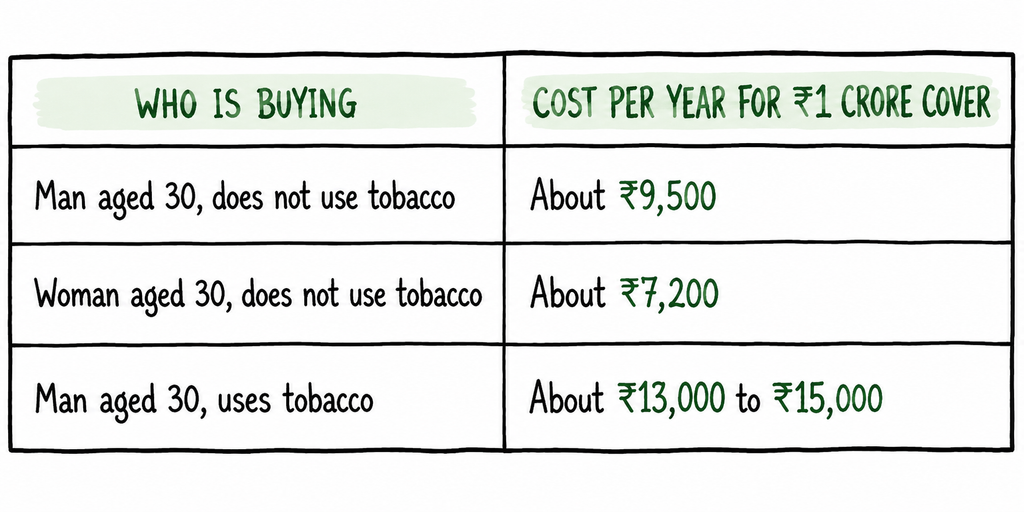
Look at the first row again. That is about ₹800 a month for one crore of protection.
One thing to note about the third row. Tobacco means cigarettes, but it also means gutka, paan masala and chewing tobacco. Companies ask about all of it. We will come back to why you must answer honestly.
3. Why Nobody Offers You This
If term insurance is cheap and simple, why did your agent never suggest it?
The answer is not complicated. Agents earn a commission on what they sell. The commission is a share of your premium. Term insurance has a small premium, so it pays the agent very little. Other policies have much bigger premiums. So they pay the agent much more. This is not a secret plot. It is just how the person in front of you earns a living. But it does mean the advice you get is not neutral, and you should know that before you sign anything.
What gets offered instead are policies that mix insurance with saving. They have names like endowment, money back, and ULIP. The pitch sounds good. You get protection, and you also get money back at the end. Here is what that mixing actually costs you. Both of these are real plans from the same company, for a man aged 40, for a term of 20 years, for the same one crore of cover.
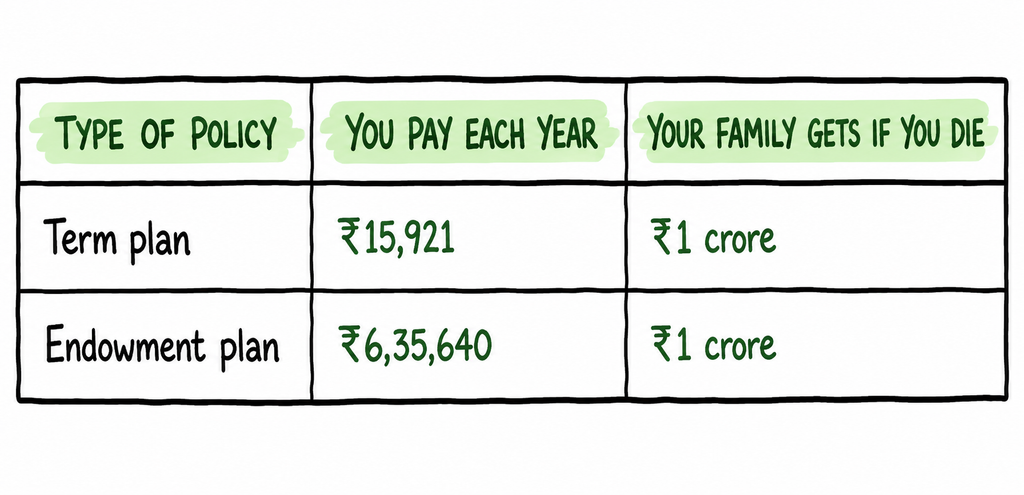
The same cover costs about forty times more.
Now turn it around, because this is the way it usually happens in real life. You do not decide the cover first. You decide what you can afford to pay each year. Say you can pay about ₹16,000 a year. With the term plan, your family gets one crore. With the endowment plan, the same ₹16,000 buys cover of roughly two and a half lakh. One crore, or two and a half lakh. Same money.
Yes, the endowment plan gives you money at the end and the term plan does not. But look at the gap. If your family needs one crore and you leave them two and a half lakh, the money you get back later does not fix that. The simple rule is this. Buy insurance for protection. Invest your money separately. When you mix the two, you usually get weak protection and weak returns.
4. Who Actually Needs This
Not everybody needs life insurance. Here is the test. If your income stopped tomorrow and you were not there, would somebody be in trouble? You probably need cover if any of these are true.
- Your husband or wife depends on what you earn.
- You have children who are not yet earning.
- Your parents depend on you for money.
- You have a home loan or any other loan that your family would have to repay.
You may not need it if you are single, nobody depends on your income, and you have no loans. In that case you can wait. Buy it when your life changes, not before. People often get this backwards. They buy life insurance for a young unmarried son who supports nobody, and skip it for the father whose salary the whole house runs on.
Remember what this product is for. You will never see the money. It is not for you. It is for the people who would struggle without you.
5. Buying It Without Making a Mistake
A few simple points will keep you out of trouble. Tell the truth on the form. This is the most important line in this article, so please read it twice.
The company will ask about your health, your habits, your income and any policies you already have. Answer every question honestly. If you take blood pressure tablets, say so. If you chew tobacco, say so. If you had an operation five years ago, say so. People hide these things because they want a lower price. That is a terrible trade. Claims get rejected years later when the company finds out something was hidden. Your family then gets nothing, at the worst moment of their lives, and they will not even know why. Paying ₹4,000 more each year is much better than your family receiving zero.
Buy it online, directly from the company. Going through the company website is usually cheaper than buying through an agent, because there is no commission to pay. You can compare a few companies in an evening.
Choose a term that covers your working years. Most people take cover until about age sixty, or until their children are old enough to earn. Cover for longer than that usually costs more than it is worth, because by then your family is no longer depending on your salary.
Keep it plain. Companies offer many extras. Some are useful, most just add cost and confusion. A simple term policy with the right cover does the main job.
Write down a nominee. The nominee is the person who will receive the money. The form will ask you. Usually it is your husband or wife. If your life changes later, for example if you marry, go back and change the name. This takes ten minutes and saves your family a great deal of difficulty.
Do not miss the payments. If you stop paying, the cover stops. There is usually a short grace period, but after that the policy is finished and all the money you paid so far has bought you nothing. Set up automatic payment from your bank so it never depends on you remembering.
Check the claim settlement ratio, but do not worry too much about it. This number tells you how many claims out of every hundred the company paid. Most large companies are now above 98. Anything in that range is fine. A difference between 98 and 99 is not worth losing sleep over.
Tell your family it exists. This one sounds obvious and gets forgotten constantly. Tell your husband or wife the name of the company, the policy number, and where the papers are. A policy nobody knows about pays nobody.
That is the whole thing.
Work out whether anyone depends on your income. If they do, buy a plain term policy, big enough to look after them. Answer every question truthfully. Tell your family where the papers are.
It is a boring product and it takes one evening to sort out. How much cover you actually need is a separate question, and it is the subject of the next article.
This article is for learning. It is not personal advice about your money, and it is not a recommendation of any company or policy. The prices shown are examples to explain an idea. What you actually pay depends on your age, your health, the company and the plan, and prices change over time. Please check current details before you buy anything. For advice about your own situation, speak to a SEBI-registered investment adviser or a qualified insurance professional who does not earn a commission on what they suggest.