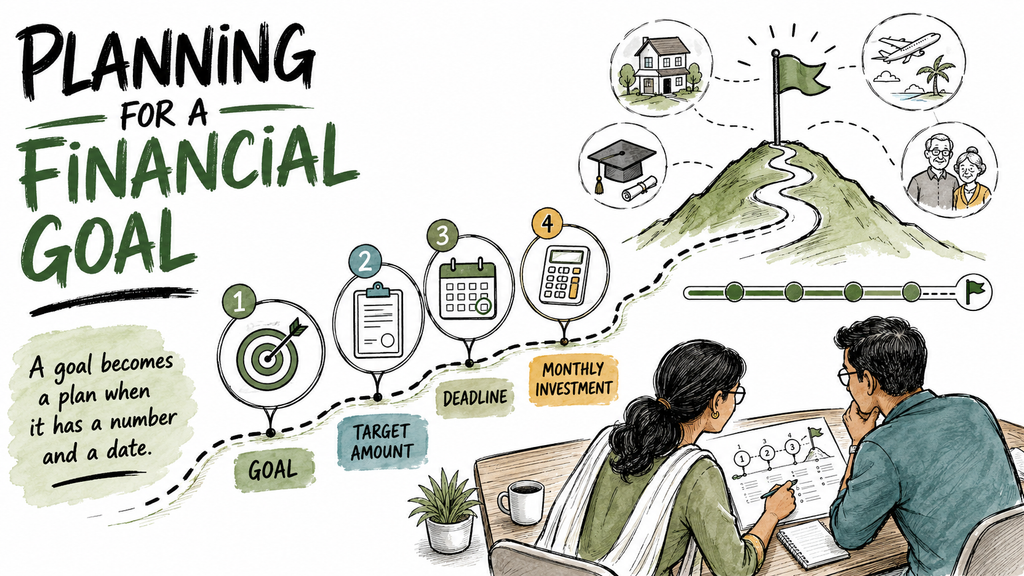
“I want to buy a house one day.” That is a wish. It has no amount and no date. So nothing happens.
A goal is different. A goal has three things: an amount, a date, and a number you put away every month. That last one is what turns a wish into something real. This article shows how to work it out.
1. The Three Questions
Before any sum, answer these.
- How much? Use today’s prices. You can adjust for price rises later.
- By when? Pick a year. Not “some day”. A year.
- Where will the money sit? This decides how much it can grow, and it depends on how long you have.
The third question surprises people. But the answer changes the monthly number a great deal, as you will see.
When you have more than one goal
Most people do not have one goal. They have a car, a house, a child’s education, and a retirement they try not to think about. Write them all down first. Put an amount and a year against each one. Only then work out the monthly numbers. The total will almost certainly be more than you can afford. That is normal, and it is useful, because now you can choose properly instead of guessing.
Sort them into two piles. Some goals have a fixed date that you do not control. Your daughter turns 18 in a particular year whether you are ready or not. Other goals can wait. A bigger car can always be next year. Fund the fixed dates first. Let the flexible ones take whatever is left. And do not leave retirement off the list. It feels far away, and no bill ever arrives to remind you. But it is usually the largest goal of your life, and it is the only one you cannot take a loan for.
2. Two Ways to Do the Sum
Which way you use depends on how far away the goal is.
Goals within about three years
Just divide. Take the amount and divide it by the number of months. Say you want ₹6,00,000 for a car in three years. That is 36 months. So you need about ₹16,700 a month. Do not try to be clever here. Money you need in three years should sit somewhere safe, like a fixed deposit or a liquid fund. It will not grow much, and that is fine. The job of this money is to still be there.
Goals ten years away or more
Now dividing gives you the wrong answer. It gives a number so large that most people give up before they start. Over long periods, your money can grow. That growth does a lot of the work for you. If you ignore it, you scare yourself for no reason.
3. What Time Does to the Number
Here is the same goal, ₹10,00,000, across different time periods. The columns show what you would need to put away each month.
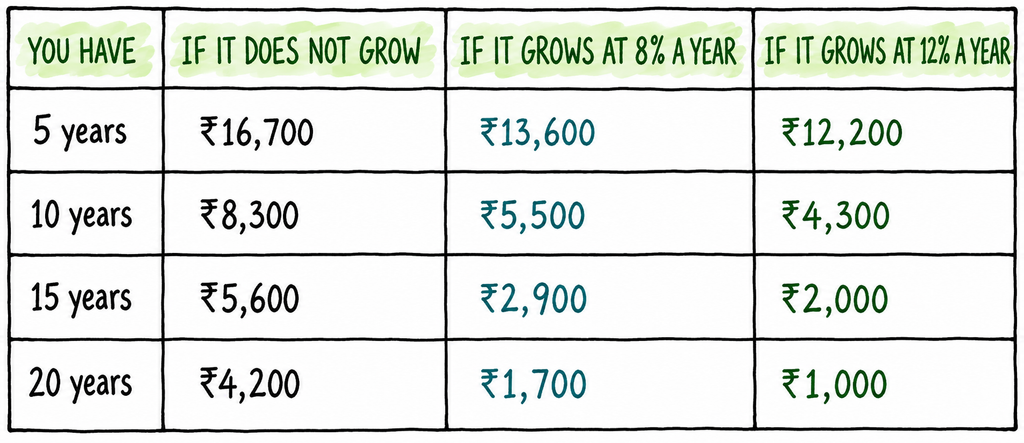
Read the bottom row slowly.
With 20 years, the same ten lakh needs ₹4,200 a month if the money just sits there. It needs about ₹1,000 a month if it grows at 12%. That is four times less, for the same goal. Now compare across the rows instead. At 12% growth, the same goal costs ₹12,200 a month over five years, and ₹1,000 a month over twenty. So the years matter more than anything else. Starting early does more for you than picking a slightly better investment ever will.
One warning about those two growth columns. They are examples of what different rates would do. They are not promises. Money that can grow at those rates can also fall, sometimes for years. Use a lower rate in your own sum if you want to be careful.
4. A Full Example
Meena has a daughter aged 6. She wants to pay for her college, which starts in about 12 years. She checks a college she would be happy with. The course costs about ₹25,00,000 today. But she will not be paying today’s price. Fees rise. A simple way to handle this is to double today’s cost for a goal about ten years away. So Meena plans for ₹50,00,000. That is a frightening number. Now watch what the years do to it.
If the money simply sat in a cupboard, she would need about ₹34,700 a month. If it grows at 10% a year, she needs about ₹18,000 a month. Here is the part worth pausing on. Over those 12 years, Meena puts in about ₹26,00,000 of her own money. The remaining ₹24,00,000 comes from growth. Almost half the goal is paid for by time. She only had to keep going.
5. What To Do With the Number
You now have a monthly figure. Four things to do with it.
Make it automatic. Set it to leave your account two days after your salary arrives. If you wait until month end to see what is left, nothing will be left.
Put it in the right place. That depends on how long you have. Money needed within three years stays safe. Money for fifteen years away can take more risk, because it has time to recover from bad years. This is the allocation question, covered in how asset allocation keeps a plan balanced.
Check once a year. Has the cost changed? Has your income changed? Raise the monthly amount when you get a raise. A goal you set at 30 and never look at again will not survive to 45.
Start, even if the number is too big. This is the common one, so it needs saying plainly.
Very often the monthly number is more than you can manage. When that happens, you have three honest choices.
- Give the goal more time.
- Make the goal smaller.
- Save what you can now, and raise it as you earn more.
There is a fourth choice that people reach for, and it is the wrong one. Do not pick a riskier investment just to make the monthly number look smaller. That does not reduce what the goal costs. It only moves the shortfall somewhere you cannot see it, until the year you actually need the money.
Saving ₹5,000 towards a goal that needs ₹18,000 is not a failure. It is ₹5,000 more than the person who did the sum, felt discouraged, and did nothing at all.
Start smaller, then raise it every year
There is a better version of that idea, and it works well for most salaried people. Instead of paying the same amount for twelve years, start lower and raise it a little every year as your income grows. Go back to Meena. The flat answer was about ₹18,000 a month, every month, from the very first year. Now suppose she starts at ₹12,000 instead, and raises it by 10% each year. In year two she pays ₹13,200. In year three, ₹14,520. And so on. She still gets past ₹50,00,000. But she began with about a third less than the flat plan asked for.
This suits real life better. Your salary in ten years will probably be larger than it is today, so your saving can grow with it. Most banks and fund houses let you set this up once, and it then increases on its own. So take one goal tonight. Write the amount. Write the year. Work out the monthly number.
Then set up the transfer before you go to bed.
This article is for learning. It is not personal advice about your money. The growth rates used above are examples chosen to show how the sum works. They are not forecasts, and no investment promises a fixed return. Money that can grow can also fall in value. For advice about your own situation, speak to a SEBI-registered investment adviser.