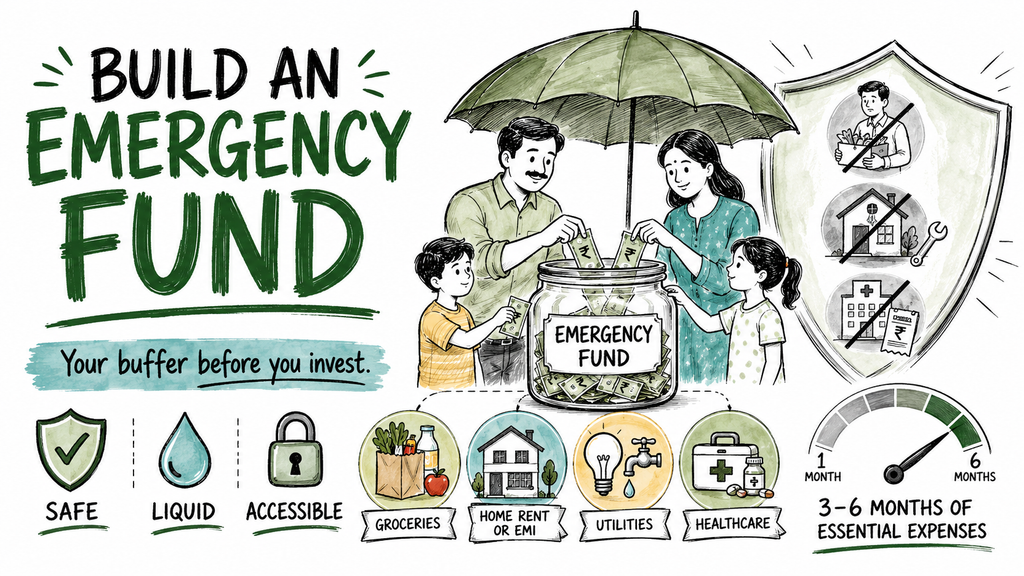
Everyone says to keep three to six months of expenses aside.
That advice is not wrong. It is just too vague to act on. If your expenses are ₹40,000 a month, three months is ₹1,20,000 and six months is ₹2,40,000. Those are very different amounts. Which one do you actually need? The honest answer is that it depends on your life. This article shows how to work out your own number, and where to keep the money once you have it.
1. What This Money Is Actually For
An emergency fund is not an investment. Do not judge it by what it earns. Its only job is to be there on the day you need it. That is the whole point of it. It exists so that a bad month does not turn into a bad decade. Without it, people borrow at high interest, or sell their investments at the worst possible time, or stop their monthly saving and never restart.
What counts as an emergency
A real emergency is three things at once. It is unexpected. It is urgent. And it is necessary. Losing your job is an emergency. A hospital bill your insurance did not cover is an emergency. A leaking roof is an emergency. So is a sudden trip home because a parent has fallen ill. A holiday is not. A new phone is not. A wedding you have known about for a year is not, because it was never unexpected. That is a goal, and goals get their own monthly saving.
One more that catches people out. A share price falling is not an emergency. Money moving from your emergency fund into the market during a crash is exactly the opposite of what this fund is for.
2. Start With Essential Spending
Most people size the fund against their whole monthly spending. That is more than you need. If you lost your income tomorrow, some spending would stop by itself. You would not be eating out. You would not be shopping. Several subscriptions would go. So count only what would continue.
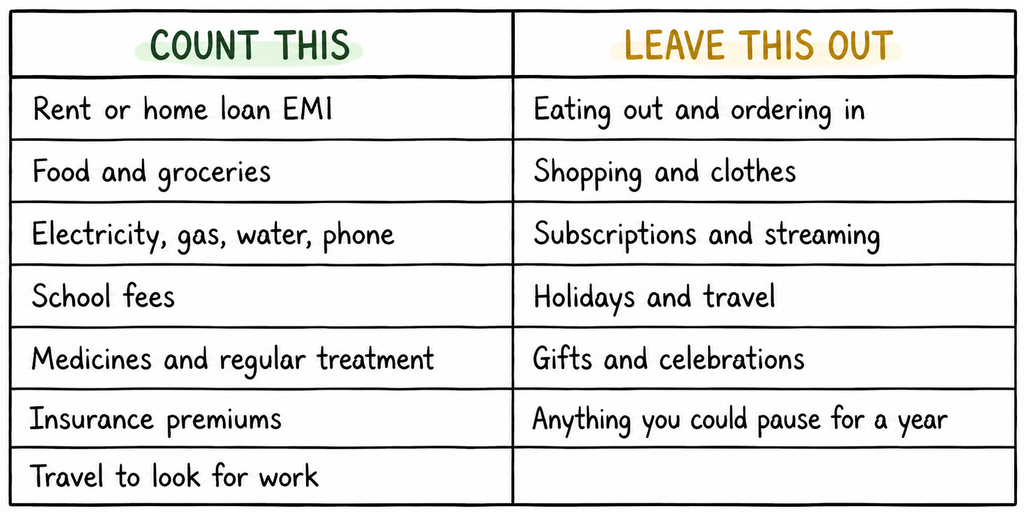
Add up the left column. That is your monthly essential figure. For most families it comes to about two thirds of what they normally spend. Keep the insurance premiums in. Those are the last things you should stop paying in a difficult year.
3. Now Choose the Number of Months
This is the part the usual advice skips. Three months and nine months are both right, for different people. The real question is simple. If your income stopped, how long would it take to replace it, and how many people are relying on you while you look?
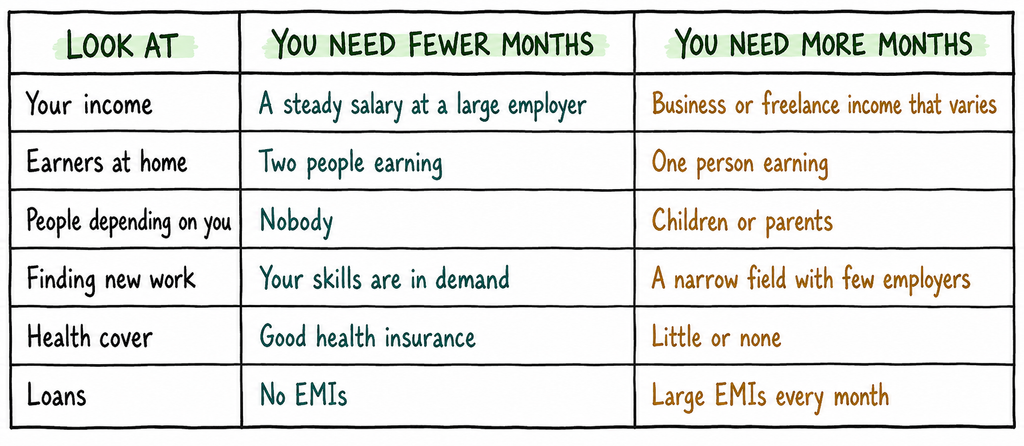
Read down the two columns and see where you mostly sit.
- Mostly in the left column: about 3 months.
- A mix of both: about 6 months.
- Mostly in the right column: 9 to 12 months.
Multiply your essential monthly figure by that number. Now you have a target instead of a range.
4. Two People, Two Very Different Answers
Arun and Priya earn about the same. Their emergency funds should not be anywhere near the same size.
Arun has a salaried job at a large company. His wife also works. They have no children and no loans, and both have health cover through work. His essential spending is ₹35,000 a month. He sits almost entirely in the left column. Three months is enough. His target is ₹1,05,000.
Priya is a freelance designer. Her income arrives in uneven lumps. She is the only earner, she has two children, her parents depend on her, and she pays a home loan EMI. Her essential spending is ₹55,000 a month. She sits firmly in the right column. Nine months is reasonable. Her target is ₹4,95,000.
Similar incomes. One needs about a lakh. The other needs nearly five. This is why the standard advice helps so little. Given to Arun it is too cautious. Given to Priya it is dangerously thin.
5. Where to Keep It, and How to Build It
The money has to reach you within a day or two. That single rule rules out most places. A simple arrangement that works well is to split it in two.
- About one month in a savings account. You can reach this in minutes, at midnight, from your phone.
- The rest in a liquid fund or a sweep-in fixed deposit. These take a day or so to reach your account, and they earn a little more than a savings account while they wait.
Do not keep this money in shares or equity funds. Emergencies do not check whether the market is up. The one time you are forced to sell may be the worst month of the year. Also avoid anything with a lock-in or a penalty for early withdrawal. Money you cannot take out is not an emergency fund, whatever it earns.
Building it when the target looks impossible
Priya’s ₹4,95,000 is not something anyone saves in a month. That is fine. Treat it as a goal, and give it a monthly number, exactly like any other goal. Aim for one month of expenses first. That alone handles most of the small shocks that push people towards borrowing. Then keep going. Put any money that arrives unexpectedly straight into it. A bonus, a tax refund, a gift. Those are the fastest way to fill it.
Four rules once it exists
- Keep it in a separate account. Money sitting next to your daily spending gets spent. Out of sight genuinely helps.
- Refill it after you use it. Using it is not a failure. That was its purpose. Leaving it empty afterwards is the failure.
- Do not chase returns with it. You will be tempted, because it looks like lazy money. It is not lazy. It is on duty.
- Resize it when life changes. A new child, a new loan, a move to freelance work. Each one raises the number.
None of this is exciting. An emergency fund will never be the interesting part of your money. But it is what lets everything else survive a bad year, which is why it comes before investing, and why it is worth doing properly rather than approximately.
Work out your essential spending. Pick your number of months. Multiply. Then start filling it this month.
This article is for learning. It is not personal advice about your money. The examples are made up to show how the method works. Your own answer depends on your income, your family and your commitments. For advice about your own situation, speak to a SEBI-registered investment adviser.