A bonus lands, or a policy matures, and you have a large amount sitting in your bank. Put it all in today, or spread it over the next several months? This works out the difference, using the same money either way.
All in today
The whole amount, right now
₹33.00 lakhSpread out
12 equal monthly instalments
₹31.75 lakhIf the market does something else
Same money, same years. Only what happens during the spreading months changes.
Both paths assume the same market and the same total years, so the only difference is when your money arrives. Money still waiting earns the safe rate you set. Tax and exit charges are ignored, and switching in instalments can trigger both.
The honest answer
Putting it all in today usually wins.
The reason is dull. Markets go up more often than they go down, so money still waiting is usually missing out rather than being protected. Look at the panel above. Spreading only wins in the rows where the market is falling or barely moving. Notice how low the crossover is. Your waiting money might earn six per cent. But only about half of it is waiting at any moment, so the market has to beat roughly half that rate for going in at once to win.
Why people spread it anyway
Because the maths is not the only thing going on. Put twenty lakh in on a Monday, watch the market fall fifteen per cent by March, and the question stops being about expected returns. It becomes whether you can leave it alone. Spread the money over a year and hold on for fifteen years, and you do well. Go all in and sell in a panic in month four, and you do not.
So the small expected cost of spreading gets you something real. Treat it as the price of a decision you can actually stick to.
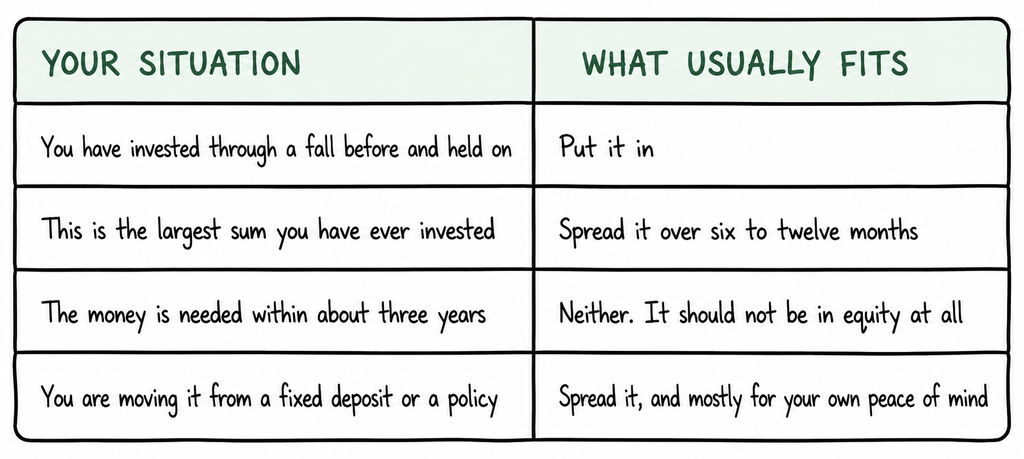
Do not spread it over too long
Six to twelve months is the usual range, and there is a reason it stops there. Set the spreading period above to thirty six months and watch the gap widen. Every extra month is more of your money sitting out of the market. At some point you are not being careful. You are just not investing.
How to actually do it
Do not leave the waiting money in your savings account. It earns very little there, and it is easy to spend. The usual method is to put the whole amount into a liquid fund and set up a systematic transfer into your equity fund. The money keeps earning while it waits, and the instalments happen without you deciding each month.
One warning that catches people. Each transfer out of the liquid fund is a sale, so it can create a small taxable gain. Over a year of monthly transfers that is a dozen small gains to account for at filing time. Worth knowing before you start.
If you are investing month by month from your salary rather than deploying a lump sum, the SIP calculator is the right tool. For a single amount left alone, the compound interest calculator shows how the growth builds. And before any of this, check the buffer, because a lump sum is often the moment to top that up first.
This calculator is for learning. It is not personal financial advice and it is not a forecast. Real markets do not move at a steady rate, and nobody knows what they will do during the months you are spreading. Tax and exit charges are ignored here and both can matter, particularly when transferring in instalments. Money that can grow can also fall in value. For advice about your own situation, speak to a SEBI-registered investment adviser.