
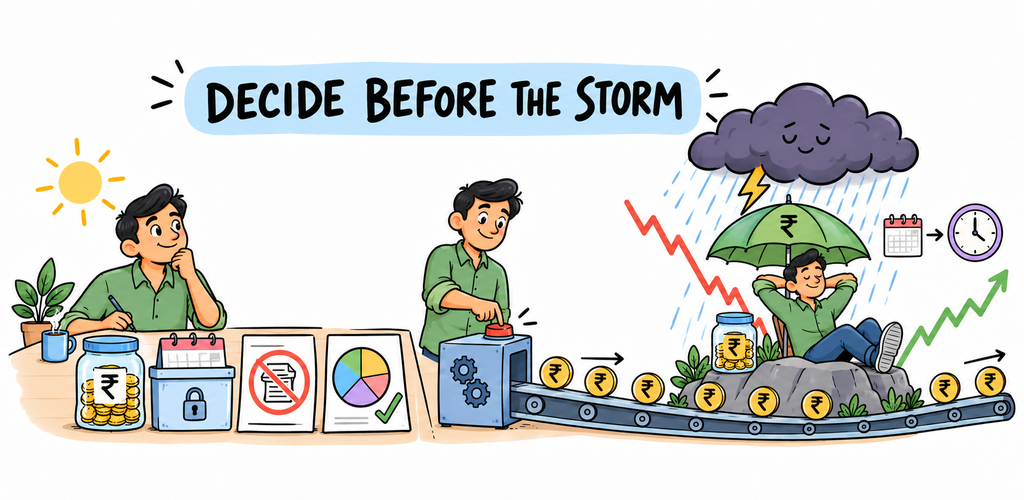
You cannot make your money crash proof. Anyone selling you that is selling something.
But a market fall is not really a moment for decisions. By the time it arrives, your choices have already been made. The fall just shows you what they were.
So this is about what to settle now, while nothing is going wrong.
First, two words people mix up
A recession is about the economy. Firms sell less, they hire fewer people, some let people go. It builds slowly over months.
A crash is about prices. Share prices drop hard and fast, sometimes in days.
They are not the same thing and they do not always turn up together. Markets have fallen when the economy was fine. The economy has struggled while markets rose.
This matters because they hurt you in different ways. A crash takes money off your screen. A recession can take your job. The second one is the one that forces people to sell at the worst time.
How often this actually happens
Falls feel rare because each one feels like the end of the world. They are not rare at all.
- A fall of about 5% happens roughly twice a year.
- A fall of about 10% happens roughly once a year.
- A fall of 20% or more happens roughly once every four years.
If you invest for thirty years, you should expect to sit through seven or eight big ones. This is ordinary weather, not an emergency.
Most of them pass fairly quickly. The common sort bottoms out in about four months and is back within eight.
The big ones take longer. In 2008 the market lost more than 60% from its high. It had made all of that back by 2009 and 2010. In early 2020 it fell 37% in a single month.
Why big falls take so long to undo
There is an unfair bit of maths here worth seeing.
If your money falls 40%, it does not need to rise 40% to get back. It needs to rise 67%.
Falling 60% is worse still. That needs a rise of 150% just to return to where you started.
Markets have done this every time so far. But it explains why a deep fall can take years to undo, and why the date you need your money matters so much.
The only question that really matters
When do you need this money?
Take ₹10 lakh. Say the market drops 40% tomorrow, and then grows 11% a year after that.
- You need it in 3 years. It falls to ₹6 lakh, and grows back to about ₹8.2 lakh. You are still short, and you are out of time.
- You need it in 15 years. It falls to the same ₹6 lakh, and grows to about ₹28.7 lakh. The fall barely shows.
Same fall. Same money. Opposite endings.
Nothing about being brave separates those two people. One of them had time and the other did not, and that was settled years earlier.
So decide these four things now
- Money you need within three years should not be in shares. Not some of it. None of it. A house deposit for next year, school fees due in March, a wedding. Keep those somewhere dull and safe.
- Build the emergency fund before you invest more. This is the one that actually protects you. People rarely sell because they panic. They sell because the car broke and there was no other money.
- Never borrow to invest. A loan has to be repaid on a date. Shares do not recover on a date. Put those two together and a fall stops being something you can wait out.
- Pick a mix you can live with, then write it down. Not the mix that makes the most in a good year. The one you can hold through a bad one. How asset allocation keeps a plan balanced covers how to choose it.
About “buy more when it falls”
You will hear this a lot, and it needs saying carefully.
Buying when prices are low does work. The trouble is it usually assumes two things you may not have. Spare cash sitting idle, and the nerve to spend it while everything looks terrible.
Here is the good news. If you have a monthly investment running, you are already doing it, and you do not have to be brave at all.
Say you put in ₹10,000 a month. The market falls 40% and takes three years to climb back. Over those three years your ₹3,60,000 buys about 28% more units than it would have at a steady price. When prices return, that money is worth about ₹4,60,000.
You did nothing clever. You just did not stop.
Which turns the advice around. The useful thing is not finding courage to buy more. It is making sure nothing forces you to stop. That is the emergency fund again, and it is why SIP investing spends so long on it.
What not to do when it happens
- Do not stop your monthly investment. This is the single most expensive thing people do, and it always feels sensible at the time.
- Do not move everything to safety at the bottom. That turns a fall on paper into a real loss, and you will go back in only after prices have risen.
- Do not check every day. It changes nothing and it makes selling more likely.
- Do not go looking for something that has been going up. Whatever held up best in the fall is usually the worst thing to buy next.
The truth is a little dull. You cannot avoid falls, and you do not need to. You need to not be forced to sell during one. Everything above is just different ways of arranging that, and every one of them has to be done beforehand.
This article is for learning. It is not personal financial advice. The figures on how often markets fall and how long they take to recover come from past Indian market history, and the past does not promise anything about the future. The growth rate used is an example to show how the sums work, not a forecast. Money in shares can fall and may not recover in the time you have. For advice about your own money, speak to a SEBI-registered investment adviser.