
The short answer
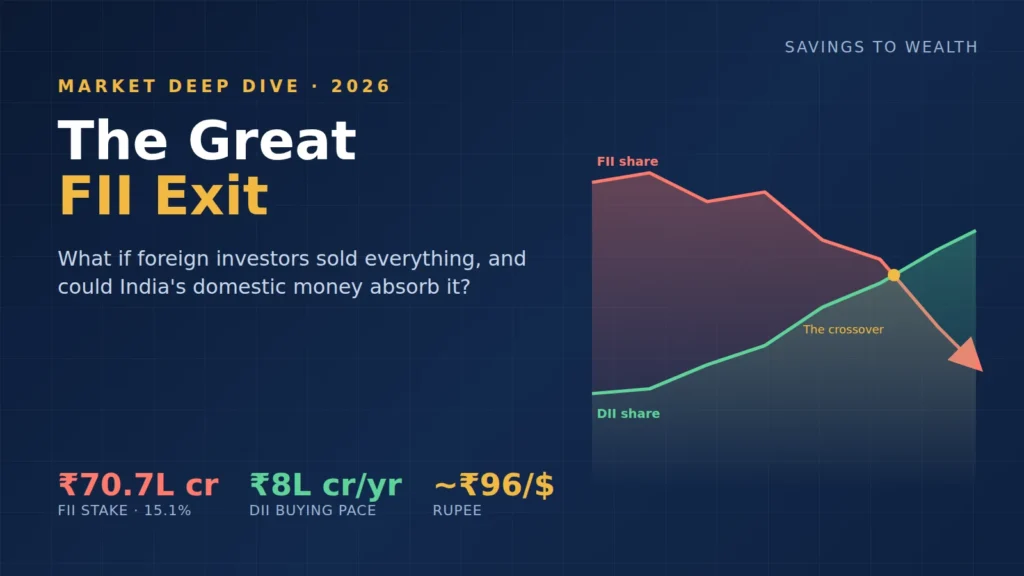
If foreign investors sold all ₹70.7 lakh crore (about $735 billion) of their Indian shares, DIIs could take the shares, but only slowly. They couldn’t take the dollars at all. Spread over eight to ten years, domestic institutions could absorb the whole FII stake at today’s buying pace, and prices would barely move. Squeezed into one year, the gap would be ₹50–60 lakh crore, and the Nifty would probably have to fall 40–55% before enough domestic money stepped in.
The real limit isn’t the stock market. It’s the rupee. DIIs pay for shares in rupees, but FIIs leaving want dollars, and a full exit is about the size of India’s entire foreign-exchange reserves.
This article takes a thought experiment seriously: what happens if the foreign stake goes to zero? It sizes that stake, adds up the domestic money on the other side, and works through the price, currency and history. It also explains why a full exit is very unlikely, and what a realistic stress looks like.
How big the foreign stake is
At June 2026, FPIs held 15.1% of NSE-listed market cap, worth ₹70.7 lakh crore. That’s a 17-year low. They sold a net $15.1 billion in the April–June quarter alone, and their share fell 74 basis points in three months. In the Nifty 500, which is where foreign money actually sits, the share is closer to 17%, or about $750 billion.
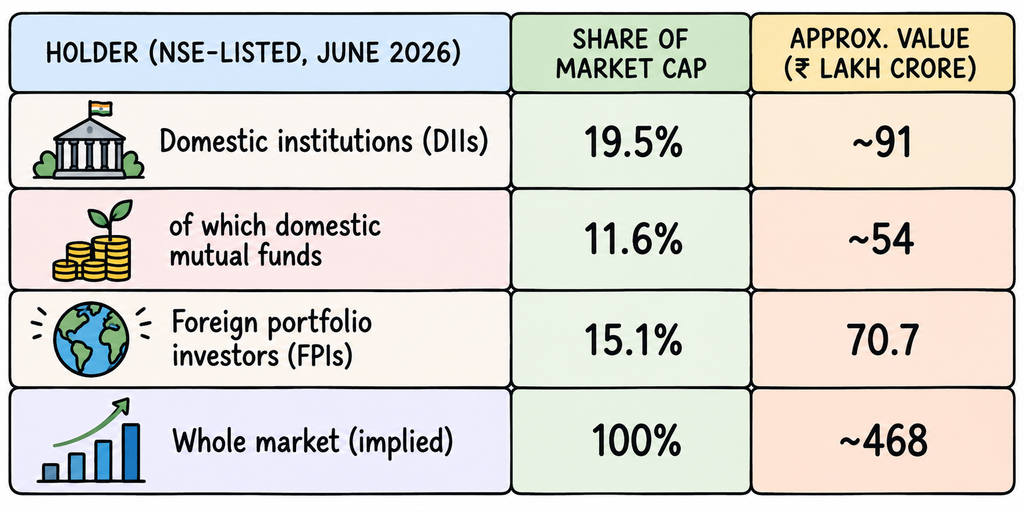
The values are worked back from the ₹70.7 lakh crore FPI figure, so the implied total NSE market cap is about ₹468 lakh crore. June 2026 was the seventh quarter in a row that DIIs out-owned FPIs. The 4.4-point gap is the widest since 2001.
Three things matter for an exit:
- Concentration. Foreign money sits in large caps, especially private banks, IT and big consumer names. So FPIs own well above 15% of the Nifty 50 (roughly 20–25%, approximate), and several heavyweight banks are close to half foreign-owned. A full exit would hit the index heavyweights first.
- Passive vs active. A large share is index money (MSCI EM and FTSE trackers, ETFs). It leaves only if India’s index weight is cut or if the investors behind those funds redeem. It doesn’t leave because a manager changes their mind.
- Strategic holders. Some FPI holdings are long-term stakes: sovereign funds, pension funds, and anchor holders in banks and new-age companies. These are sticky even in a crisis.
Who is on the other side
DIIs are putting about ₹8 lakh crore a year into Indian stocks right now, the most ever. They bought ₹6.21 lakh crore in the first nine months of 2026 and have been net buyers for 38 months running, a total of about ₹20.2 lakh crore. The 2025 calendar year was already a record at over ₹6 lakh crore.
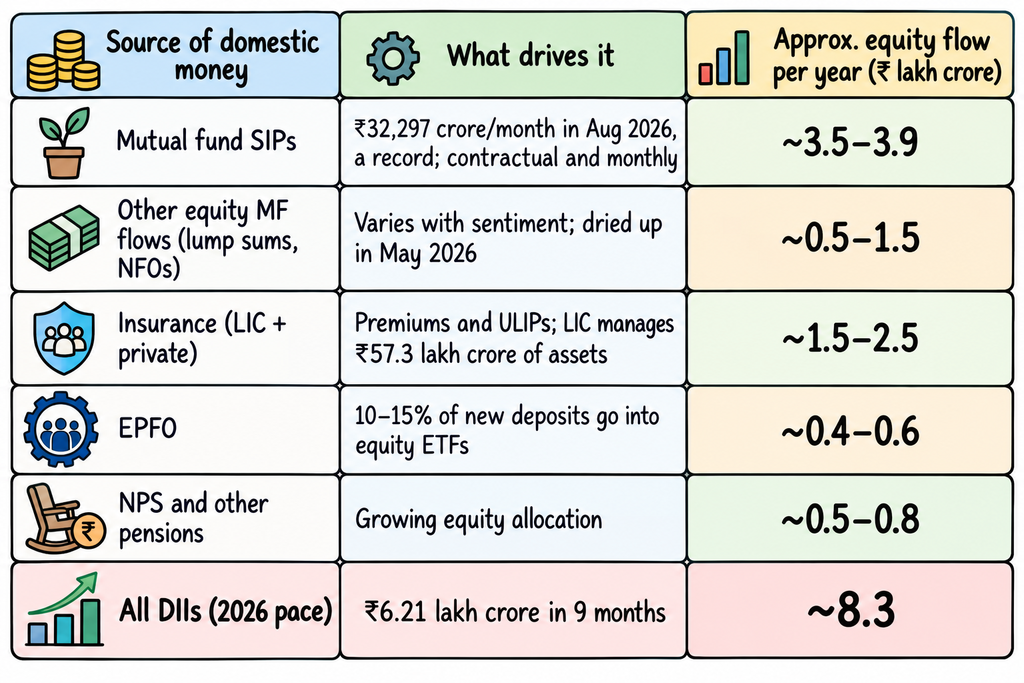
The first two rows are from AMFI data. The other rows are rough estimates that show the order of magnitude; they aren’t disclosed figures.
This stack is sturdier than it was in 2008 or 2013, for two reasons:
- It’s contractual. SIPs are auto-debits from about 9 crore accounts. They have stayed above ₹31,000 crore a month for ten straight months, including through the 2026 fall.
- It can surge. In March 2026 DIIs bought a record ₹1.36 lakh crore in one month, about ₹4,000 crore a day. That month FPIs pulled out a record ₹1.17 lakh crore, and DIIs matched it.
On top of the DIIs, retail investors buying directly and promoter buybacks add perhaps ₹1–2 lakh crore a year (approximate). Mutual funds also hold a cash cushion of a few percent of AUM that they can deploy quickly. Stretched to the limit, domestic buyers might absorb ₹12–15 lakh crore in a single year. That’s about a fifth of the foreign stake.
The absorption maths
At the 2026 pace, DIIs would need about 8.5 years to buy the whole foreign stake at today’s prices: ₹70.7 lakh crore ÷ ₹8.3 lakh crore a year. If SIPs and insurance flows keep growing 12–15% a year, it takes closer to 6–7 years. The whole question is how fast the selling comes.
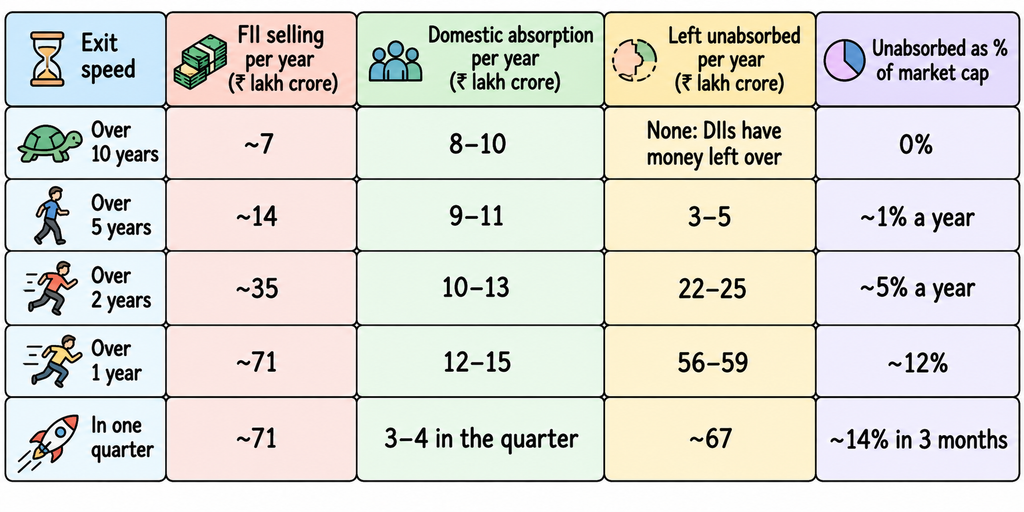
Two things work against a straight reading of this table.
Falling prices shrink the problem. FIIs can only sell what their shares are worth. If the market falls 40%, the foreign stake is worth about ₹42 lakh crore, not ₹70.7 lakh crore. Cheaper stocks also bring in money that sits out today: promoters buying back their own companies, cash-rich corporates, EPFO raising its equity cap, and retail investors who buy dips. Much of the adjustment happens through price, not volume.
The plumbing sets a speed limit. NSE’s cash market trades roughly ₹1–1.3 lakh crore a day (approximate). Selling ₹70.7 lakh crore means 55–70 full days of the entire market’s turnover, all of it one-way. Market-wide circuit breakers at 10%, 15% and 20% would halt trading long before a one-quarter exit could finish. Physically, a sudden full exit can’t happen. The question is only how far prices fall while a slower one plays out.
What it would do to prices
A ten-year exit would cost the Nifty perhaps 5–15%, mostly through lower valuations. A one-year exit could cost 40–55%, as deep as 2008. The difference is entirely the selling that DIIs can’t cover.
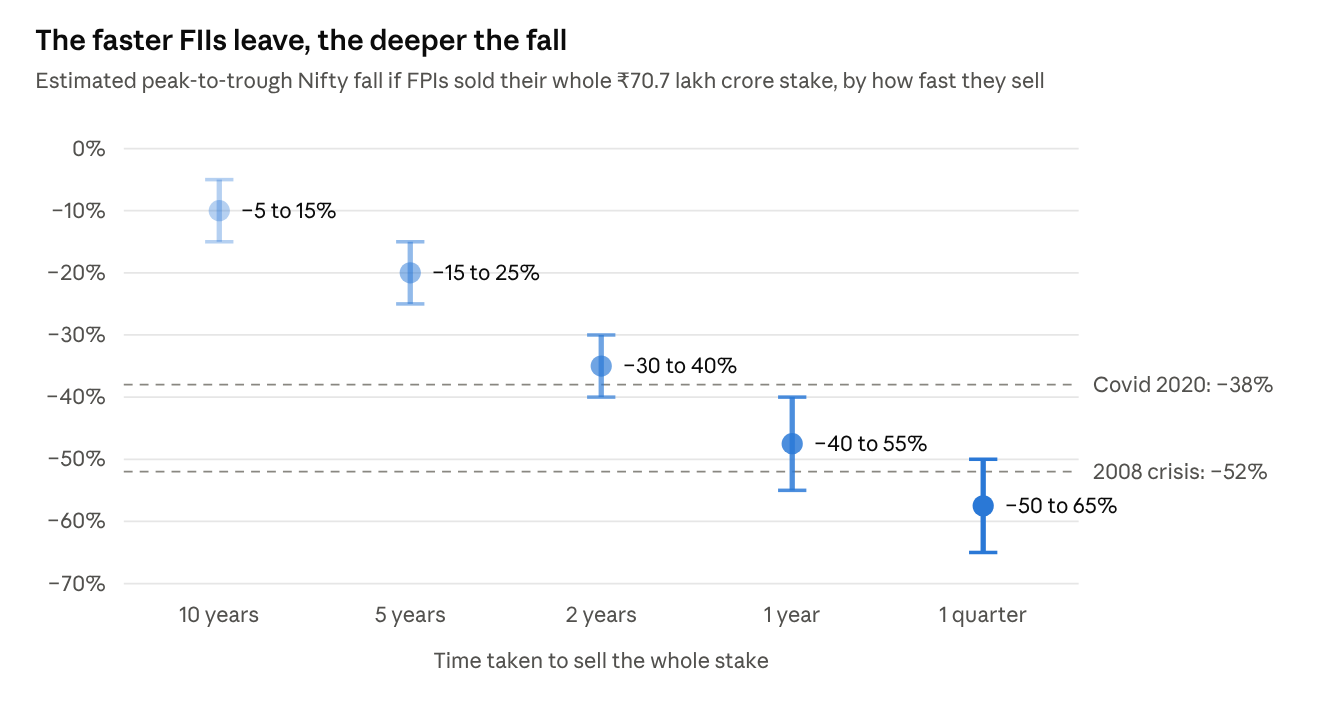
The estimate uses the “inelastic markets” idea from Gabaix and Koijen’s 2021 research. Because most holders don’t trade much, each rupee of net selling that no one absorbs moves total market value by several rupees; they found about five in the US. Using a more cautious 3–5× for India, 1% of market cap sold unabsorbed each year takes roughly 3–5% a year off prices. The ranges are then trimmed for the fact that the foreign stake shrinks as prices fall.
A cross-check on valuation: the Nifty trades at about 20 times trailing earnings (approximate). A 45% fall would take it to about 11 times. That’s close to the 2008 and 2011 lows, a level where promoters, corporates and long-term domestic money have always turned heavy buyers.
The fall wouldn’t be even across the market:
- Hit hardest: private banks, large-cap IT, and consumer and new-age stocks with FPI ownership of 30–50%+. These are also the biggest index weights, so the Nifty would fall more than the broad market.
- Hit least: PSUs, companies with 70%+ promoter holdings, and mid-caps already dominated by mutual funds.
- Volatility, not just level: India VIX would stay high for months. Daily limits and market-wide circuit breakers (10%, 15%, 20%) would trigger repeatedly in the fast scenarios.
Beyond stocks: rupee, reserves, rates
DIIs can absorb the shares. They can’t absorb the currency. An FII that sells ₹70.7 lakh crore of stock is left holding rupees, and it converts them to about $735 billion at around ₹96 to the dollar. Only the RBI’s reserves, or a much weaker rupee, can supply that.
- Rupee. The rupee is already near ₹96 to the dollar after 2026’s record outflows. A full exit, even spread over two to three years, would be the largest capital outflow India has faced. Without heavy RBI selling, a further 15–30% fall in the rupee is plausible (a scenario estimate). A weaker rupee raises import costs for oil, electronics and gold, and so pushes up inflation.
- Reserves. India’s reserves are roughly $650–700 billion (approximate), about the same size as the entire FII equity stake. The RBI couldn’t defend the rupee dollar for dollar. It would ration its defence and let the currency take part of the hit.
- Bond yields and rates. To defend the rupee, the RBI could keep rates higher than growth needs. Foreign holders of Indian bonds, including those in the global bond indices, would come under pressure to sell too. Higher yields make equities less attractive for the DIIs we’re relying on.
- Policy response. The toolkit exists, and was last used in 2013 and 2022: raising FPI debt limits, NRI deposit schemes, cutting the tax on capital gains for foreign investors, curbing gold imports, and swap lines. None of it is free.
- Feedback into stocks. A falling rupee cuts the dollar returns of the FIIs that remain. That can prompt more selling, which is the loop that makes emerging-market sell-offs overshoot. Exporters (IT, pharma) would gain relative to importers and companies with dollar debt.
In short, the stock market could survive a slow exit. The balance of payments is what makes a fast one dangerous.
What past sell-offs tell us
Each big FII sell-off has done less damage than the one before, because the domestic cushion keeps getting bigger. In 2008 DIIs were a thin buffer. By 2025 FPIs could sell a record amount and the Nifty still ended the year higher.
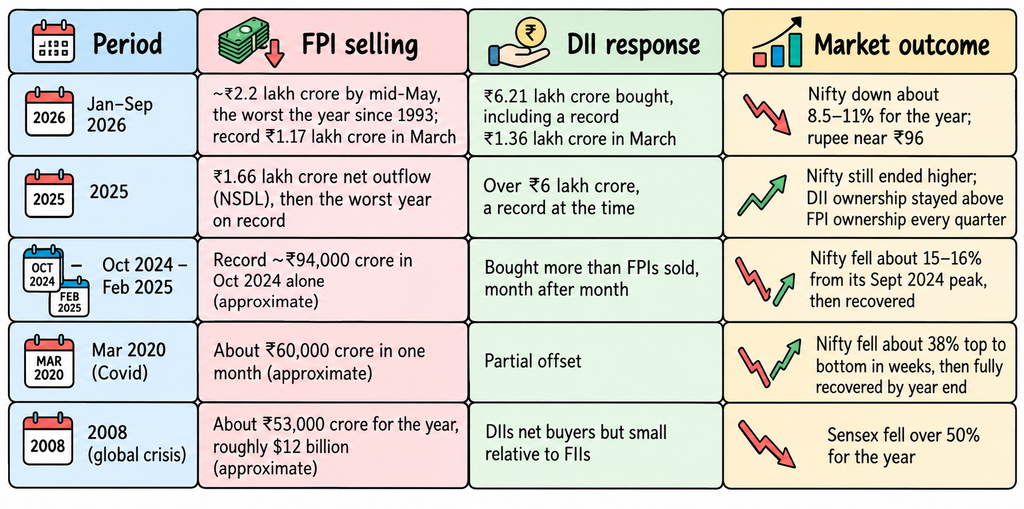
The pattern: DII buying now routinely matches or beats FPI selling in rupees. But the index still falls, because prices are set by the marginal trade and by sentiment, not just net flows. The strong domestic bid turns a potential crash into a correction. It doesn’t make Indian stocks immune.
Why a full exit won’t happen, and what could
A full foreign exit from a $4–5 trillion market that’s part of the benchmark indices would need India to be removed from them. It would also need sovereign and pension funds to abandon strategic stakes, and every active manager to go to zero at the same time. That hasn’t happened in any large emerging market outside sanctions, capital controls or war. Russia in 2022 is the example, and there foreigners were trapped, not allowed out.
A realistic stress is a much smaller share of the stake:
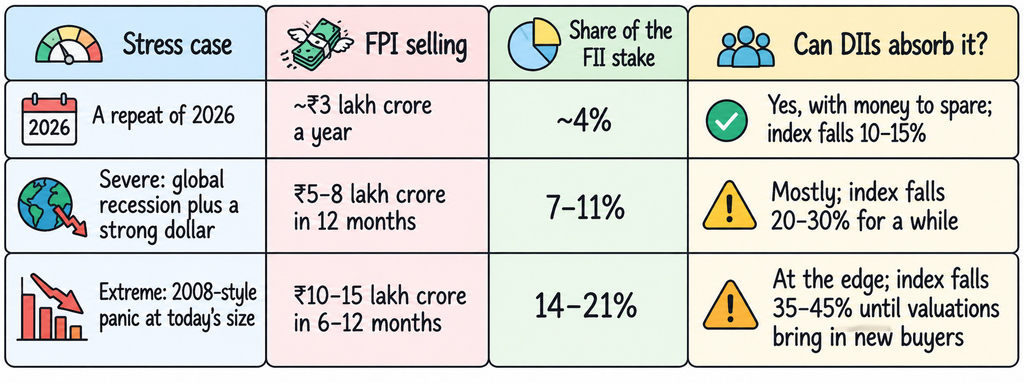
The triggers to watch: MSCI or FTSE cutting India’s weight, US rates and the dollar, Indian earnings downgrades, the rupee, and policy shocks such as taxes on foreign investors.
What it means for investors
The foreign exodus is a valuation risk and a currency risk. It isn’t an existential risk to Indian equities. The domestic bid is now large enough to set a floor under the market, though not a high one.
- Keep SIPs running through FII sell-offs. The domestic bid is made of SIP money. Stopping SIPs in a sell-off takes away the very support that limits the fall, and it means missing the cheapest units.
- Know where foreign ownership is concentrated. Private banks and large-cap IT and consumer names with high FPI ownership are most exposed to forced selling. Stocks with high DII and promoter ownership are held more steadily.
- Hedge the rupee, not just the market. A fast exit hurts through the currency. Some international equity or gold in the portfolio offsets a weaker rupee. So do exporters.
- Keep dry powder. In every past episode (2008, 2020, 2024–25) heavy foreign selling produced the best entry points for patient domestic money. An asset allocation with a rebalancing band lets you use them.
- Watch the gap, not the headline. Daily “FII sold ₹X crore” headlines matter less than whether DII buying keeps covering it. Also watch the rupee and India’s index weights.
Figures marked approximate and all scenario ranges are estimates for illustration, not forecasts or investment advice.