
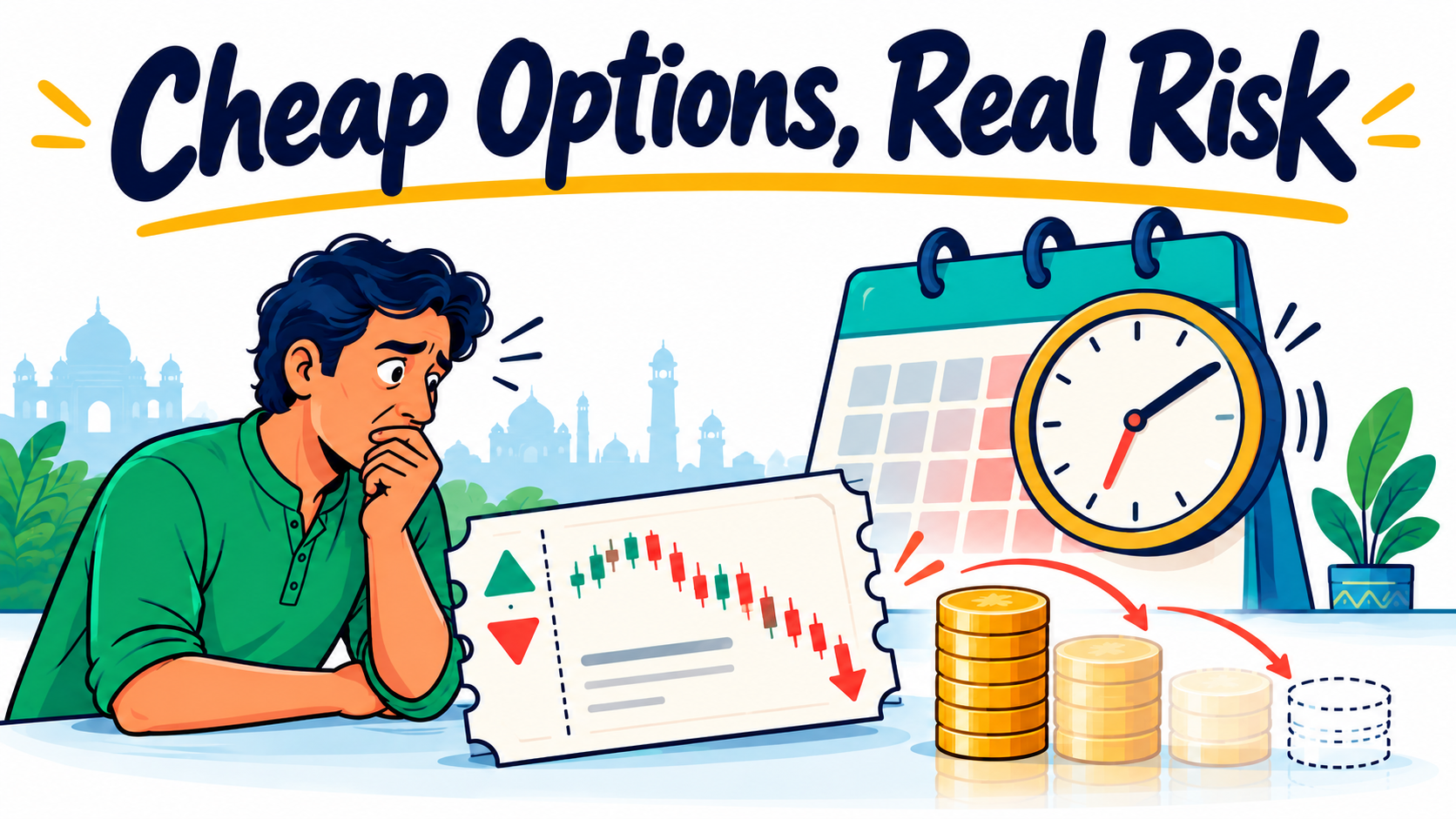
An option priced at ₹5 can look affordable beside a share priced at ₹1,000. But the smaller price can hide a larger mistake: you may lose the entire amount paid for the option, and the deadline can be very close.
This article is about buying an option. Selling an option is a different activity, with different obligations and potentially much larger losses.
First, multiply the price by the lot size
You generally buy exchange-traded options in a fixed lot, rather than one unit of your choice. Suppose an option costs ₹5 per unit and its lot contains 100 units. Your purchase costs ₹500 before charges. These are made-up numbers; actual lot sizes depend on the contract and can change.
Buy ten such lots and the amount at risk becomes ₹5,000. A small price on the screen does not make the total position small. Use the current contract details, not a remembered lot size.
An option comes with a deadline
An option gives its buyer a right under a contract that ends on a specified expiry date. A call is broadly a bet that the underlying price will rise enough; a put is broadly a bet that it will fall enough. The price you pay for this right is called the premium.
Consider a simplified call with a strike price of ₹100, bought for ₹5. The strike price is the price used to calculate the contract’s value at expiry. If the underlying ends at ₹103, the call has a value of ₹3 per unit at expiry. You paid ₹5, so you still lose ₹2 per unit before charges—even though the underlying rose.
At ₹100 or below, this simplified call has no value at expiry. Your premium can be lost completely. At ₹110, its expiry value is ₹10, leaving a ₹5 gain per unit before charges. This is an expiry illustration, not a prediction or an explanation of prices before expiry.
Direction is only part of the story
Before expiry, the option price also responds to the time remaining and the market’s expectations of future price movements. As the deadline approaches, the extra value for remaining time can shrink. A price move that comes too late, or is too small, may not rescue your purchase.
This is why “the company is good” or “the index will rise eventually” is not enough to justify a short-lived option. A long-term view and a contract expiring shortly are different decisions.
A low price may be telling you something
An option may be cheap because there is little time left or because the underlying is far from the level needed for a worthwhile expiry payout. It can also have poor trading activity. A displayed price may not be a price at which you can sell the whole position.
Buying more lots to make a cheap option feel profitable increases the amount you can lose. Repeated small purchases can become a large monthly loss, even if each one feels harmless.
Do not ignore settlement obligations
The premium example is not the whole story for every Indian contract. Individual-stock options can involve physical settlement: actual shares and funds may be required at expiry. Broker rules, required funds and close-out arrangements matter. Do not assume every option simply ends with a cash adjustment or that your obligations can never exceed the purchase premium.
Before buying, check whether the contract is on an index or an individual stock, how it is settled, and your broker’s expiry rules. If you cannot explain these in your own words, pause before placing the order.
Four questions before clicking buy
What is the total purchase cost for all lots? How much of that amount could I lose? What must happen before which date? What happens if I hold it to expiry? Add charges and leave room for a worse exit price than the screen shows.
Treat the money paid for an option as money you could lose. It should not be rent money, an emergency reserve or borrowed money. A low premium is a price; it is not protection.
Read next: Your Stop-Loss Price Is Not a Guaranteed Exit Price.
Source: NSE’s individual-stock derivatives specifications. All numerical examples above are hypothetical and exclude charges and taxes.