
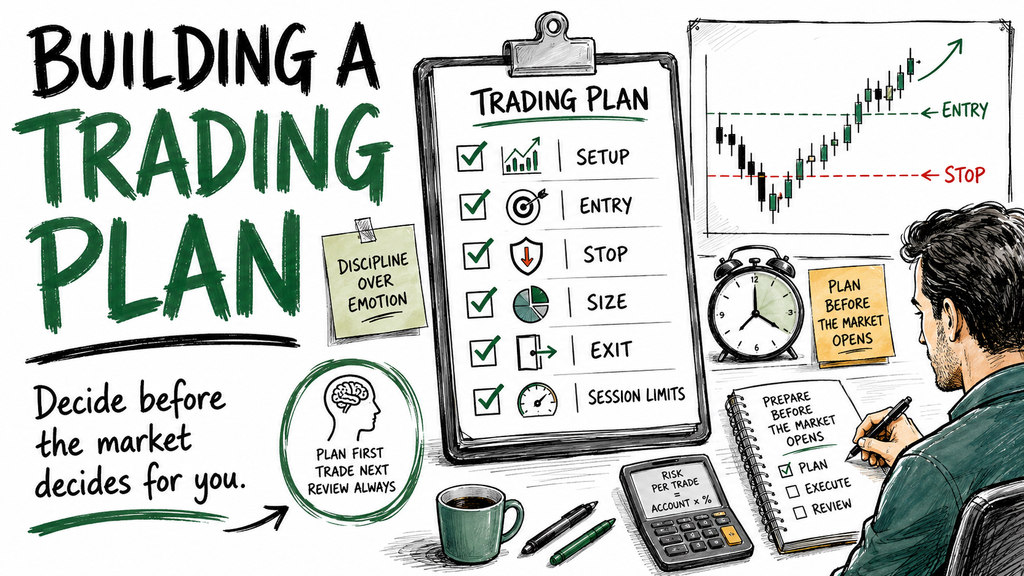
At 9:15 the screen starts moving, and it does not wait for you to think.
That is the entire problem with deciding things during market hours. Price is moving, money is at stake, and your brain is running on adrenaline rather than judgement. Every decision you make in that state, how much to buy, where to get out, whether to hold “just a little longer” is a decision made badly.
A trading plan is simply the practice of making those decisions earlier, in a quiet room, when nothing is at risk.
Before we get to how to build one, it’s worth being honest about what we’re dealing with because most writing on this subject skips straight past it.
1. The Numbers Nobody Puts in the Advertisement
SEBI publishes studies on how individual traders actually do. They are not marketing material, and they make uncomfortable reading.
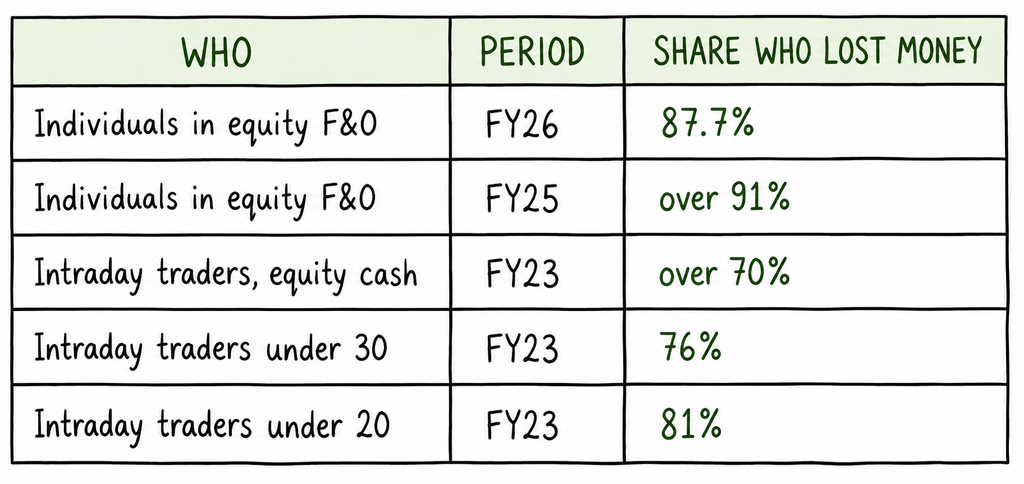
In FY26, individual traders lost about ₹91,685 crore in equity derivatives between them an average of roughly ₹1.17 lakh each. Options accounted for around 92% of that. Transaction costs took a further ₹25,000 crore or so on top.
Two details from those studies deserve more attention than the headline percentages.
Costs hurt the losers far more than the winners. In the intraday study, traders who lost money spent an additional 57% of their losses on trading costs. Profitable traders spent 19% of their profits. If you are losing, costs are not a small drag on the side they are close to a second loss stacked on the first.
People are leaving. Active individual derivatives traders fell from about 98.1 lakh in FY25 to 78.6 lakh in FY26 — roughly a fifth of them gone in a year. That is not a market maturing. That is people finding out.
None of this means trading is impossible. It means the base rate is brutal, and that anything you do without a plan is not trading, it is paying for entertainment. What follows won’t move you into the minority who make money. What it can do is stop you losing money for reasons that were avoidable.
2. What a Trading Plan Actually Is
A trading plan is not a prediction about where the market is going. Nobody has that, and a plan built on having it is a wish.
A trading plan is a set of decisions made in advance, written down, covering what you will do in situations you can anticipate. It answers: what would make this a trade, how much am I risking, what proves me wrong, and when do I stop for the day.
Three things matter about the form it takes.
- It must be written. A plan you hold in your head isn’t a plan, it’s a mood and it will quietly revise itself the moment a position moves against you. Writing it down fixes it in place while you’re still thinking clearly.
- It must be specific enough to be broken. “Trade with the trend” cannot be violated because it cannot be tested. “Only take this setup between 9:30 and 2:30, risking no more than ₹2,000” can be and knowing you broke it is the information you need.
- It must be written before the session, not during it. A plan amended at 11:40 because a trade is going badly is not a plan. It is a rationalisation with a timestamp.
Trading money is not investing money
Before any of this, one separation has to be real rather than notional: the money you trade with and the money you invest with are different money, held separately, and neither ever rescues the other.
The temptation runs one way. A bad week in the trading account creates a very reasonable-sounding argument for moving something across from the long-term portfolio, just temporarily, just to trade back to level. That is how a contained problem becomes a serious one.
So: fund the trading account once, with an amount whose complete loss would change nothing important about your life. It sits outside your asset allocation rather than forming part of it, and it comes after the emergency fund is already built. If it runs out, that is the end of the experiment, not a prompt for a transfer.
3. The Five Things to Settle Before 9:15
For each trade you’re willing to take, you should be able to answer all five of these before the market opens. If you can’t, you don’t have a trade — you have an urge.
- The setup. The specific, describable condition that makes this a trade. Not “it looks strong” something you could hand to another person and have them identify the same opportunity.
- The trigger. What precisely gets you in, and at what price. “Around 1,240” is not a trigger. It’s how you end up filled at 1,265 in a hurry.
- The stop. The price at which the trade is proven wrong and you are out. This is decided before entry, always. A stop chosen after you’re in the position is chosen by hope.
- The size. How many shares or lots and this follows from the stop, not from how confident you feel. The distance to your stop and the rupees you’re willing to lose together determine the size. That relationship is important enough that it gets its own article in this series.
- The exit if you’re right. People plan obsessively for being wrong and not at all for being right, then take a small profit out of nervousness while letting losses run. Decide in advance where you take profit, or what would make you hold.
Notice that only one of those five is about predicting direction. The other four are about controlling the consequences. That ratio is roughly right.
Written out, a single trade’s plan is short. This is the shape of one, an illustration of the form, not a suggestion of what to trade or how:
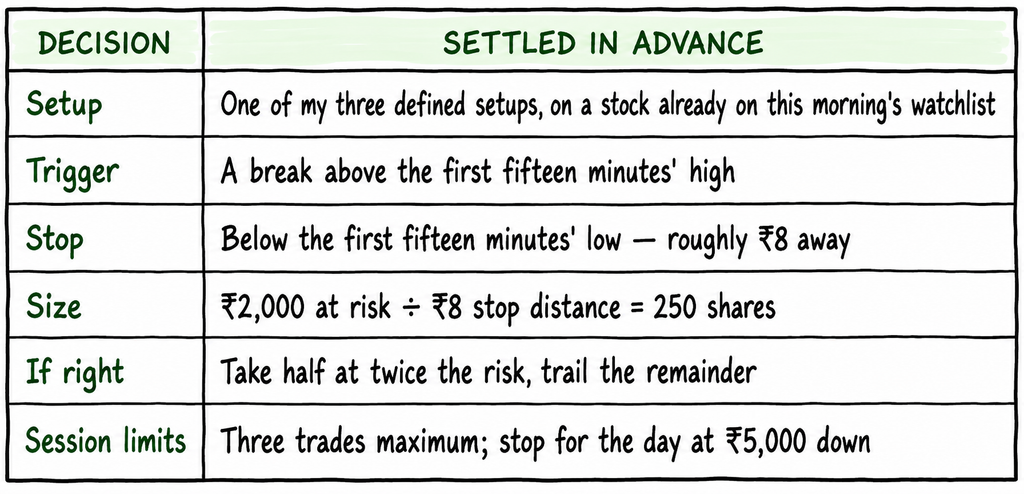
The important line is the fourth. The size wasn’t chosen because the setup looked convincing it fell out of the sums, once the stop distance and the acceptable loss were both fixed. Change the stop and the size changes with it. Conviction never enters the calculation.
4. The Rules That Protect You From Yourself
Beyond individual trades, a plan needs limits that apply to the whole session. These exist because the version of you at 2pm, down ₹8,000 and wanting it back, is not the person who wrote the plan.
- A daily loss limit. A rupee figure at which you stop for the day, close the terminal and go and do something else. This single rule prevents more damage than everything else combined, because catastrophic days are almost never one bad trade they are six, each one trying to repair the last.
- A cap on trades per day. Overtrading is what boredom looks like on a P&L statement. A limit forces each trade to compete for a slot.
- No new setups mid-session. If it wasn’t on the list this morning, it isn’t a trade today. It can go on tomorrow’s list, where you can look at it with a clear head.
- Never move a stop further away. Moving a stop to give a losing trade “room” converts a planned small loss into an unplanned large one. Tightening a stop is fine. Loosening it is the plan failing in real time.
- Know your costs before you trade. Brokerage, STT, exchange charges, GST, stamp duty and SEBI turnover fees all come off whatever you make. Given what the SEBI data says about costs and losing traders, a strategy that only works before costs does not work.
One more, which sounds like a lifestyle point but is really a risk rule: never trade with money you need. Not rent, not fees, not the emergency fund. Trading with money that has a job elsewhere guarantees you will make decisions on the wrong timeframe, because you cannot afford to be patient or to be wrong.
5. The Log Is Where the Skill Comes From
A plan you never review is just paperwork. The log is what turns a series of trades into something you can actually learn from. Record every trade the day you take it, not from memory at the weekend, which is memory doing public relations on your behalf.
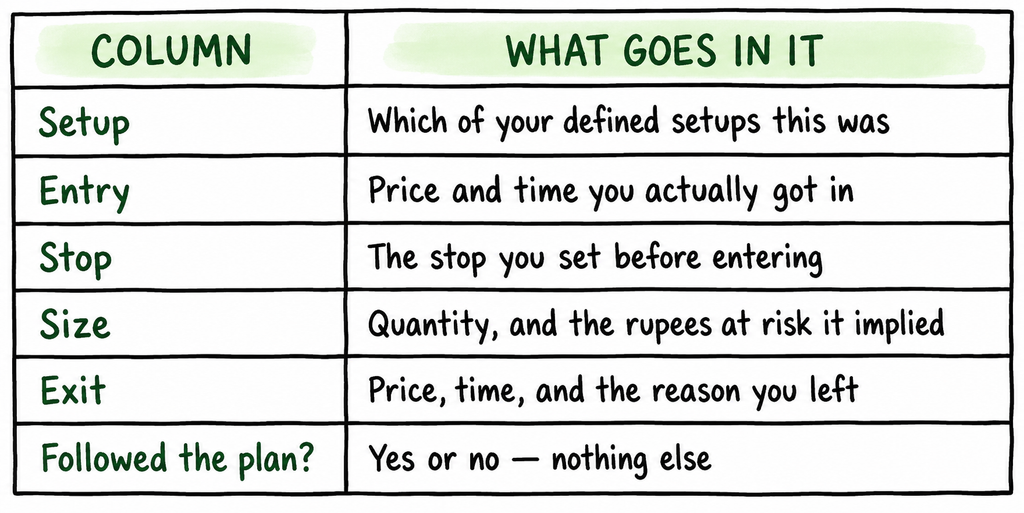
That final column is the one that matters, and it’s the one everybody omits. Profit and loss on any single trade tells you almost nothing – a reckless trade can make money and a disciplined one can lose it. Whether you followed your own plan is the only thing fully within your control, and it’s therefore the only thing you can actually improve.
Review weekly, and sort your losses into two piles:
- Losses that came from following the plan. These are the cost of doing business. Every plan produces them. They are not mistakes.
- Losses that came from breaking the plan. These are the mistakes, and they are the only ones worth agonising over because they’re the only ones you can stop.
If pile two is large, your problem is not strategy. Reading about a different setup will not help you. The problem is execution, and it gets solved by trading smaller until following the plan stops feeling expensive.
If pile two is empty and you’re still losing steadily over a meaningful number of trades, then the plan itself needs work and now you have clean evidence of that, rather than a vague feeling.
That is the real argument for writing all this down. Without a plan, a losing month tells you nothing at all. With one, it tells you exactly which of two very different problems you have.
Write it tonight. Trade it tomorrow. Change it only on a weekend, never at 11:40 with a position open.
This is educational content, not personal financial advice or a recommendation to trade. Trading in equities and derivatives carries a real risk of substantial loss, and SEBI’s own studies show most individual traders lose money. Nothing here is a strategy, a signal, or a suggestion that trading is suitable for you — for decisions about your own money, speak to a SEBI-registered investment adviser. Figures quoted are from SEBI studies covering the periods stated. Past returns don’t mean future returns will be the same. Everything can fall. Everything can go up. Trade accordingly, or don’t.