
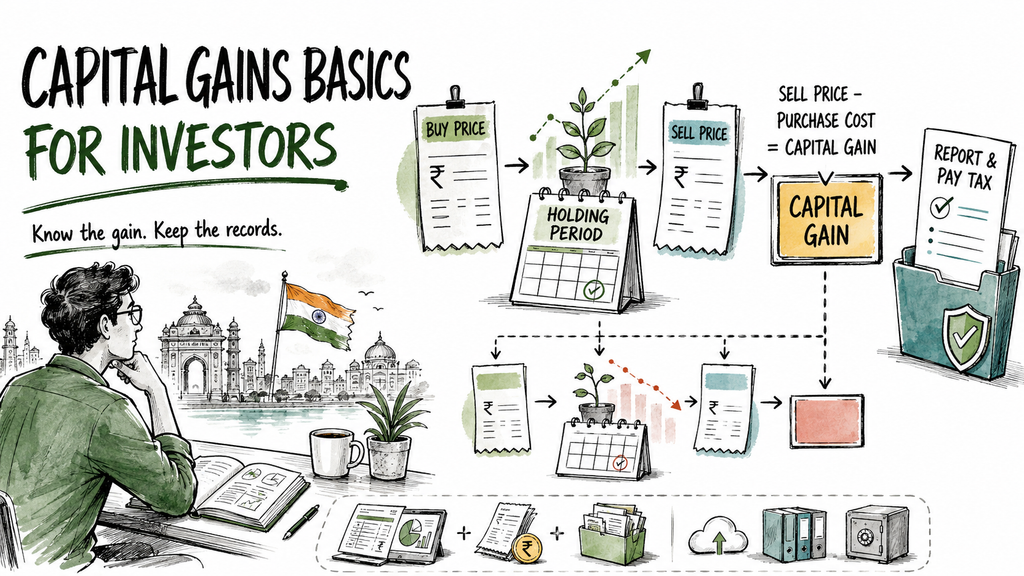
Capital gains tax is where careful investors get caught out, because most of it only matters on the day you sell.
You can hold something for fifteen years and never think about it. Then you sell, and suddenly there are holding periods, exemptions, losses and a form to fill.
This article covers the parts people actually get wrong. If you want the rates themselves, they are set out in how asset allocation keeps a plan balanced. Here we go a step further.
1. Nothing Happens Until You Sell
A capital gain is what you make when you sell something for more than you paid for it. The important word is sell. Your fund can double in value and you owe nothing. The tax arrives only when you take the money out. People find this confusing because their app shows a profit every day. That number is not income. It is a price. Until you sell, it can go back down again, and the tax office has no interest in it.
Two things are not capital gains, and they are taxed differently.
- Dividends from shares or funds are added to your income and taxed at your slab rate.
- Interest from deposits, bonds and savings accounts is also added to your income.
So a fund that pays you a dividend is handing you taxable income now. A fund that simply grows is not. That difference is worth understanding before you choose between the two options a fund offers.
2. The Clock That Decides Everything
How long you held the thing decides which rate applies. The dividing line is not the same for everything.
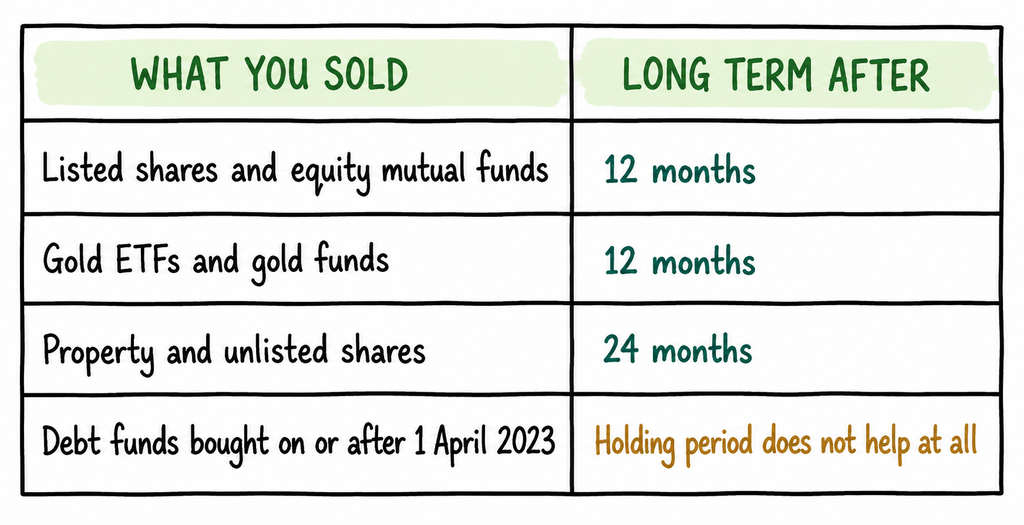
That last row catches people out. For those debt funds, the gain is added to your income and taxed at your slab rate whether you held it for three months or ten years. There is no long term rate waiting for you.
One practical note on the clock. It runs from the date you bought to the date you sold. If you are close to the line, waiting a few days can change the rate you pay. It is worth checking the dates before you place a sell order, not after.
3. Which Units Get Sold First
Here is something most people have never thought about. If you have been running a monthly SIP for years, you do not own one holding. You own dozens of small purchases, each bought on a different date at a different price.
So when you sell part of it, which ones did you sell? The oldest ones go first. This is called first in, first out. Say you hold three lots of 100 units each, bought in January 2023 at ₹50, June 2024 at ₹80, and March 2026 at ₹120. You sell 150 units. You have sold all 100 units from 2023, and 50 units from 2024. The 2026 units are untouched. This matters twice over. Those older units were bought cheaper, so they carry the largest gain. But they have also been held longest, so they are more likely to qualify for the lower long term rate.
You do not have to work any of this out by hand. Your fund house, broker or the registrar will give you a capital gains statement for the year, with the lots and the gains already matched up. Ask for it before you file. It will save you hours and it will be more accurate than anything you reconstruct from memory.
4. Losses Are Worth Something
This is the part that gets ignored, and it is the part with real money in it. A loss on paper does nothing for you. A loss becomes useful only when you actually sell and the loss is realised. At that point it can reduce the tax on your gains.
There are rules about what can cancel what.
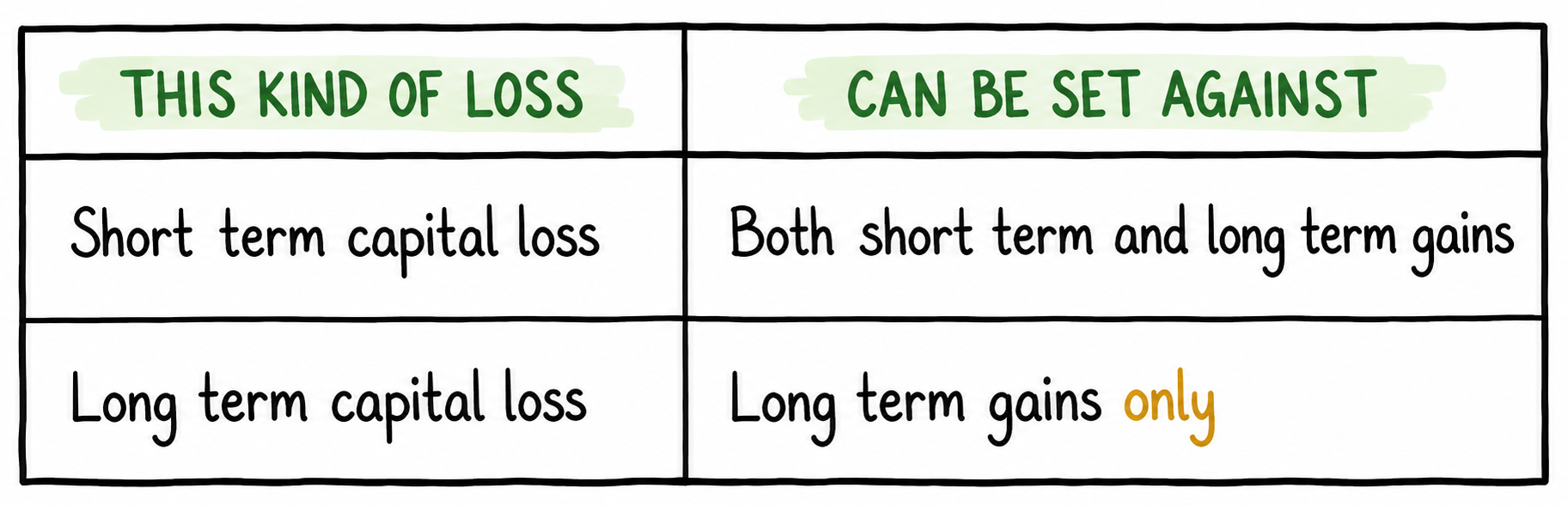
Note what is missing. You cannot set a capital loss against your salary. Losing money on shares does not reduce the tax on your pay.
Two quick examples.
One. You made a long term gain of ₹3,00,000 on one holding, and a long term loss of ₹1,00,000 on another. The loss cancels part of the gain, leaving ₹2,00,000. The first ₹1,25,000 of long term equity gains is exempt, so ₹75,000 is taxable. At 12.5% plus cess, that is ₹9,750.
Two. You made a long term gain of ₹1,50,000 and a short term loss of ₹50,000. A short term loss can be set against a long term gain, so you are left with ₹1,00,000. That is under the exemption, so you pay nothing at all.
The rule that costs people the most
If your losses are bigger than your gains this year, the extra does not disappear. You can carry it forward for up to eight years and use it against future gains. Say you sold at a loss of ₹3,00,000 this year, with no gains to set it against. Next year you make a gain of ₹2,00,000. That carried loss wipes it out, and ₹1,00,000 is still available for the years after. But there is a condition, and it is strict.
You must file your return by the due date. File it late, and you lose the right to carry that loss forward. Permanently. The loss is simply gone.
People miss this every year. They had a bad year in the market, they assume there is nothing to report because they owe no tax, and they file late or not at all. They throw away a deduction they could have used for the next eight years. If you sold anything at a loss, file on time. Even if you owe nothing.
5. Four Things Worth Knowing
- Shares bought long ago get special treatment. For listed shares and equity funds bought before 1 February 2018, the gain is measured from their value on 31 January 2018 rather than from what you originally paid. Growth before that date is left alone.
- A large gain may mean advance tax. If you sell something big, the tax may be due during the year rather than at filing time. Selling in March leaves very little room to sort this out, so think about the timing.
- Keep your purchase records. You need to prove what you paid and when. Contract notes, statements and account records. This matters most for things held a very long time, which is exactly when people no longer have the paperwork.
- Do not let tax drive the decision. Selling a good holding to save tax, or clinging to a bad one to avoid it, usually costs more than the tax involved.
Most of this comes down to two habits. Get the capital gains statement from your broker or fund house before you file. And file on time, particularly in a year when you lost money.
The rest is sums that somebody else will do for you.
This article is for learning. It is not personal tax advice. It describes the position for tax year 2026-27, and tax rules change with every Budget. The examples are simplified, and the exact order in which exemptions and set-offs are applied can get technical in real cases. Your filing software or a qualified tax professional should do the actual calculation. Please check current rules before acting on any of this.