
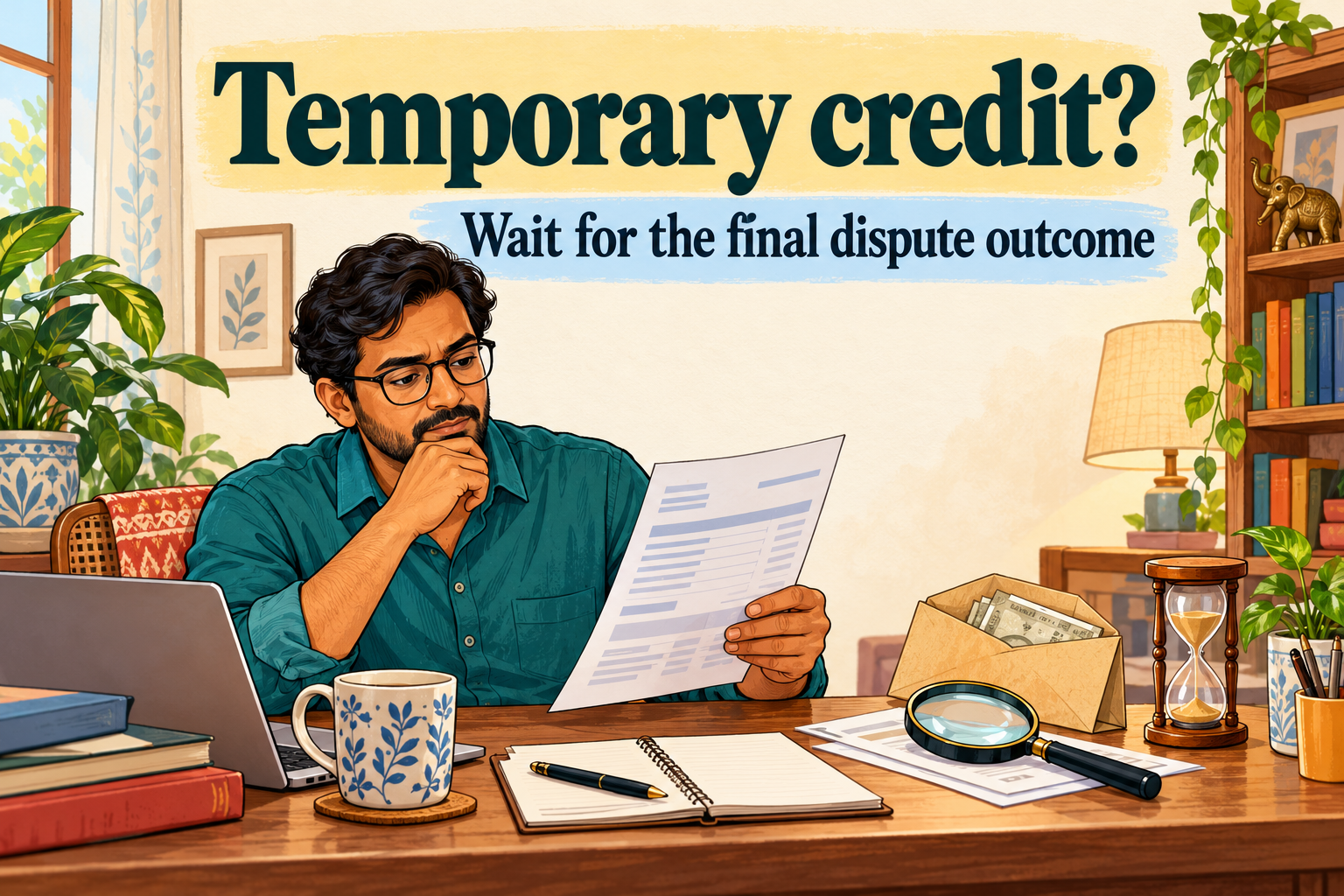
A lower credit-card balance can feel like the end of a shopping dispute. Before putting that money back into your spending budget, check what the entry actually means. A temporary credit is relief while a case is investigated—not, by itself, confirmation that you have won.
The useful question is not simply “Has my balance fallen?” It is “What has the issuer confirmed, and what can still change?”
Read the case outcome, not just the balance
SBI Card’s transaction-dispute FAQ, checked on 20 October 2026, says temporary credit may be provided depending on the dispute and company policy. It offsets the disputed outstanding, but the corresponding spending limit remains blocked during investigation. If the case closes in the cardholder’s favour, a permanent credit replaces the temporary one. If liability rests with the cardholder, the credit can be reversed; associated charges and finance charges for the temporary-credit period may also apply under its policies.
Those are SBI Card’s stated arrangements, not a promise that every issuer handles every dispute identically. Its FAQ gives no visible publication or update date, so this is an explanation of currently accessible guidance—not an announcement of a new rule.
Treat a reassuring account entry and a written final decision as two different pieces of information. Ask for the outcome in writing and match it to the transaction reference.
A household example: keep the reserve separate
Imagine that Arjun has budgeted ₹42,000 for his card bill. Included is an ₹8,400 appliance purchase that he disputes because it was not delivered. His issuer posts an ₹8,400 temporary credit while investigating. For this simplified example, assume no other transactions, interest or fees.
The displayed outstanding could now be ₹33,600: ₹42,000 minus ₹8,400. That subtraction does not tell Arjun that the appliance dispute has been decided. Nor does it tell him what his issuer requires him to pay by the due date.
A cautious budgeting approach is to keep the ₹8,400 accessible and earmarked until he receives the final outcome, while confirming and paying the amount the issuer says is due. If liability is ultimately assigned to him, he has a reserve toward the original purchase; any applicable additional charges would need separate provision. If the dispute succeeds, he can release the reserve after reconciling the final entries.
This is an original illustration, not a bank quotation, a predicted decision or advice to withhold a payment.
Ask for the payable amount before the due date
Send the issuer a short, specific request: “Please confirm whether this credit is temporary or permanent, the amount payable by my next due date, and how the disputed amount and related charges are being treated.” Keep the response with the statement.
For comparison, ICICI Bank’s credit-card FAQ says posted merchant refunds, reversals, chargebacks and permanent fraud credits are adjusted against outstanding balances as payments. It also warns that not paying the total amount due can attract interest. Do not apply that description of posted credits to a merchant’s promise that a refund will arrive later, or assume a pending complaint cancels the whole bill.
The ICICI page is also undated; it was checked on 20 October 2026. Your own issuer’s confirmation, current card terms and actual account entries matter. Do not cancel an automatic payment merely because a complaint has been registered.
Build a small case file—and keep following it
Create one folder with the order confirmation, payment reference, promised delivery date, cancellation or return evidence, merchant correspondence, statements and the issuer’s acknowledgement. Write a brief chronology in your own words. This makes it easier to explain what happened without repeatedly searching messages.
ICICI’s FAQ asks for a completed dispute form and supporting evidence appropriate to the problem, such as merchant communication for non-delivery or cancellation proof for an unprocessed refund. SBI Card’s reporting windows differ by transaction type; check the applicable window promptly rather than assuming every card has the same deadline.
If the merchant separately refunds the purchase while the issuer’s case is open, tell the issuer and ask how the two credits will be reconciled. Do not budget on recovering the same purchase twice. When a final decision arrives, compare the original debit, temporary adjustment, any merchant refund, final credit and related charges before filing the case away.
If you did not authorise the payment, report it to the issuer immediately and secure or block the card through its official channels. That is different from waiting for a merchant to resolve a delivery complaint; this article does not determine liability for unauthorised transactions.
The takeaway: a temporary credit can ease the account balance without settling the dispute. Keep the evidence, confirm the next bill payment and wait for the final decision before treating the money as available to spend.
Editorial context: Mint’s refund-versus-chargeback explainer, published 19 October 2026 at 4:10 pm IST, prompted this independently researched, narrower budgeting angle. The example and structure above are original. General education, not personalised financial or legal advice.