
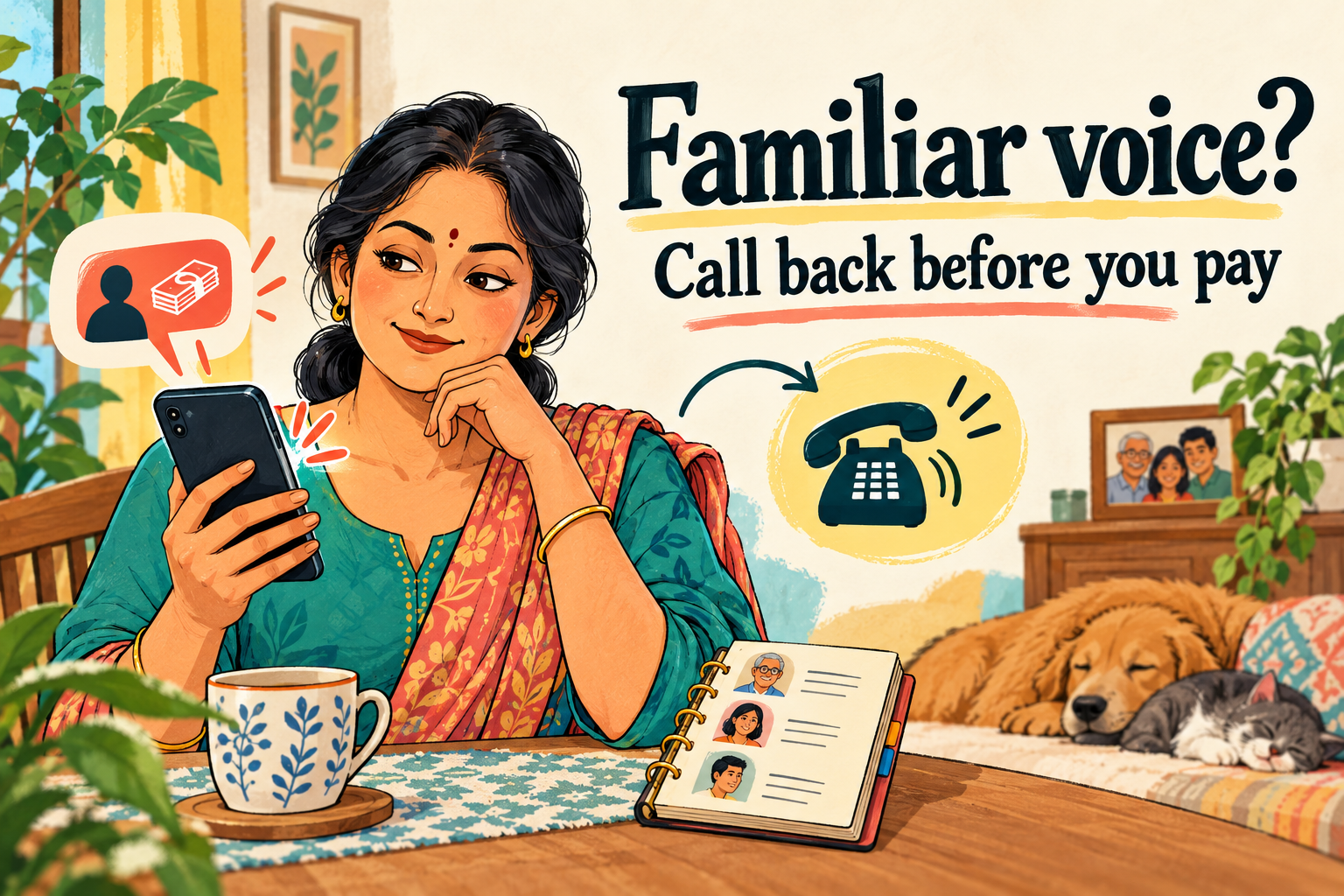
An urgent call sounds like someone you love. The request is simple:
send money now, and ask questions later. Your family needs a response
agreed in advance—not an argument about whether the voice sounds
convincing.
The useful safeguard is to separate the conversation from the payment
decision. End the unexpected call and verify the request through contact
details you already trust.
The
warning is current; the safety principle is established
Mint
reported on 17 October 2026 at 1:30 pm IST on an SBI voice-cloning
warning it attributed to the bank’s 16 October social-media post. That
report prompted this household checklist; it is not the announcement of
a new banking rule or compensation entitlement.
The independently checked primary guidance is CERT-In
Advisory CIAD-2026-0020, originally issued on 26 April 2026. Its
advice for individuals includes verifying voice calls, video messages
and urgent requests involving money or sensitive information. It warns
that AI-enabled impersonation can be convincing. The date is the
advisory’s original issue date, not the website footer’s update
date.
You do not need to prove that AI was used before refusing an
unverified payment request.
Agree on a
callback route before anyone needs money
Make a short family contact note with two independently known ways to
reach the people you might urgently help. For example, keep their usual
phone number and the number of another trusted family member who can
check on them. Keep those details current when someone changes
numbers.
Agree on one calm sentence: “I will help, but I will call you back on
the number I already have.” Make clear that this applies to everyone,
including parents and children. A pause for verification should not be
treated as disloyalty.
Use the saved contact or another previously verified route—not a
replacement number supplied during the suspicious conversation. If that
route is unavailable, contact the trusted backup. An unanswered call is
not confirmation that the request is genuine.
Verify the need
and the destination separately
Consider this fictional situation. A caller claiming to be Nisha says
her travel booking has failed and asks her father to transfer ₹18,500 to
a “travel desk” account. He should not make the transfer simply because
he recognises the voice or hears a plausible travel story.
His first task is to reach Nisha independently and establish whether
she actually needs help. Only after that should they check the proposed
payment recipient and purpose. Confirming the person does not, by
itself, confirm every account or payment instruction forwarded in the
conversation.
This two-part check is our suggested household routine, not a
procedure prescribed by a regulator. It helps make the decision
manageable: Who needs help? Where would the money go?
Keep the
payment screen closed during the check
Avoid opening your payment app while an unexpected caller dictates
instructions. Do the verification first, away from the pressure of the
call. Do not share banking credentials or install an app to “complete”
the verification.
SBI’s
public cyber-security guidance describes phone-based attempts to
obtain private information and provides reporting routes. The page is
undated; it was checked on 17 October 2026. This article does not claim
that every genuine bank call is fraudulent.
If
money has already gone, switch from checking to reporting
Contact your bank immediately through its official app, website or a
contact route you already know. Preserve the transaction reference,
recipient details, messages and call information. SBI’s guidance also
directs people to the financial cybercrime helpline
1930 and cybercrime.gov.in.
Reporting is not a promise of recovery or an automatic bank refund.
This checklist does not determine liability. If there is a real threat
to someone’s physical safety, seek appropriate emergency help while
independently checking the money request.
The family rule can stay simple: a familiar voice deserves attention;
an unexpected payment request still needs independent verification.
General household safety information, checked on 17 October 2026.
The fictional example is original and is not a reported
incident.