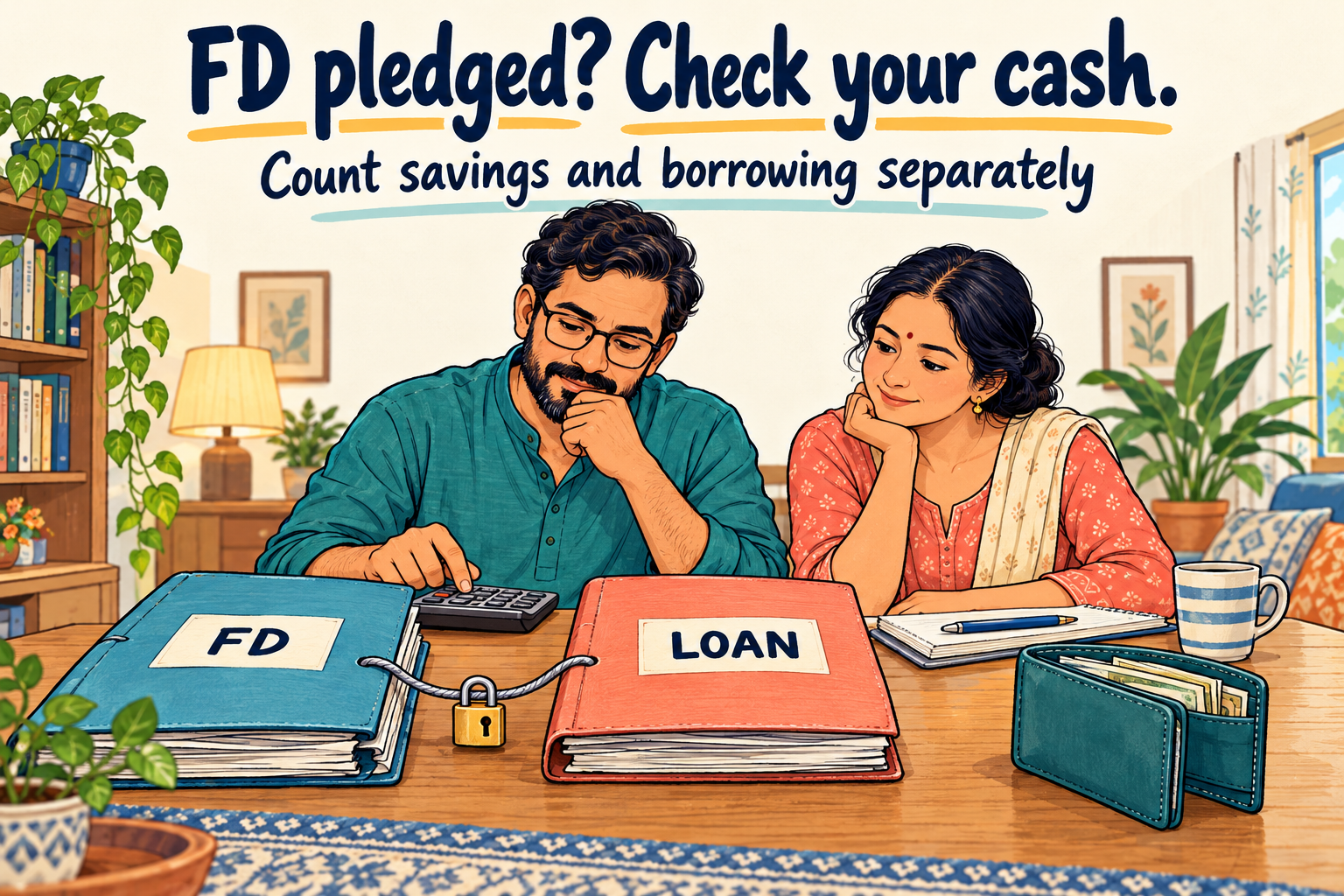
Your fixed deposit can remain visible in your banking app after you borrow against it. That does not mean its entire balance is still available for your next emergency.
A loan against an FD links an asset to a repayment obligation. For household planning, record three things separately: the deposit, the amount owed, and the money you can actually spend without taking another loan. This becomes especially important if the deposit was your family’s main reserve.
Bank terms checked on 19 October 2026. This is an explanation of existing facilities, not a new RBI rule or a recommendation to borrow.
Check what the bank has a claim on
SBI’s loan-against-time-deposit page identifies a lien over the underlying deposit as its security. In plain language, the deposit is tied to the borrowing arrangement; its displayed balance alone is not proof that you can freely withdraw it.
The HDFC Bank terms, under “Supersaver / Over Draft Facility”, illustrate the connection. Clauses 5.2 and 5.10 provide for a first charge over the relevant deposits and adjustment of deposit proceeds against overdraft dues, including premature liquidation under the agreement.
These are examples of bank-specific terms. Ask your bank which FD receipts are pledged, what amount is restricted, and what must happen before the restriction is removed. Do not assume that repaying part of the loan releases the same amount of deposit automatically.
Separate net value from money available today
Consider our own simplified example. Kavya has a ₹4.8 lakh FD and ₹45,000 in an unrestricted savings account. She has drawn and spent ₹1.6 lakh against the FD. Assume no other assets or debts, and temporarily ignore accrued interest and charges.
Her FD less the loan principal is ₹3.2 lakh. Including the savings account, her simplified net financial position is ₹3.65 lakh. But neither figure tells her what can be paid out immediately. The FD remains subject to the borrowing arrangement. The ₹45,000 savings balance is her identified unrestricted cash; she must confirm the conditions for accessing anything else.
If her app shows an unused overdraft limit, she should record it as potential additional borrowing, subject to the facility’s terms. Drawing it would create more debt. It should not be added to the FD balance and labelled extra savings.
Likewise, if borrowed money is still sitting in the savings account, the cash exists—but so does the matching repayment obligation. Moving a loan into a bank account does not itself increase net wealth.
Put the maturity date beside the repayment plan
SBI’s product page says an unrepaid demand loan is liquidated when its supporting time deposit matures. It also says an overdraft taken through YONO or Internet Banking must be liquidated at FD maturity if the customer has not repaid it. Branch-opened overdrafts have separate renewal provisions.
The household implication is practical: do not allocate the full expected maturity proceeds to a school fee, home repair or another goal until the bank explains how outstanding dues will be settled. A maturity date is not evidence that the entire deposit will reach your savings account untouched.
Ask for the repayment deadline and an estimated settlement amount for the date you expect to need the money. Also ask whether renewal is permitted, requires a branch visit, or is unavailable for your particular facility. Do not build a repayment plan around an assumed automatic extension.
Check the cost and the payment route
The interest-rate spread is not the full borrowing rate. SBI’s page lists its loan rate as one percentage point above the relevant time-deposit rate. HDFC Bank’s FD-overdraft fees page lists two percentage points above the FD rate for the period the amount is used. Verify your own sanctioned rate and charges rather than treating either example as an industry-wide tariff.
For illustration only, ₹1.6 lakh outstanding at an assumed 8% annual rate for 30 days produces about ₹1,052 of simple interest on a 365-day basis. That is an estimate, not a bank quote; actual interest calculation, debits and other charges follow the agreement.
Access also has a practical meaning. HDFC Bank’s product page permits use of its OD limit through NEFT, RTGS and fund transfers, while excluding debit-card transactions against that limit. Before relying on any facility for an urgent payment, confirm the permitted transfer method and applicable limits.
Update the family’s emergency note
For each pledged FD, keep a short record of the deposit reference, linked loan account, current dues, repayment date, permitted payment route and bank contact. Keep sensitive account details in your private records.
Then write down the unrestricted cash available separately. If that amount would not cover the emergency you are planning for, address the gap before committing the remaining reserve elsewhere. If repayment looks difficult, contact the lender early for the options available under your agreement.
Borrowing against an FD can provide temporary access to money. Its usefulness depends on a realistic repayment source and a clear view of what remains available for the family afterwards.
Source dates and scope: SBI’s page displays “Last Updated” as 17 October 2025. The cited HDFC Bank product, fees and terms pages do not display publication or effective dates for these provisions; all were checked on 19 October 2026. Sanction terms, deposit type, ownership and channel can change eligibility and operation. The example excludes tax, deposit-interest adjustments and other charges and is not a settlement quotation.