
Most money advice tells you to do one more thing. It rarely tells you which thing to do first.
This scores eight parts of your finances out of 100, then names the one that is costing you most points. That is the thing to do next.
About you
Including your EMI, home costs and all the rest.
Your safety net
Money you can reach the same week. Not your investments.
Term cover only. Policies that pay you back at the end do not count for much here.
Your own cover, not your firm’s. That one stops the day you leave.
Your money
All your loans added up, card dues as well.
Your provident fund, PPF, NPS and any funds or shares.
Your paperwork
A nominee on each account, and a will that says who gets what.
Your score
64out of 100
in good shapeDo this next
Start here.
How the score is built
Eight parts, a hundred points. The weights say what matters most.
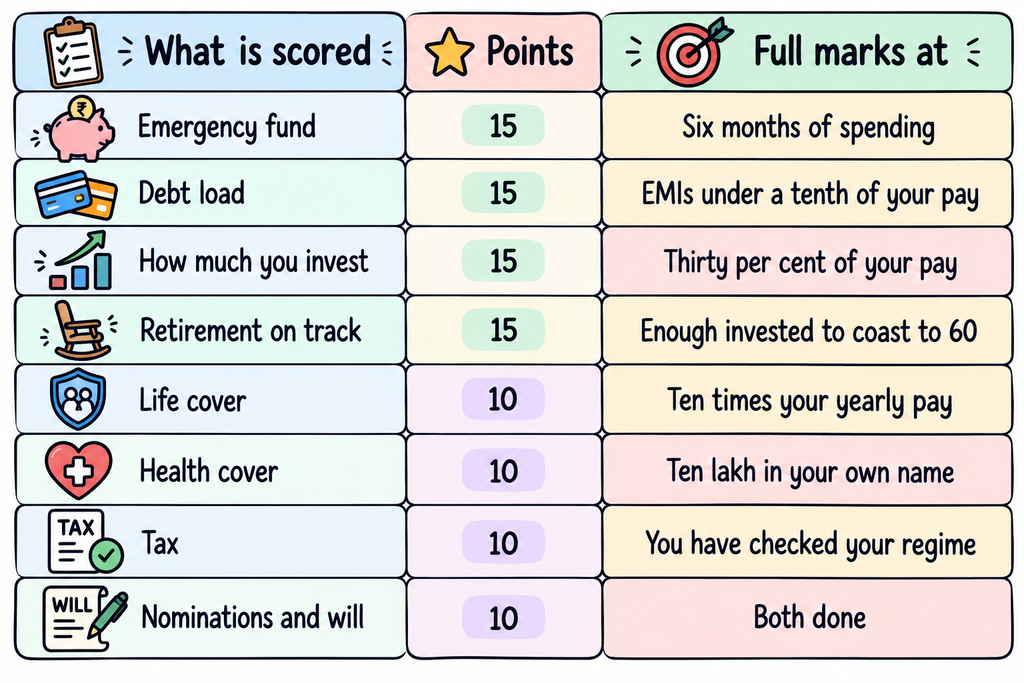
The first four carry sixty points between them. They are the foundations, and nothing else holds up without them. Cover takes twenty. The last twenty go on papers, which surprises people. Both are cheap to fix and dear to skip.
What the bands mean
- Under 40, needs work. Often one big thing is wrong, not all of it. The score names which.
- 40 to 59, getting there. The basics are starting to hold. Keep going in the same order.
- 60 to 79, in good shape. Most people never get here. What is left is often just papers.
- 80 and above, strong. Check it once a year and get on with your life.
Two things worth saying
A score is a nudge, not a verdict. It cannot see your job, your family, or what you are about to spend on. And it is meant to be used once, then forgotten for a year. Checking it monthly tells you nothing. These numbers move slowly, which is the point of them.
Each part has its own page here. The emergency fund, the debt payoff, the savings rate and when you can stop investing cover the four that carry the most points.
This calculator is for learning. It is not advice for your own case. No fund, insurer or company is named or backed here. The weights are this site's own view, not a standard. Another set would give another number. The retirement part assumes you stop at 60. Prices rise 6% a year, your money grows 10% a year, and you draw 3.5% a year after that. Those are the same figures the other tools here use, so the pages agree. They are assumptions, not forecasts. For advice on your own money, speak to a SEBI-registered investment adviser.