
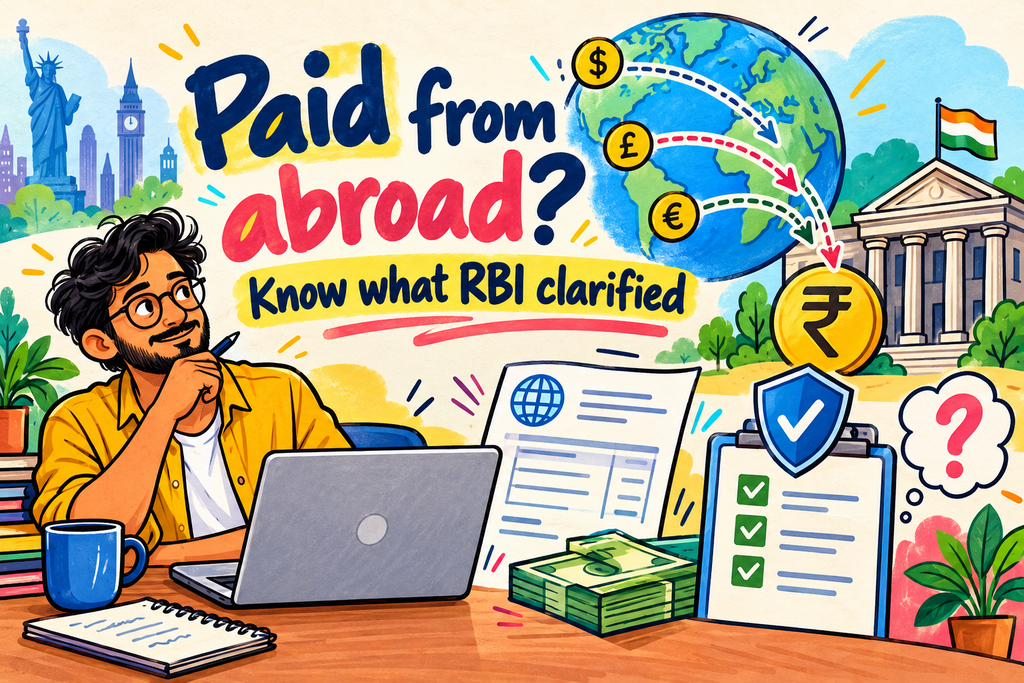
The Reserve Bank of India has tried to calm confusion over the foreign-exchange reporting rules that took effect on 1 October 2026. But freelancers should not read the clarification as a blanket exemption.
At its 7 October monetary-policy press conference, the RBI said transactions of a personal nature are outside the reporting requirement and that banks and authorised dealers—not individuals—will operate the EDPMS and IDPMS reporting systems. It also said an FAQ would follow. That clarification is helpful, but the written regulations still contain specific duties for service exporters.
What the written rule says
The Foreign Exchange Management (Export and Import of Goods and Services) Regulations, 2026 were issued on 13 January 2026, amended through 22 September 2026, and came into force on 1 October 2026.
Under Regulation 3, an exporter of services must generally submit an Export Declaration Form (EDF) stating the full export value within 30 days from the end of the month in which the invoice was raised. One EDF may cover all service exports for a month. For non-software services, the form may instead be submitted on or before the date the payment is received.
The authorised dealer—normally the bank handling the foreign payment—is then responsible for entering the service-export details in EDPMS.
What the ₹10 lakh relief actually does
For an export invoice of up to ₹10 lakh, or the foreign-currency equivalent, the bank may close the EDPMS entry using the exporter’s declaration that payment has been realised. The exporter may also give these declarations quarterly for bulk closure.
This limit applies per invoice, not to the freelancer’s annual income. More importantly, the provision is about closing an EDPMS entry. It should not automatically be treated as an exemption from every declaration or documentation requirement.
A Moneycontrol report published on 8 October 2026 at 10:20 IST and a New Indian Express report published on 7 October 2026 describe the RBI’s press-conference clarification. The RBI said individuals are not required to report transactions of a personal nature and cited tutoring or small software services among its examples. It also said banks and authorised dealers would handle system reporting.
Why the clarification still leaves an important question
The practical boundary between a “personal-nature” transaction and a business or professional service export is not yet fully explained in the written regulations. A person receiving an occasional overseas tutoring payment may look different from a consultant issuing regular invoices to several foreign clients, even if both work as individuals.
Until the promised RBI FAQ is published, it is safer not to assume that every payment received by an individual is personal, or that an invoice below ₹10 lakh needs no action.
Two simple examples
Example 1: a regular freelance designer. Anita raises three invoices in October for overseas clients. Each invoice is below ₹10 lakh. She should retain the invoices and payment records, contact the forex or trade-services desk of her authorised dealer, and ask how the bank wants the EDF and self-declaration submitted. The rules allow a single EDF for the month and quarterly bulk declarations for closing small-invoice entries, but the bank’s process may vary.
Example 2: occasional online tutoring. Ravi receives one small payment from a family abroad for a few tutoring sessions. The RBI’s press-conference example suggests that some such individual activity may be treated as personal in nature. Ravi should still ask his bank for written confirmation until the RBI’s FAQ defines the boundary more clearly.
A practical checklist for freelancers
- Do not ignore the transaction. Ask the authorised dealer bank that receives the foreign payment whether it treats your activity as personal or as a service export.
- Speak to the right team. A normal branch counter may not know the process; ask for the forex, trade-services or compliance desk.
- Keep clean invoices. Record the client’s name and country, invoice date and number, service description, currency and amount.
- Track the deadline. If the EDF applies, the standard deadline is 30 days from the end of the invoice month. Non-software exporters also have the payment-date option described above.
- Track collection. Export proceeds generally must be realised and repatriated within nine months from the service-invoice date. If invoiced or settled in rupees, the written rule gives twelve months. The bank may extend the period for reasonable cause.
- Ask for the bank’s SOP. RBI requires authorised dealers to publish the main features of their internal policy and standard operating procedure.
- Keep tax compliance separate. FEMA reporting does not replace income-tax or GST obligations. Ask a qualified professional if your facts are complex.
The bottom line
The RBI’s clarification reduces the fear that every individual must directly navigate a central reporting portal. But it does not justify throwing away invoices or assuming that all overseas freelance income is exempt from documentation.
For now, the sensible approach is simple: keep complete records, contact the authorised dealer’s forex team, use the small-invoice declaration where applicable, and watch for the RBI’s promised FAQ.
This article explains the rules for general awareness and is not legal, tax or investment advice. Bank procedures can differ, and the RBI’s forthcoming FAQ may provide additional clarification.