
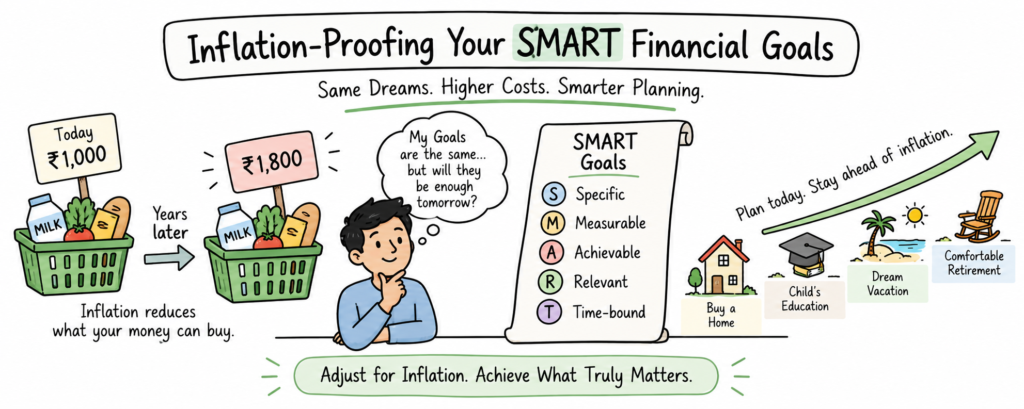
A plain home cooked vegetarian thali cost about ₹28.40 in June 2026. Roti, rice, dal, a few vegetables, curd and salad. That is the rating agency Crisil’s number, worked out every month from what the ingredients actually cost across north, south, east and west India.
A year earlier the same plate cost about 5% less. Keep that going for twenty years and the same thali costs about ₹75.
Nothing about the meal changed. Same roti, same dal, same amount of food. Only the price moved.
This is the part of goal planning that people skip, and it is the part that decides whether the plan works. In turn a distant goal into a monthly number the advice was to use today’s prices and adjust for price rises later. This is later.
Your goal is priced in the wrong rupees
Take Meena from that article. Her daughter is 6. College starts in about 12 years, and a course she would be happy with costs ₹25,00,000 today.
She will not pay ₹25,00,000. She will pay whatever it costs in twelve years. At 5% a year that is ₹44,89,641. The goal did not get bigger. The rupee got smaller.
Here is the same ₹25,00,000 course, twelve years out, at different rates of price rise.
- At 5% a year, about ₹44,90,000
- At 6% a year, about ₹50,30,000
- At 8% a year, about ₹62,95,000
- At 10% a year, about ₹78,46,000
Look at the spread. The rate you assume for price rises changes the goal by more than thirty lakh. It is not a detail at the end of the sum. It is one of the two or three numbers that matter most.
Where the “just double it” rule comes from
A common shortcut says to double today’s cost for a goal about ten years away. It is a reasonable rough guess, and it is worth knowing what it assumes.
Doubling in ten years needs prices to rise about 7% a year. At 5% a year, doubling takes about fourteen years instead. So the rule quietly assumes 7%, which is higher than the general rate of price rises in India has been recently, and lower than what many families see on school fees and hospital bills.
Use it if you want a quick answer. Do not use it for the goal that actually matters.
Not everything rises at the same speed
The headline inflation number you see in the news is an average across a basket of things the average household buys. In July 2026 that figure was 4.45%, which was a nineteen month high. The Reserve Bank aims to keep it near 4%.
Your life is not the average basket. The thali went up 5% over the same sort of period, and the non vegetarian version went up 6%. School fees, college fees and medical treatment have generally climbed faster than the headline number, which is why families who plan using the headline number often find themselves short.
So use a rate that matches the thing you are buying, not the thing the news is reporting.
- Everyday living costs. The general figure is a fair starting point.
- Education. Assume more than the general figure. Better still, ask the actual college what their fee was five years ago and work out the rate yourself.
- Medical care. Assume more again. This is the one that ruins retirement plans, because it arrives late in life when you have stopped earning.
That second suggestion is worth doing once. Two real fee figures five years apart tell you more about your own goal than any national average ever will.
The number that actually matters
Here is the idea that makes all of this simpler.
If your money grows at 11% a year and prices rise at 5% a year, you are not 11% better off. You are about 5.7% better off in terms of what you can actually buy. That gap between growth and price rises is the only part that builds real wealth. People call it the real return. It is the number your plan lives or dies by.
Most people subtract, and say 11 minus 5 is 6. Close enough for a rough answer, and it is slightly optimistic. The honest figure is a little under 6.
Now the uncomfortable part. What growth should you assume?
You will constantly hear that Indian shares return 12% to 15% a year over the long run. The Nifty 50 started in November 1995. Its actual growth since then, to the end of the 2026 financial year, works out to about 10.59% a year. Its growth measured over the most recent twenty year stretch has just fallen below 10%, only the second time that has happened in the index’s roughly thirty year history.
So what does that leave, after prices rise at 5%?
- Assume 15% growth, and you are planning on 9.5% real. Almost certainly too hopeful.
- Assume 12% growth, and you are planning on 6.7% real.
- Assume 10.59% growth, what actually happened, and you are planning on 5.3% real.
Planning a twenty year goal on 9.5% real when the honest figure is closer to 5% is not optimism. It is a shortfall you have agreed to discover late.
Two ways to do the sum, and the catch in the second one
Back to Meena. Twelve years, ₹25,00,000 today, prices rising 5%, money growing 11%.
The first way. Raise the goal to what it will really cost, ₹44,89,641, and work out the monthly amount at 11% growth. That comes to ₹15,125 a month, every month, for twelve years, never changing.
The second way. Leave the goal at ₹25,00,000 in today’s money and use the growth after price rises, 5.7%. That comes to ₹12,123 a month, which is about 20% less and much easier to start.
Both are correct. But they are not the same promise, and this is where people go wrong.
The second number is in today’s rupees. It only works if you raise it by 5% every year. Meena starts at ₹12,123 and by the final year she is putting away ₹20,735 a month. Run that through, and she finishes with about ₹44,83,000, which is the goal. Take the lower number and never raise it, and she misses badly.
So pick whichever suits you. A flat amount you never think about again, or a smaller start that you increase each year as your salary grows. The second usually fits a salaried life better. Just do not take the smaller starting number and quietly skip the part where it goes up.
What ignoring this actually costs
Suppose Meena does what most people do. She takes today’s price of ₹25,00,000, works out the monthly amount at 11% growth, and gets ₹8,422 a month. It looks manageable. She sets it up and feels organised.
Twelve years later she has ₹25,00,000, exactly as planned. The fee is ₹44,89,641.
She is short by nearly ₹20,00,000. That is 44% of the goal, missing, in the year she needs it. She did not make a bad investment. She did not stop the transfer. She planned in the wrong rupees for twelve years, and there is no way to fix a gap that size in the final year.
The wrong way to close the gap
When the honest number turns out to be ₹15,125 and you can manage ₹9,000, there is a tempting fix. Change the growth assumption. Put 15% in the box instead of 11% and the monthly figure drops to something you can afford.
Nothing has changed except the spreadsheet. The college still costs what it costs. All you have done is move the shortfall somewhere you cannot see it, and you will meet it again in the year your daughter needs the fees.
The honest choices are the same three as before. Give the goal more time. Make the goal smaller. Or save what you can now and raise it as you earn more. Choosing one of those beats a comfortable number that was never true.
What to do this week
- Take your largest goal and write down what it costs today.
- Pick a rate for price rises that matches that thing, not the headline figure. For fees, ring the institution and ask what it cost five years ago.
- Work out what it will cost in the year you need it. That, not today’s price, is your goal.
- Use a growth figure you can defend. If you are unsure, use less rather than more.
- Redo the monthly number, and put a yearly reminder to raise it.
For retirement, which is the goal where all of this matters most and where people are furthest out, the retirement calculator does the whole thing in one place. It takes what your month costs today, applies the rate of price rises you choose, and tells you what you need saved and what to put away from next month.
None of this makes your goal cheaper. It just means the number you are aiming at is the real one, so you find out now instead of in the year the bill arrives.
The thali will cost what it costs. You may as well plan for it.
This article is for learning. It is not personal advice about your money. The thali cost is Crisil’s Roti Rice Rate for June 2026 and the inflation figure is the official consumer price index for July 2026. The Nifty figures are past growth to the end of the 2026 financial year, and past growth is not a promise about the future. Every rate used above is an example chosen to show how the sum works, not a forecast. Money that can grow can also fall in value. For advice about your own situation, speak to a SEBI-registered investment adviser.