
Once you decide to buy term insurance, one question stops most people. How much cover should I take?
Fifty lakh sounds like a lot. One crore sounds like a very big number. Two crore feels greedy. So people pick whatever the agent suggests, or whatever sounds about right. There is a better way. It takes about fifteen minutes and a piece of paper.
1. Why the Common Answers Are Weak
You will often hear a simple rule. Take cover of ten times your yearly income. If you earn twelve lakh a year, take one crore twenty lakh.
It is easy to remember. It is also a guess.
Think about two people who both earn twelve lakh a year.
The first is 30 years old. He has a young child, a home loan of forty lakh, and almost no savings. The second is 50 years old. Her children are already working, her loan is finished, and she has a crore saved.
The rule gives them both the same answer. Their situations are not remotely the same.
The rule ignores your loans. It ignores what you have already saved. It ignores how many years your family would actually need help. Those three things matter far more than your salary.
Use the rule as a rough check at the end. Do not use it as your answer.
2. The Method That Works
You are trying to answer one question. If I were not here, how much money would my family need?
Add up three things. Then subtract one thing.
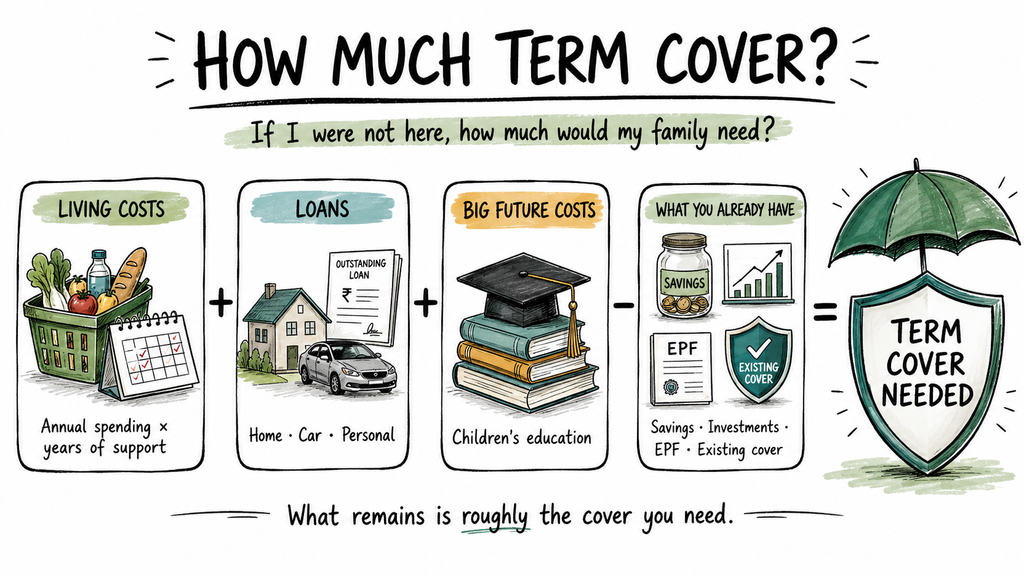
That is the whole method. The only part that needs explaining is the first line.
3. Working Out the Living Costs
Start with what your household spends in a month. Not what you earn. What you actually spend. Now take away the part that was only for you. Your travel to work. Your phone. Your clothes. If you were not there, that spending stops. What is left is what your family would still need every month. Multiply it by twelve to get a year.
Then ask how many years they would need that support. There is no perfect answer, but two simple ways to pick a number.
- Count the years until your youngest child finishes studying and can earn.
- Or count the years until your husband or wife would reach about sixty.
Take the larger of the two. Multiply the yearly figure by that many years.
One honest note here. Prices rise every year, so your family would need more money later than they do today. But the money would also be sitting in a bank or safe investment, earning something. For a simple estimate, we are ignoring both. They roughly cancel each other out. This is not exact. It does not need to be. You are trying to get close to the right number, not to the last rupee.
Guessing the education cost
Education is the other number people struggle with, because it sits far in the future. Start with what the course costs today. Pick a college you would actually be happy for your child to attend, and find out this year’s fees. Then allow for prices rising, because education in India has become a lot more costly, quite fast. A simple, rough approach is to double today’s fee if your child will start in about ten years.
If doubling feels like a wild guess, here is something better. Ask a college what their fees were ten years ago, and compare that with today. That one question will tell you more about what is coming than any general rule.
4. A Full Example
Here is Rajesh. He is 35. He is married, with two children aged 5 and 9. His household spends about ₹50,000 a month. Of that, roughly ₹10,000 is spending only on him. So his family would still need about ₹40,000 a month, which is ₹4,80,000 a year. His youngest is 5. Rajesh thinks that child will be earning at about 25. So the family needs support for around 20 years.
Now the full sum.
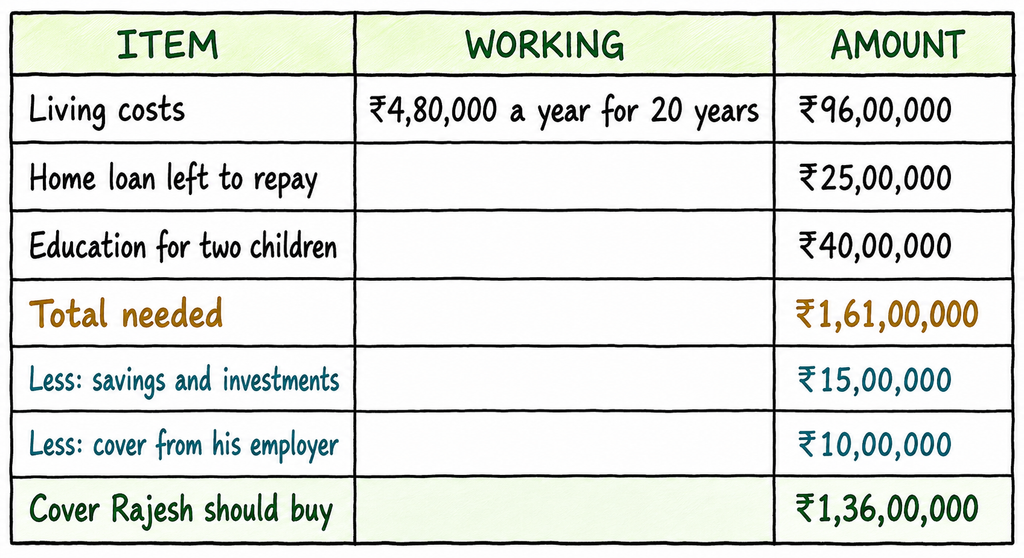
Rajesh rounds up and takes one and a half crore. Notice how far this is from the simple rule. Rajesh earns about ₹9,00,000 a year. Ten times that would be ninety lakh. His real answer is forty-six lakh higher than that, because of the loan and the children.
People are usually surprised by the size of the number. They are then surprised again by the price, because term cover of this size costs far less than most people expect. Get a few quotes online before you decide the number is impossible.
What if you cannot afford that much
Sometimes the honest answer really is that the full amount is out of reach right now. That is common, and it is not a reason to give up. Buy what you can afford today. Half the right cover is enormously better than none. Your family would still have something to fall back on. If you have to choose what to protect first, start with the loans. A home loan does not disappear when you do. Your family would be left with the debt and without your salary, which is the worst combination of the two. Then add more cover later, when you earn more. You can hold two policies at the same time. There is nothing wrong with buying fifty lakh now and another crore in three years.
The mistake to avoid is deciding that because you cannot do the whole thing properly, you will do nothing at all. That leaves your family with zero, which is the one outcome this exercise exists to prevent.
5. Things People Forget
Five mistakes come up again and again.
- Counting on cover from the employer. Rajesh subtracted his ten lakh of office cover, which is correct today. But that cover ends the day the job ends. If he changes jobs or is asked to leave, it goes with him. Treat it as a bonus, not as your main protection.
- Forgetting the person who runs the house. A homemaker earns no salary, but her work has a real money value. Without her, somebody has to be paid to look after the children, cook, and manage the home. That cost is real, and it is worth covering.
- Counting the house you live in. It is worth a lot on paper. But your family has to live somewhere. They cannot spend it, so do not subtract it.
- Working it out once and never again. A new child, a new loan or a big jump in salary all change the answer. Check it again when your life changes.
- Taking far more than you need. Cover is meant to replace what you would have provided. It is not meant to make anyone rich. Extra cover just costs you money every year for no reason.
Sit down tonight with a piece of paper. Write your monthly spending. Take away what is only for you. Multiply by twelve, then by the years your family needs support. Add the loans. Add the education. Take away what you already have. Round the answer up to a neat figure. That is your number.
If you have not yet read about which kind of policy to buy, start with term insurance without the sales pitch. Then buy the cover, tell your family where the papers are, and get on with your life.
This article is for learning. It is not personal advice about your money, and it is not a recommendation of any company or policy. The example is made up to show how the method works. Your own answer depends on your family, your loans, your savings and your plans. For advice about your own situation, speak to a SEBI-registered investment adviser or a qualified insurance professional who does not earn a commission on what they suggest.