
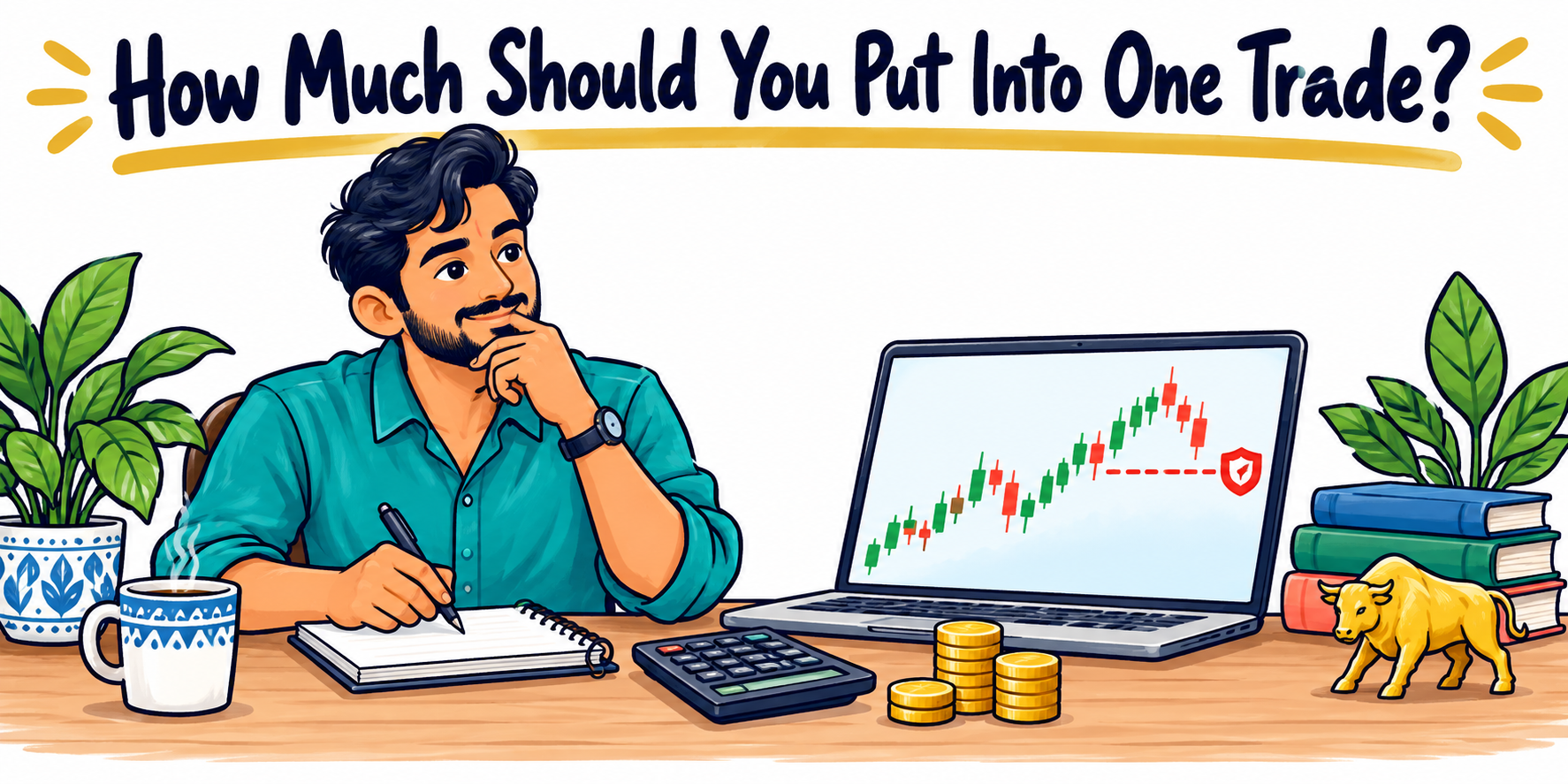
A share looks attractive at ₹250. You have ₹50,000 in your trading account. Should you buy 200 shares? The money available is only one part of the decision. First ask how much you could lose if this trade goes wrong.
Try the Trade Risk Calculator. It uses just three numbers: your planned loss limit, buying price and stop-loss price. It is for buying ordinary shares, not futures, options or trades where you sell first.
Start with a loss amount you can live with
Suppose you decide to keep the planned price loss within ₹500. This is money you can afford to lose without touching rent, EMIs, school fees or emergency savings. ₹500 is an example, not a suitable limit for everyone. If even that loss would hurt your household, the sensible trade size may be zero.
Your planned buying price is ₹250. You would exit if the price fell to ₹240. A stop-loss is an instruction intended to help you exit when the price moves against you. It does not guarantee the price you receive.
Work out the loss on one share
The difference between ₹250 and ₹240 is ₹10. If you bought one share and sold it at ₹240, the price loss would be ₹10, before charges.
₹500 ÷ ₹10 = 50 shares. Buying 50 shares at ₹250 needs ₹12,500, before charges. If all 50 sell at ₹240, the price loss is ₹500. The purchase amount and the planned loss are different numbers.
Now suppose the same buying price has a planned exit at ₹230. The difference is ₹20 per share. Keeping the same ₹500 price-loss limit gives 25 shares, costing ₹6,250. A bigger gap to your exit means fewer shares for the same planned loss.
Round down, never up
If your loss limit is ₹500 and the difference per share is ₹12, the calculation gives 41.67. You cannot buy a fraction of an ordinary share on the exchange. Round down to 41. The planned price loss is ₹492. Buying 42 would put it at ₹504, above your chosen limit.
Check whether you can pay for those shares
A small difference between buying and exit prices can produce a very large share count. That does not mean you can afford the purchase. If the calculator gives ₹60,000 of shares but you have only ₹20,000 available, reduce the quantity. Do not borrow simply to match the calculator’s number. Keep money aside for charges too.
Do not move the stop just to buy more shares
Choose an exit price for a reason in your trading plan. Moving it closer only to make the share count larger changes the plan. Moving it farther away after buying can increase the amount at risk. Read Position Sizing: Decide the Risk Before the Trade for the broader planning principles.
Your actual loss can still be higher
A share can jump below your planned exit price, especially between trading sessions. An order may also remain unfilled. If the 50 shares in our example sell at ₹235 instead of ₹240, the price loss is ₹750, before charges. Brokerage, taxes and other trading charges can add to what you pay.
NSE explains that a stop-loss order becomes active when its trigger price is reached or crossed. Its risk disclosure also explains that execution depends on available orders and that a limit order may not execute. Read Your Stop-Loss Price Is Not a Guaranteed Exit Price.
Several small trades can add up to one big risk
Five open trades with a planned loss of ₹500 each add up to ₹2,500 before charges and unexpected price moves. Shares from the same industry may fall together. Check the total amount at risk across your open trades, not just the new one.
The calculator helps you turn a loss plan into a share count. It cannot tell you whether a share is worth buying, predict a profit or make a trade safe. Use a smaller quantity if the purchase amount or possible loss makes you uncomfortable.
For education only. No share or return is recommended. Sources: NSE trading system and NSE risk disclosure.