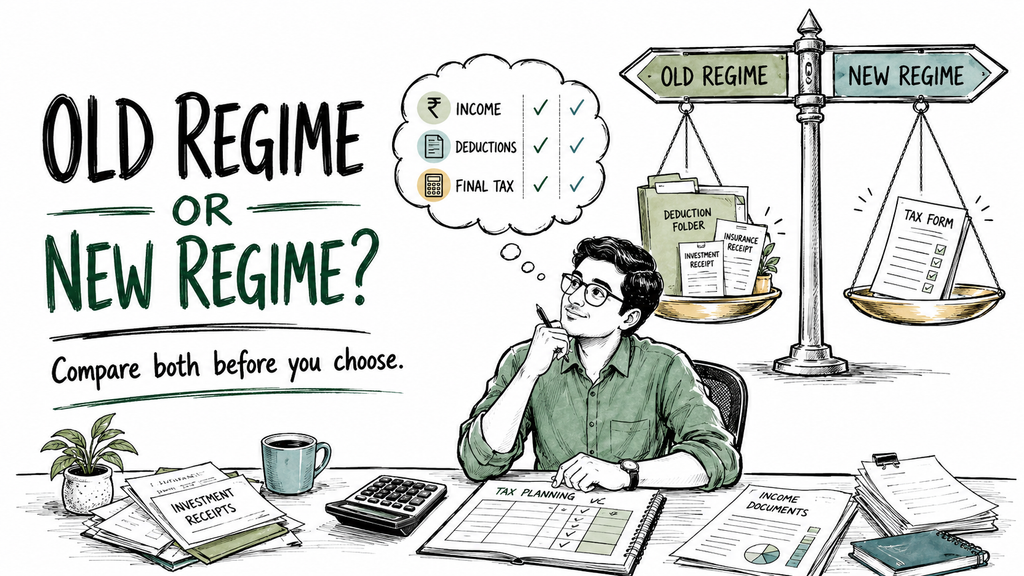
Every year your office asks which tax regime you want. Old or new.
Most people pick whatever they picked last year, or whatever a colleague says. That can cost you a lot of money in either direction. The choice is actually simple once you see what it turns on. This article shows the rates for this year, and gives you one number to check.
1. What the Two Regimes Are
They are two different sets of rules for taxing the same income. You pick one.
The old regime has higher tax rates that start at a lower income. But it lets you subtract a great many things before the tax is worked out. Your provident fund, life insurance premiums, health insurance, house rent, home loan interest, and more.
The new regime has lower rates and a much higher starting point. But it lets you subtract almost nothing.
So it is a straight trade. Lower rates, or more things to subtract. One thing to know before anything else. The new regime is now the default. If you tell your office nothing at all, you are in the new regime.
2. The Rates for This Year
These are the rates for tax year 2026-27, which runs from April 2026 to March 2027. The Budget in February 2026 left them unchanged from last year.
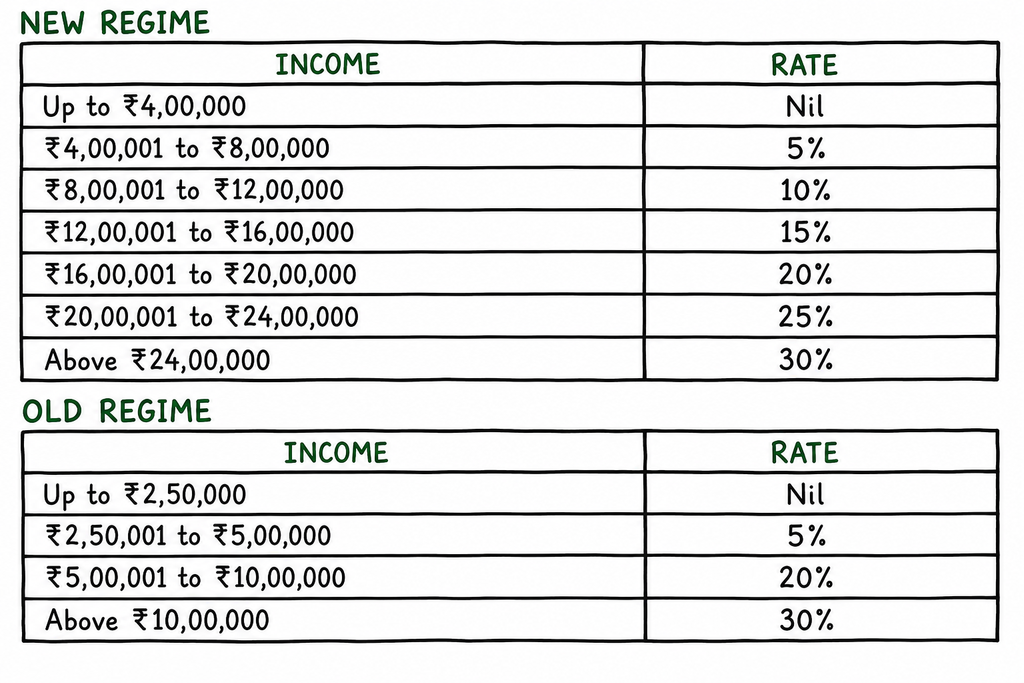
Salaried people also get a standard deduction, which is subtracted before any of this. It is ₹75,000 in the new regime and ₹50,000 in the old one. A further 4% cess is added on top of whatever tax comes out.
The number most people should know
There is a rebate in the new regime that wipes out the tax entirely if your taxable income is ₹12,00,000 or less. Add back the ₹75,000 standard deduction, and it means this.
A salary of up to ₹12,75,000 pays no income tax at all under the new regime.
Not reduced tax. No tax. If you earn below that, the new regime is almost certainly your answer, and you can stop reading and go and enjoy your evening.
3. The One Question That Decides It
If you earn more than that, the question is simple. How much can you actually subtract under the old regime?
Add up what genuinely applies to you. The usual items are these.
- Up to ₹1,50,000 for provident fund, PPF, life insurance premiums, ELSS funds and children’s school fees. This is now Section 123, though most people still call it 80C.
- Up to ₹50,000 more for the National Pension System.
- Health insurance premiums, for you and for your parents.
- House rent, if you pay rent and your salary includes an HRA component.
- Up to ₹2,00,000 of interest on a home loan for the house you live in.
Now compare your total against this table. The old regime only beats the new one if your deductions are larger than the figure shown.
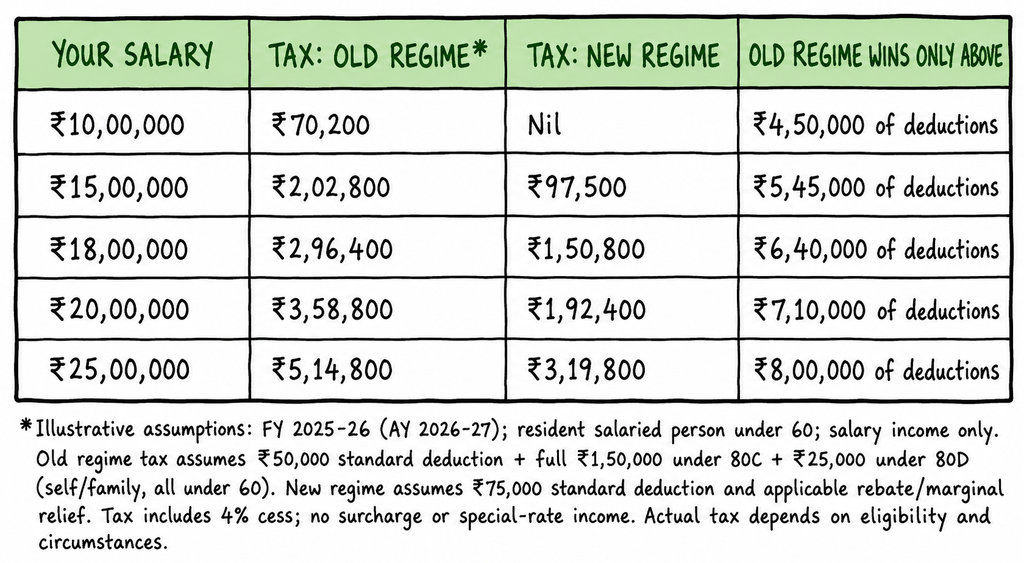
Those right hand numbers are large. That is the whole point of the table. A typical salaried person with no home loan and no rent claim reaches about ₹2,25,000. That is the full ₹1,50,000, plus ₹50,000 of NPS, plus ₹25,000 of health cover. It is nowhere near the break-even figure at any income level. To get past ₹6,00,000 you generally need both a home loan and a real rent claim, which not many people have at the same time.
4. Two People, Two Answers
Anil earns ₹14,00,000. He has no home loan. He claims the full ₹1,50,000, puts ₹50,000 into NPS, and pays ₹25,000 for health insurance. His deductions come to ₹2,25,000. Under the new regime he pays ₹81,900. Under the old regime he would pay ₹1,56,000. The new regime saves him ₹74,100. It is not close.
Kavita earns ₹18,00,000 and has almost everything. Rent claim of ₹2,40,000, home loan interest of ₹2,00,000, the full ₹1,50,000, and ₹50,000 of health cover for herself and her parents. Her deductions come to ₹6,40,000. Under the new regime she pays ₹1,50,800. Under the old regime she pays ₹1,51,320. After all of that, the two are within a few hundred rupees of each other. The new regime still just wins.
This surprises people, and it is the most useful thing in this article. Even a fairly loaded old regime claim now barely keeps up. Kavita would need deductions above about ₹6,42,000 before the old regime actually pays her back.
5. Practical Points
Five things worth knowing once you have decided.
- Tell your office in April. They ask at the start of the year so they can deduct the right amount each month. Say nothing and you get the new regime by default.
- Salaried people can change every year. Choosing one this year does not lock you in for the next. If you take a home loan next year, run the numbers again.
- Business income works differently. If you run a business or profession, moving back and forth between regimes is restricted. Get proper advice before you switch.
- Do not buy something only to save tax. A poor investment with a tax benefit is still a poor investment. This is how people end up with insurance policies they never wanted.
- Keep the paperwork. If you claim deductions, keep the receipts and certificates together through the year. Hunting for them in July is nobody’s idea of a good time.
That fourth point deserves a moment. For years the old regime quietly pushed people into buying things they did not need, every February, to fill up a deduction limit. If the new regime suits you, that pressure disappears entirely. You can then choose investments because they are good, which is the only sensible reason to choose one.
Work out your deductions honestly. Look at the table. Pick the regime that wins, and tell your office. Then check again next year, because your life will have changed even if the rules have not.
This article is for learning. It is not personal tax advice. The rates shown are for tax year 2026-27 and were correct when this was written, but tax rules change with every Budget. The Income Tax Act 2025 replaced the old 1961 law on 1 April 2026, so section numbers you may remember have moved. The examples are simplified and ignore surcharge, which applies at higher incomes. Your own position depends on your full income, your family and your investments. Please check current rules, or speak to a qualified tax professional, before making a decision.