
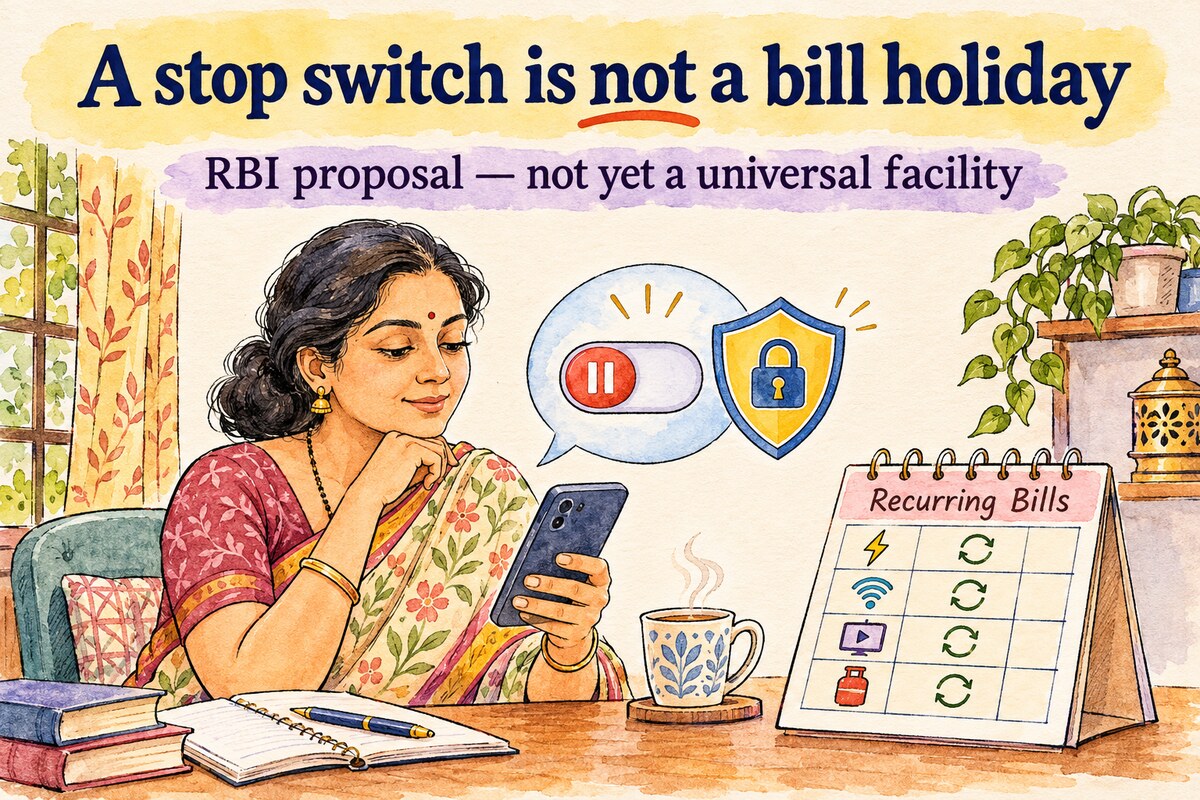
A banking safety button and a bill-cancellation instruction do different jobs. Confusing them could leave a family believing its payments have stopped when some are still due.
This is a proposal, not a universal facility available today. RBI released draft preventive safeguards on 23 November 2026, inviting comments until 14 December 2026. Separate drafts cover seven bank categories. The details below refer to the commercial-bank draft, not a final notification.
What the proposed switch would leave running
Under proposed paragraphs 76FF–76FH, a Stop Switch would disable future customer-initiated outward debits. It would also prevent new mandates, new standing instructions and UPI registration on new third-party apps. Inward credits would remain unaffected.
But existing recurring mandates and standing instructions are excluded, as are liens and bank-initiated recoveries such as due charges and loan instalments. It is therefore not a blanket freeze or a way to cancel a repayment obligation.
One family, two separate decisions
Consider a fictional household with ₹60,000 in its account, a ₹19,000 loan instalment and a ₹4,000 recurring payment coming up. Its safety question is: “How do we stop an unwanted new transfer?” Its budgeting question is different: “Which existing payments remain scheduled?”
If the proposed switch were implemented on these terms, the family should not treat the entire ₹60,000 as untouched spending money merely because it activated the switch. The ₹23,000 of scheduled payments needs its own review. These are illustrative amounts, not a bank product or a guarantee about debit timing.
Make a payment map, not an assumption
Before relying on any bank safety control, ask the bank what it actually blocks and how to restore access. Separately list recurring debits, their dates and the institution that must receive any cancellation request. Keep a note of changes and confirmations. A payment-control screen is not a substitute for understanding each underlying obligation.
The draft proposes customer authentication and risk-based cooling or other safeguards for re-enabling access. Its main proposed commencement is 1 July 2027, with earlier bank implementation possible; certain bank-negligence provisions have a proposed 1 January 2027 date. Neither is a confirmed final implementation date.
Checked 28 November 2026. Follow the final RBI directions and your bank’s actual implementation before relying on a new facility. General financial education, not personalised advice.