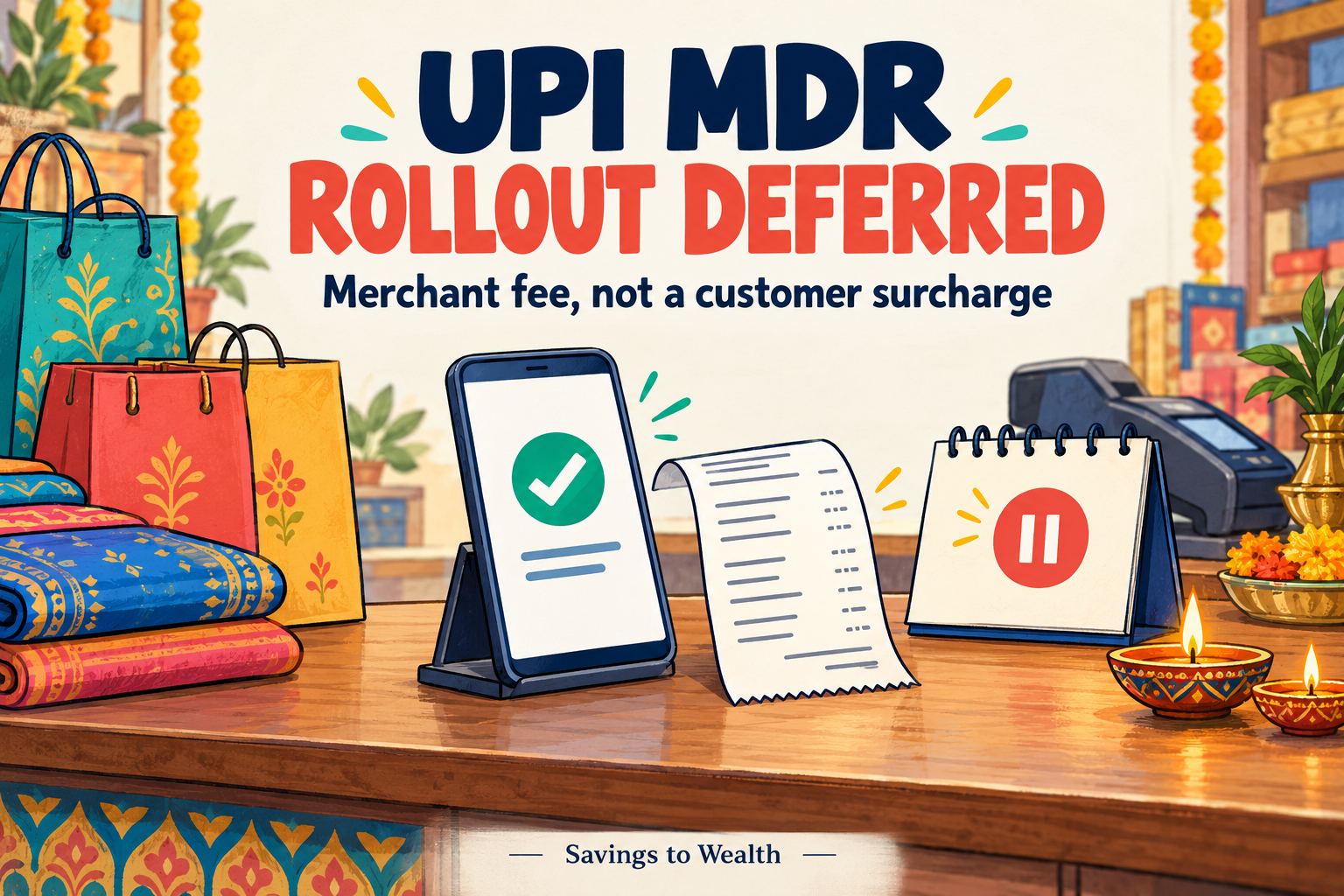
If a message says a new UPI charge starts on 15 October, check the date of the announcement behind it. NPCI’s 13 October 2026 notice moved the rollout of MDR on selected merchant transactions to immediately after Diwali, with the starting date to be notified separately.
For a household, there is a second distinction that matters just as much: a merchant’s payment-processing cost is not automatically an extra amount you owe at checkout.
The September date is not the latest instruction
The official MDR FAQs dated 15 September 2026 originally specified 15 October 2026 as the effective date in question 5. That is the source of the date still circulating in older explainers.
The later NPCI announcement dated 13 October 2026 changes the timing. It says the UPI and Services Steering Committee decided on implementation immediately after Diwali, with a separate notification to supply the date. The notice does not give a replacement calendar date.
Deferred is not cancelled. Nor should “after Diwali” be converted into an invented start date. Before applying the framework in future, look for the subsequent official notification rather than relying on a festival date or a forwarded screenshot. These sources were checked on 15 October 2026.
MDR is not a new tax on the shopper
MDR means Merchant Discount Rate: a payment-acceptance charge within the merchant ecosystem. The Finance Ministry’s clarification, published 15 September 2026 at 6:45 pm, says it is neither a tax nor a government or NPCI collection. It also distinguishes it from a charge on customers making UPI payments.
That clarification says banks have been advised to ensure merchants do not pass MDR to customers, and UPI application providers must not impose platform fees or hidden charges on UPI payments. Person-to-person transfers remain free under the announced framework.
The September FAQs describe a 0.4% merchant rate for eligible person-to-merchant payments above ₹2,000, with exemptions and category-specific provisions. That headline rate is not a universal customer tariff—and the rollout has since been deferred. There is no reason to add 0.4% to a household shopping budget merely because an old message names 15 October.
Check an unexplained addition, not just the percentage
Suppose a shop quotes ₹6,000 for a purchase, then asks for another ₹24 described as “new UPI MDR”. The arithmetic is correct: 0.4% of ₹6,000 is ₹24. The arithmetic does not establish that you owe it. This is a hypothetical receipt check, not a reported incident or a quotation of current merchant charges.
Ask what the extra line represents and request an itemised bill. Is the total the agreed purchase price, or has an additional payment-related amount appeared? A product price, applicable tax and a separately described service charge should not simply be assumed to be the same thing as MDR.
If the explanation is that NPCI has ordered customers to pay a new 0.4% fee from 15 October, ask for the current official notice. Keep the bill and payment record if you need to query the transaction through your bank or payment app’s official support channel. Do not treat a stranger’s message or search advertisement as customer support.
A small habit for future payment-rule changes
Save the source, its publication date and its effective date together. When a newer notice changes one of them, update the old note instead of keeping both as though they are equally current.
For this change, the useful household takeaway is simple: the merchant-fee rollout was deferred; the older date is not proof of a customer surcharge.
Scope and caveat: This article concerns the announced UPI MDR framework and ordinary household UPI payments. It does not determine every fee associated with a credit card, wallet, credit facility or a separately supplied service. Check the actual payment method and the provider’s applicable terms rather than assuming every checkout charge is MDR. No particular refund or dispute outcome is promised.