
If you work in the United States for one of the named technology companies—Microsoft, Adobe, Cognizant, Infosys, TCS, Wipro, HCLTech and Capgemini—the immediate question is where your immigration case stands. If you own its shares, the question is whether the policy changes its business prospects—and how much of your own wealth depends on it.
Reuters reported on 8 October 2026 that US officials announced a PERM suspension involving Microsoft, Adobe, Cognizant, Infosys, TCS, Wipro, HCLTech and Capgemini. Officials said new applications would not be accepted and pending applications would not be processed. They cited investigations and alleged abuse; allegations are not findings of guilt.
Information checked on 9 October 2026. This article relies on attributed reporting for the announcement and official US agency guidance for the general immigration framework. The company-specific notices, precise legal basis and end date were not available in the sources reviewed. Individual consequences need case-specific legal advice.
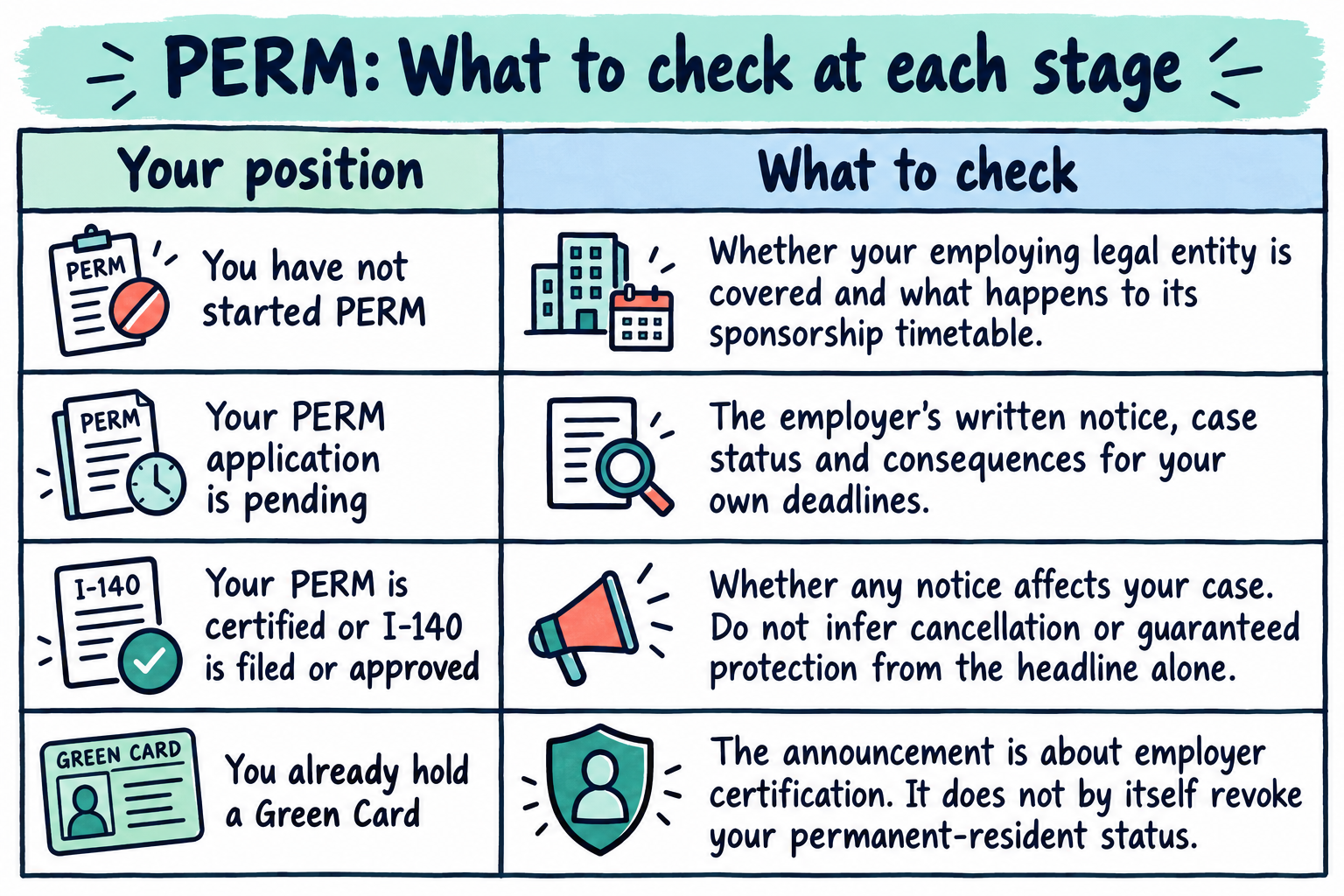
First, understand which part of your journey is affected
The US Department of Labor explains that employers normally obtain permanent labour certification before submitting the relevant employment-based immigration petition to USCIS. PERM tests the availability of suitable US workers and the effect on their wages and working conditions. The employer files it; the employee does not independently complete this stage.
A common route is PERM certification, followed by an I-140 petition and then a Green Card application when eligible. H-1B work status is a separate matter. Some immigration routes do not require PERM.
The reported action is not itself an announcement cancelling every existing H-1B visa or revoking existing Green Cards. But a valid work status today does not remove the need to review tomorrow’s deadlines.
If you work in the US, make a deadline sheet
Write down your I-94 expiry, petition validity, time used in H-1B status, PERM filing date, I-140 status and your dependants’ documents. Ask the employer’s immigration team for copies and a written assessment. These dates can matter more than the share-price reaction.
USCIS guidance on AC21 describes circumstances in which qualifying labour-certification or immigrant-petition milestones can support H-1B extensions beyond the usual six-year limit. Eligibility depends on the facts and timing. A delayed PERM case does not automatically mean you must leave, and an approved petition does not guarantee every future extension.
Before resigning, accepting a transfer or making international travel plans, ask a qualified immigration lawyer how the move affects your work authorisation and sponsorship. A new employer’s verbal promise is not an approved immigration filing.
Your household needs flexibility while the position becomes clearer
Consider reviewing large commitments such as a home purchase, a lengthy lease or education plans that assume uninterrupted US employment. This is a planning review, not a reason for every affected family to cancel its plans.
For example, suppose a family spends $5,000 a month on essentials and has $20,000 in accessible cash. That covers four months before legal fees, relocation, insurance gaps or travel. If an additional $6,000 must be reserved for those costs, the remaining $14,000 covers 2.8 months. The amounts are hypothetical; the lesson is to give transition costs their own place in the budget.
List what a change of job or country would require: health-cover continuity, lease obligations, children’s schooling, debt repayments and access to bank and investment accounts. Seek cross-border tax advice before selling assets or moving retirement money; immigration uncertainty alone does not determine the tax result.
If you own the stocks, separate the announcement from an earnings forecast
A restriction on sponsorship may create recruitment or retention difficulties. It does not directly establish a fall in sales, a particular margin loss or a fair-value reduction of the same percentage as a market decline. Those are possible channels to investigate, not measured outcomes.
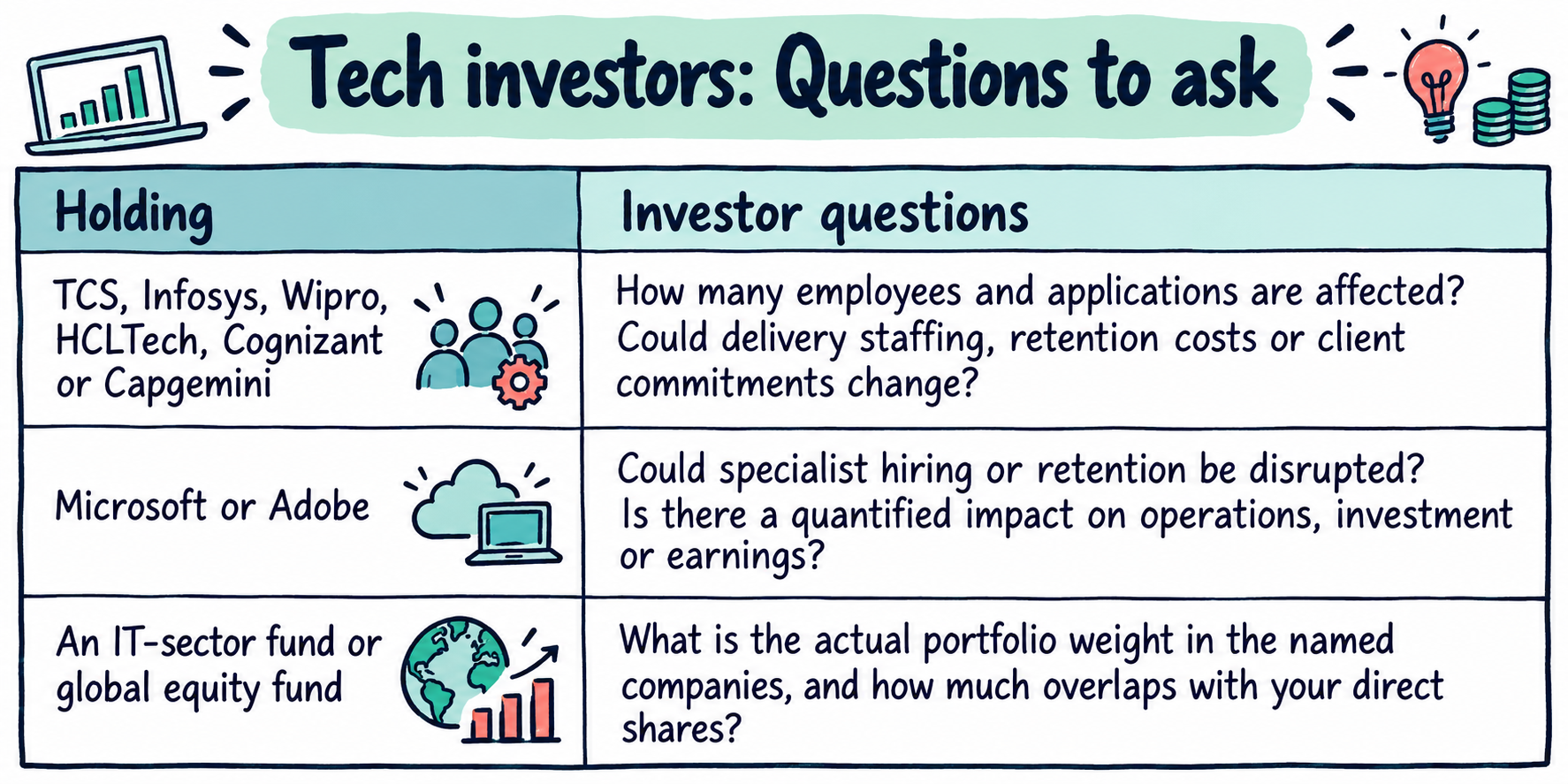
Watch company filings, earnings-call explanations, formal agency notices and court orders. Regional revenue percentages alone cannot measure dependence on PERM. Avoid treating an intraday price movement as proof of permanent business damage.
If your salary and investments come from the same company
This deserves particular attention. A difficult employer development can affect your income, sponsorship expectations and employee shares at the same time.
Suppose your investments total ₹40 lakh, including ₹10 lakh of employer stock. That is 25% in one company before counting exposure through funds. If those shares fall 20% and everything else stays unchanged, the portfolio loses ₹2 lakh, or 5%. This arithmetic illustrates concentration; it is not a prediction of any named stock’s return.
Review vested shares, fund holdings and money needed soon together. Diversification decisions should reflect taxes, dealing restrictions and your financial goals rather than a hurried response to one headline.
A practical next step for each reader
If you are an affected employee, obtain a written case assessment and update your household contingency budget. If you are a shareholder, measure portfolio exposure and wait for evidence about business consequences. If you are both, assess these risks together.
The same announcement can be urgent for a worker near an immigration deadline and much less decisive for a diversified investor. Your response should match your own exposure.
Educational information only, not personalised immigration, legal, tax or investment advice. Examples are hypothetical. Scope and implementation may change as formal notices and legal proceedings become available.