
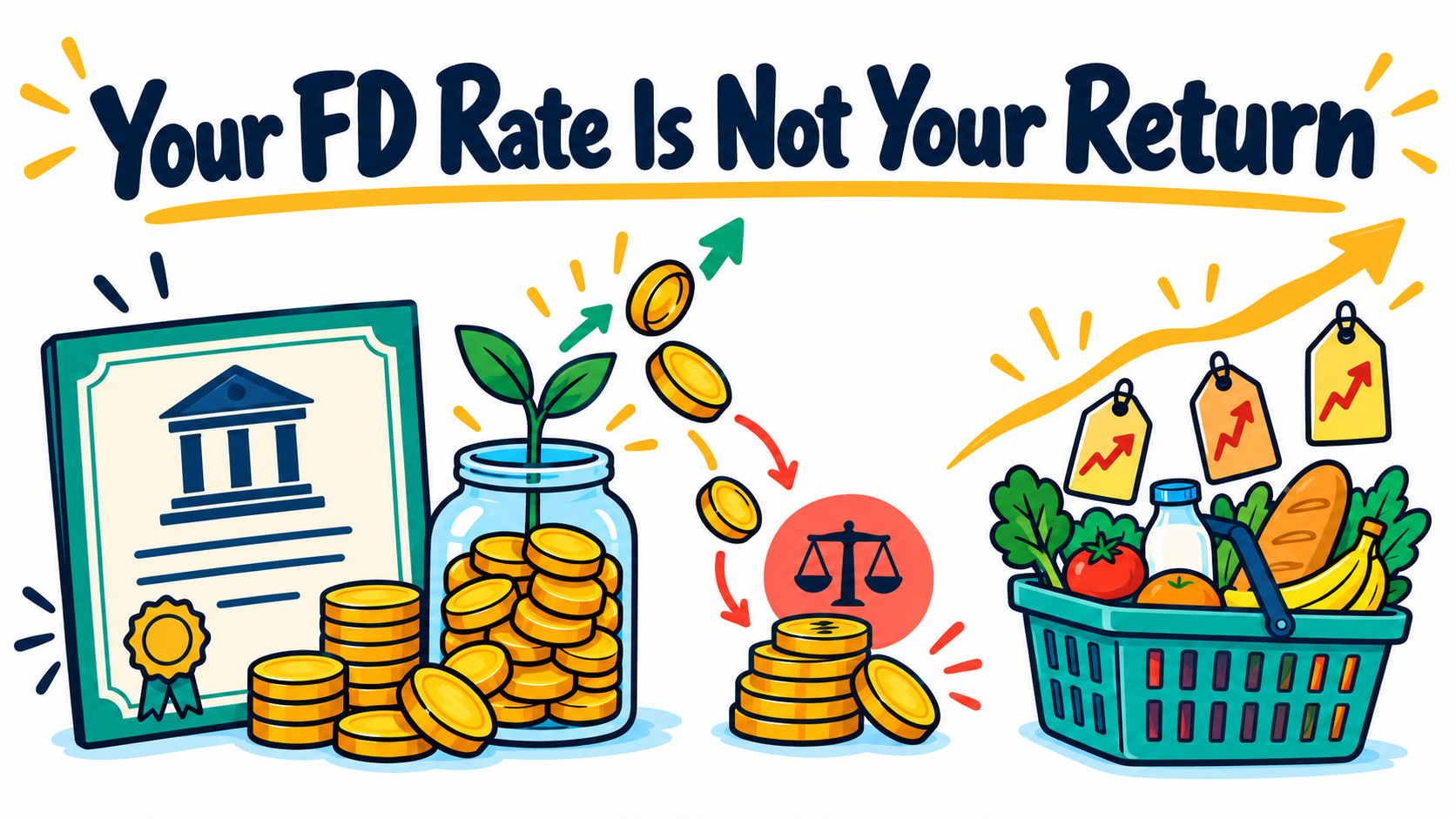
A bank offers 7% on a fixed deposit. It is tempting to read that as “my money will become 7% more useful.” The bank is quoting interest. What you keep after tax, and what that money can buy after prices rise, are different questions. An FD can still be useful. You simply need to judge it using the right number.
Start with the interest you actually receive
Suppose you put ₹1,00,000 in an FD for one year and it earns exactly ₹7,000. Your money becomes ₹1,07,000 before tax. This example assumes a 7% return over that year, with no early withdrawal. It is not a live bank offer.
The advertised rate and the maturity amount are not always the same calculation. Some deposits add interest back to the balance during the year, so later interest is earned on a larger amount. Others pay interest out regularly. Ask the bank for the maturity amount, payment schedule and calculation method. If interest is paid to your savings account, count it there too; it has not disappeared.
Tax changes what you keep
Assume the final tax attributable to that ₹7,000 interest is ₹1,400. You keep ₹5,600, so your gain after tax is 5.6% of the original ₹1 lakh. The 20% used here is only an example of an effective tax rate on this interest, not a claim about your tax slab. Actual tax depends on your total income, applicable rules, deductions and other details, including cess or surcharge where relevant.
For an ordinary resident bank FD, interest is generally taxable. Special exemptions or deductions may apply in some circumstances. The Income Tax Department explains tax deducted at source: tax collected by the payer before money reaches you. This is commonly called TDS.
TDS is not necessarily your final tax. You may owe more, or qualify for a refund when you file your return. No TDS does not automatically mean no tax. Check the bank’s interest certificate and your tax records. For a deposit that runs across several years, do not assume all tax waits until maturity; get help on the correct year of reporting.
More rupees may still buy less
Now assume the things you buy become 6% more expensive over the same year. A basket costing ₹1,00,000 today would cost ₹1,06,000 next year. Your FD money after the assumed tax is ₹1,05,600. You have more rupees, but ₹400 less than the cost of that same basket.
In today’s buying power, ₹1,05,600 divided by 1.06 is about ₹99,623. That is a small loss of about 0.38% in buying power. Simply subtracting 6% from 5.6% gives a rough estimate; dividing by the price increase gives the more accurate answer. These are made-up assumptions, not a prediction of inflation or FD returns.
SEBI’s explanation of inflation describes how rising prices reduce what money can buy. Your own costs may rise faster or slower than a general inflation figure. School fees, rent and medical expenses do not necessarily move together.
That does not make an FD a bad choice
Money needed for a near-term payment may need stability and a known maturity date more than a chance of higher growth. An FD for a school-fee payment can serve a different purpose from money for retirement twenty years away. Moving short-term money into shares just to beat inflation can create a larger problem if markets fall before you need it.
Also check what happens if you break the FD early. The bank may apply a different interest rate or a penalty under its terms. Match the deposit period to when you need the money, and keep some emergency money accessible.
Compare like with like
When comparing deposits, use the same period, the same interest-payment choice and the same tax assumptions. Check the bank and its deposit-insurance status as well as the rate. DICGC’s guide says eligible bank deposits are insured up to ₹5 lakh per depositor per bank, including principal and interest, in the same ownership right and capacity. Accounts at different branches of the same bank are combined. A company deposit is not the same as an insured bank FD.
Before choosing, ask: how many rupees will I receive, how much tax should I allow for, and what will my planned expense cost then? The interest rate answers only the first part of that decision.
Educational content, not personal investment or tax advice. All example rates and amounts are assumptions. Check the deposit terms and current tax rules for your circumstances. Sources checked on 2 October 2026.