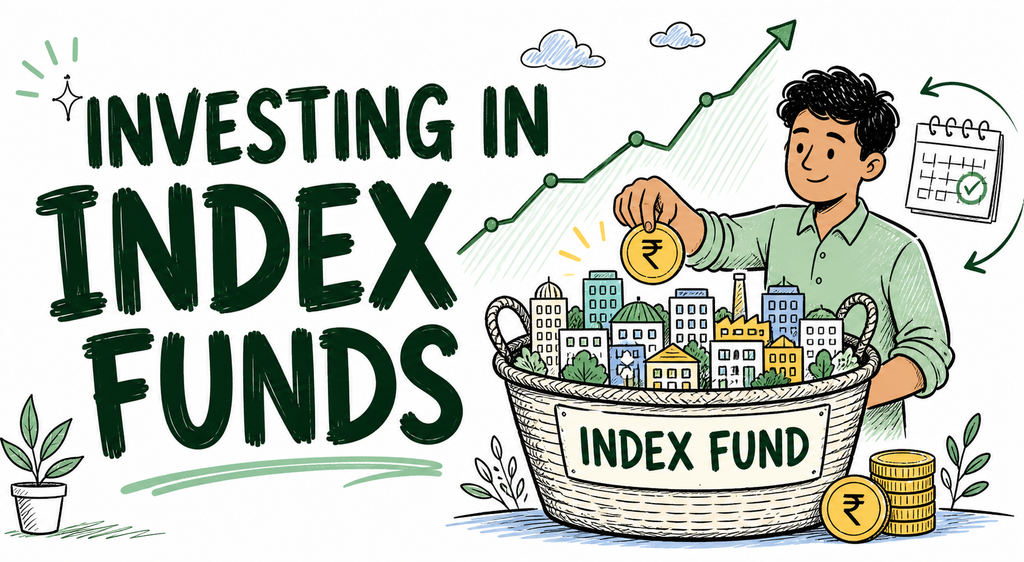
Money sitting in a savings account feels safe. It is not doing nothing, though. It is slowly losing. This is about the step after the savings account, and about one word on the fund page that costs people more than any other.
1. Your Savings Account Is Quietly Losing
Most large banks pay around two and a half to three per cent on a savings balance. Inflation in July 2026 was running at about four and a half per cent. Put those together and money in a savings account is going backwards by somewhere between one and two per cent a year. The number on your screen goes up. What it buys goes down.
One lakh left in a savings account for five years still shows a bigger number at the end. In terms of what it can actually buy, it is worth about ninety two thousand. Losing eight thousand rupees by being careful is a strange outcome, but that is what the sums say. None of which means empty the account. Your emergency fund belongs exactly where it is, and so does anything you need within about three years. This is about the money beyond that, sitting there because you have not decided what else to do with it.
2. What an Index Fund Actually Is
An index is just a list of companies. The Nifty 50 is a list of fifty large Indian companies. An index fund buys all of them, in the same proportions as the list, and does nothing else. Nobody is choosing which ones look promising. There is no manager backing a hunch. If a company drops off the list, the fund drops it too. That sounds unambitious, and it is the point. You are not trying to beat the market. You are buying the market and keeping your costs low while you do it. Because there is no research team to pay for, index funds are cheap to run. In India a plain Nifty 50 index fund commonly charges somewhere between about 0.05% and 0.20% a year.
An actively managed equity fund usually charges several times that, and has to beat the index by more than the extra cost before you are better off. Some do. Most, over long periods, do not.
3. The One Word That Costs You Most
Every mutual fund in India comes in two versions of the same thing. A direct plan and a regular plan. Same fund, same manager, same holdings, same returns before costs. The difference is that a regular plan pays a commission to whoever sold it to you, and that commission comes out of the fund every year, quietly, forever. It does not appear as a charge on a statement. It is simply taken off the returns before you see them. Half a per cent a year sounds like nothing. Over a working life it is not nothing.
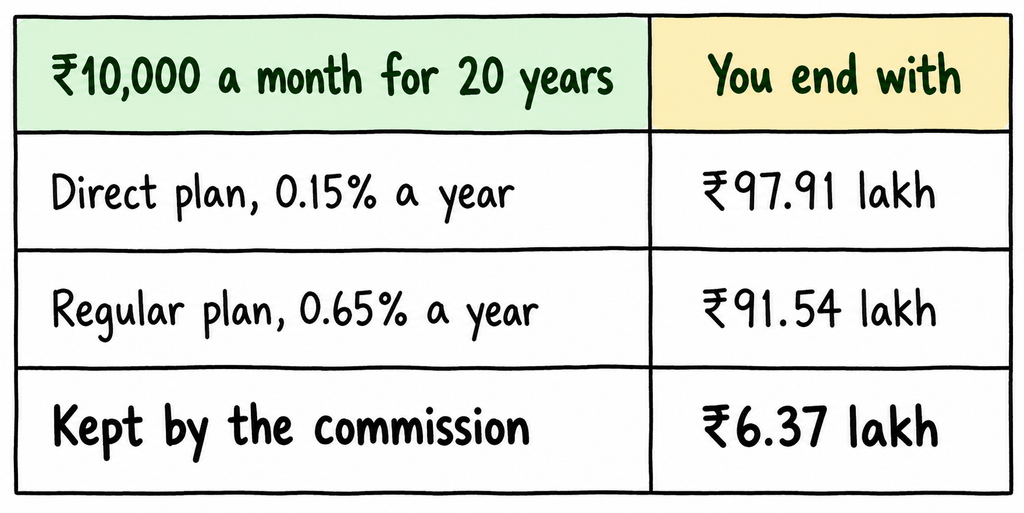
You invested twenty four lakh over those twenty years. The half per cent took six and a half lakh of the result. That assumes twelve per cent a year before costs, which is an assumption and not a promise. The gap between the two columns is the part that is certain. So check the word. If the fund name ends in Direct, you are in the cheaper version. If it does not say direct, it is regular, and someone is being paid.
Sometimes that is a fair trade. If a real adviser is guiding your decisions, they should be paid for it. What you want to avoid is paying a commission for advice nobody ever gave you.
4. What You Actually Need to Start
Less than people expect, and the list has not changed in years.
- A PAN card and completed KYC. KYC is a one time identity check. Once it is done with any fund house or platform, it works across all of them.
- A bank account in your own name. Money must come from and return to an account that belongs to you.
- Five hundred rupees a month. That is the usual minimum for a monthly plan. It is a real starting point, not a token one.
You do not need a demat account for mutual funds. That is for shares, and it is a common reason people think this is harder than it is. You can go straight to the fund house’s own website, which is always direct, or use a platform that offers direct plans. Both are fine. Platforms are easier when you hold funds from several houses. Be careful with anything free. If an app costs you nothing and sells you regular plans, you are paying through the expense ratio instead, every year you hold the fund.
5. Four Decisions, Then Leave It Alone
- Pick a broad index. Nifty 50 for the largest companies, or a broader market index. Skip the narrow ones for now.
- Check it says direct. Then look at the expense ratio and compare two or three funds tracking the same index.
- Set the date, not just the amount. A day or two after your salary arrives, as a standing instruction.
- Then stop looking. Once a year is plenty. Nothing you do in between will improve the outcome.
Two index funds tracking the same index are close to interchangeable. Both hold the same fifty companies. Spending a fortnight choosing between them costs you more in delay than the difference could ever be worth.
Before any of this, make sure the buffer is in place. Before your first investment covers what has to be true first. Once you have picked an amount, the SIP calculator shows what it could grow into, and what consistency can and cannot do is the honest account of what a monthly habit actually buys you.
This article is for learning. It is not personal financial advice and it is not a recommendation of any fund. Inflation and savings account rates quoted are from around the middle of 2026 and will have moved. Expense ratios differ between funds and change over time, so check the current figure on the fund’s own page. The twenty year comparison assumes a steady return before costs, which no real investment provides. Money that can grow can also fall in value. For advice about your own situation, speak to a SEBI-registered investment adviser.