
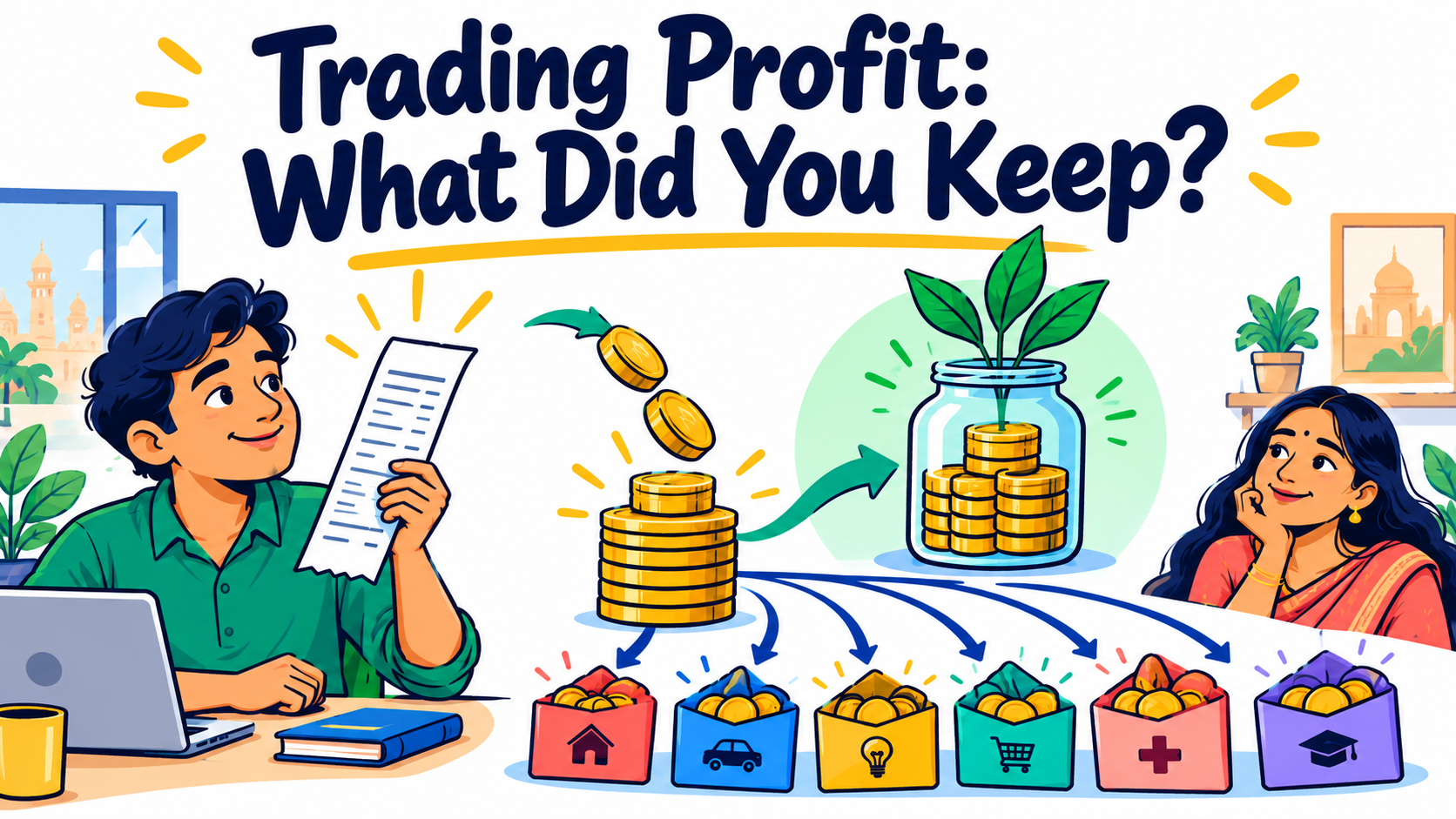
Your trading app shows a profit of ₹5,000. It is tempting to treat that as money available to spend. But first ask what the number includes, what it leaves out, and whether the position has actually been closed.
A useful trading record answers a simple question: after the trades and their costs, how much money did I really make or lose?
A profit on an open trade can disappear
An open-position profit is based on a current price. It can change before you sell. Even the displayed price may not be available for your full quantity. Treat it as a moving estimate, not money already earned.
Once you close a trade, the difference between your purchase and sale prices gives the trading result before any costs not already included. Apps use different labels and calculations. Read your broker’s explanation instead of assuming that every “profit” figure means the same thing.
Small deductions can add up
Depending on the trade, costs can include brokerage, exchange charges, securities transaction tax, stamp duty, SEBI charges, GST on applicable services and other relevant account charges. A broker advertising zero brokerage is not promising that every cost is zero.
Some costs apply on one side of a trade and some on both. Shares, options, futures and delivery trades can have different treatment. Do not reuse a charge estimate from a different type of trade. Check the current tariff and the actual contract note.
A simple rupee example
Suppose your completed trades produce ₹5,000 before charges. The relevant charges total ₹850. You kept ₹4,150 before any income tax that may be due. The ₹5,000 screenshot overstates this amount by ₹850. These are hypothetical figures, not a broker’s current charges.
Now suppose the same activity produces only ₹700 before charges, while charges remain ₹850. Your result is a ₹150 loss. A successful trade direction does not necessarily produce a successful net result.
Frequent trading makes this important. A small cost repeated dozens of times is a real expense. It should be included when you judge whether your trading method works.
Check three records together
Start with the contract notes, which record executed trades and their charges. Then check the broker’s ledger, which shows money movements and debits. Finally, review the profit-and-loss report for the period and the statement of your holdings or open positions.
These records answer different questions. A ledger deposit is not a trading gain. A withdrawal is not proof of profit: you may be withdrawing the money you originally deposited. A holding that has risen in value is not the same as a completed trade.
For example, deposit ₹1 lakh, lose ₹10,000, and withdraw ₹20,000. The withdrawal does not mean you made ₹20,000. You still lost ₹10,000, before any other adjustments.
Do not subtract the same charge twice
Some broker reports already include certain charges; others show them separately. Before adjusting a number, check its definition. If brokerage is already deducted, deducting it again understates your result. If it is missing, leaving it out overstates the result.
When figures do not match, ask your broker to explain the specific difference. Keep the statements rather than relying on a single screenshot or a notification.
Income tax is a separate calculation
Transaction taxes and GST shown on a contract note are not the whole of your income-tax position. The treatment of your activity can depend on what you trade and the applicable rules. A broker’s tax report is useful information, not a final determination of your tax liability.
Keep records for the financial year and get suitable tax help where needed. Do not apply one flat tax percentage to every trade or assume that losing money removes every filing obligation.
Judge the month, not your favourite screenshot
Track the result of all completed trades, their costs and any remaining positions. Include losing trades. Separately record deposits and withdrawals so they cannot disguise performance.
The number worth improving is the money you retain after costs while taking a level of risk you can afford. A bright green number on an app is only the beginning of that calculation.
Read also: You Can Win Most Trades and Still Lose Money.
Sources: NSE: Know Your Rights and NSE: Be a Smart Investor. Examples are illustrative; check your own broker’s current records and tariff.