
Your savings rate is the share of your take home pay you do not spend. It is the single number that decides how long you have to keep working. Not your salary. The share.
What each rate gets you
Years of work still needed, starting from nothing, at the return you set above.
Independence here means having twenty five times your yearly spending invested, which is the usual shorthand for a four per cent withdrawal rate. Your own figure uses what you have already invested. The table above always starts from zero so the rates can be compared fairly.
Why the share matters more than the salary
Two people earn very differently. One takes home fifty thousand a month and spends forty. The other takes home two lakh and spends one lakh sixty. Both save twenty per cent. Both need the same number of years. That is the part people find hard to believe, so it is worth seeing why.
Your savings rate is doing two jobs at once. A higher rate means more money going in. It also means you live on less, so the savings you need at the end are smaller. Both ends move towards each other. That is why the table above bends so sharply rather than falling in a straight line.
The uncomfortable part
A raise does nothing on its own. If your pay rises by twenty per cent and your spending rises by twenty per cent, your savings rate has not moved. Neither has the year you could stop. This is how people earn three times what they did ten years ago and feel no further ahead. They are not imagining it. On this measure they are not further ahead.
The useful move is simple to say and hard to do. When your pay rises, let some of it reach your spending and send the rest straight to investing, before you get used to it.
What counts as saving
Anything that stays yours. Money invested, money moved to savings, the part of a home loan payment that reduces the loan, and your EPF contribution. EPF is the one people forget. It leaves your salary before you see it, so it feels like tax. It is not. It is you, saving. If you want the full picture, use your gross pay and count EPF as saved. If you want the simpler version, use what lands in your bank and ignore it. Just do not mix the two. Interest on a loan is not saving. That money is gone. Only that part counts.
Read the number honestly
Two warnings about the years figure, because it is the one people quote at parties.
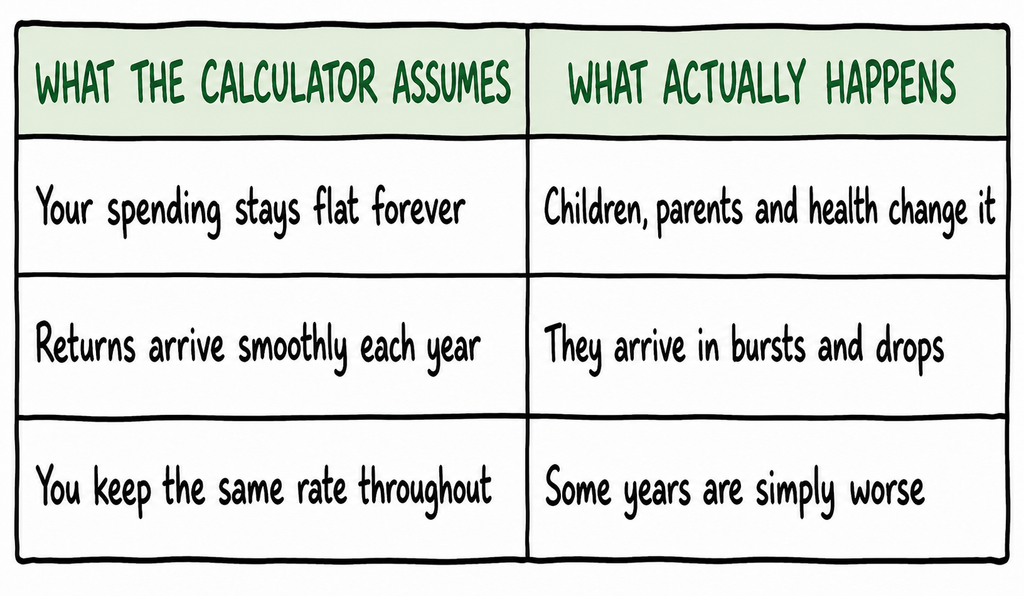
So treat the years as a direction, not a date. Nobody hits it exactly. The number is still worth knowing. Watching it move from thirty years to twenty two because you raised your rate by eight points tells you something no monthly budget ever will.
To find the room to raise it, the budget calculator shows what your pay can realistically release. If loans are eating the gap, the debt payoff calculator is the better place to start, because clearing them raises this rate permanently. And the SIP calculator shows what the saved amount could grow into once it is invested.
This calculator is for learning. It is not personal financial advice. The twenty five times rule and the four per cent withdrawal rate come from studies of long periods in other markets and are not guarantees, least of all in India. Returns after inflation are assumptions you are choosing, not facts. Tax on withdrawals is ignored here. For advice about your own situation, speak to a SEBI-registered investment adviser.