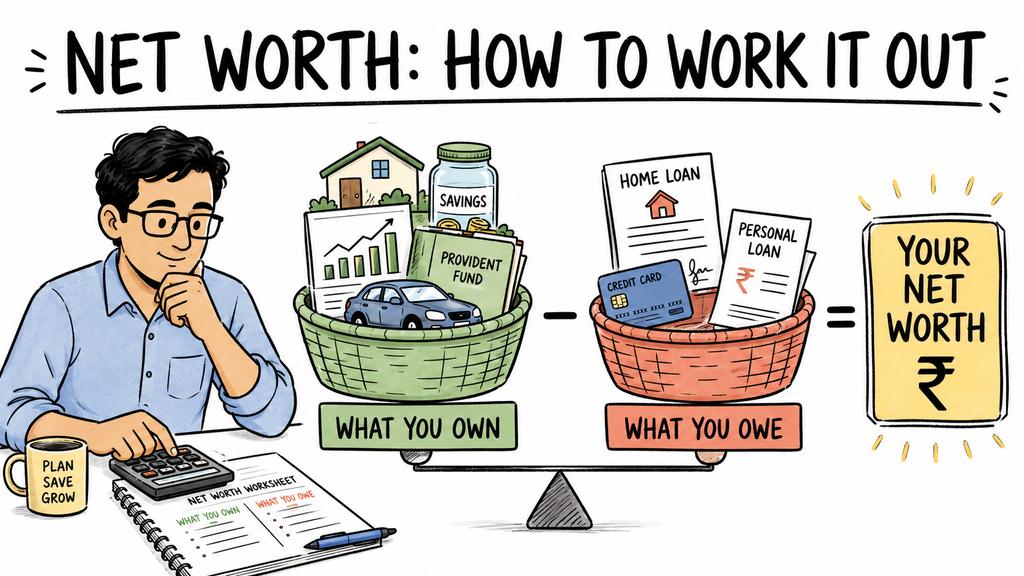
Net worth sounds like something that belongs to other people. Businessmen, cricketers, the uncle who owns three flats. It is just sums. What you own, minus what you owe. It works exactly the same at twenty three with eleven thousand rupees in the bank as it does at fifty with a crore.
1. It Is Not a Rich Person’s Number
Most people first work theirs out in their forties, usually because a bank asked for it. That is twenty years too late to be useful. The number itself is not the point at any age. What matters is the direction, and the d irection is only visible if you have an old reading to compare against. So the best time to write down a small, embarrassing number is now. It becomes the thing every later number is measured against.
There is a second reason, and it is the one people feel. Money is stressful mostly when it is vague. A bank balance you avoid looking at feels worse than a real figure, even when the real figure is bad.
2. Where to Find Each Number
This is the part that actually takes time. Not the sum, the hunt. Set aside half an hour and collect these.
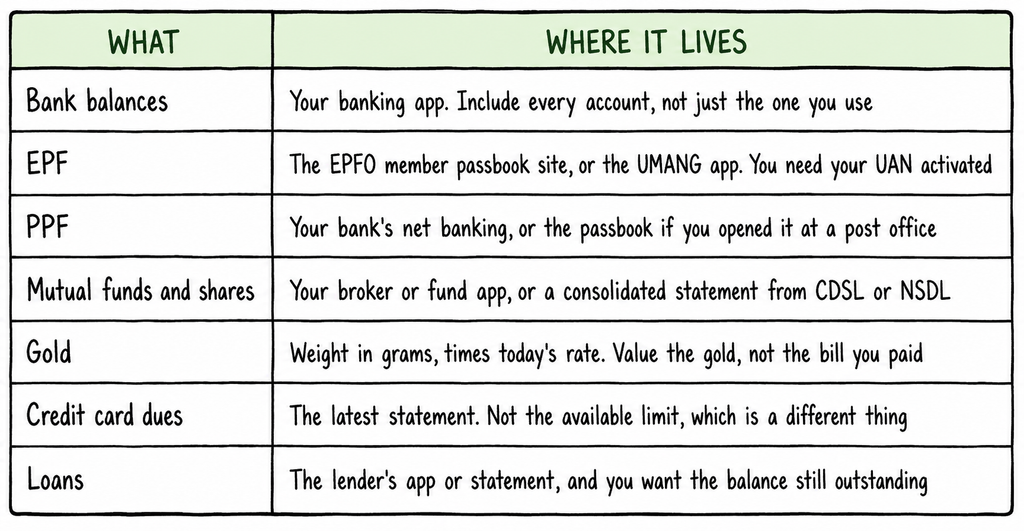
Two of these trip people up.
EPF is the one most young people forget entirely. It leaves your salary before you see it, so it never feels like yours. It is yours, and after three or four years it is often the largest thing you own. If you have changed jobs and never linked the old account, the money is still sitting there under your UAN. Finding it is frequently the nicest surprise in this whole exercise. The other one is loans. Use what you still owe today, not what you originally borrowed. Those are very different numbers and only one of them is real.
3. Starting From Zero, or Below
Plenty of people finish this and get a negative number. An education loan, a phone on instalments, a credit card that got away from you. Add it up and you owe more than you own. That is a normal place to start, and it is worth being clear about why.
An education loan bought you the earning power you are now using. The loan shows up on this page. The degree does not, because you cannot sell it. So the number looks worse than your actual position. A credit card balance is a different matter. That one is just expensive, and it is the first thing to clear. So a negative number is not one problem. It is usually two, and they need opposite responses.
The cheap loan can be left to run its course while you build something alongside it. The expensive one needs everything you can spare until it is gone. Sort your debts by their interest rate before you decide anything. A loan at nine per cent and a card at forty are not the same kind of problem, even though they sit in the same column here.
Here is the part people miss. When you are starting out, paying down a loan moves this number just as much as investing does. A year where you cleared eighty thousand of debt and invested nothing is a good year, and the sums say so even if it did not feel like progress.
What a first one actually looks like
Take someone two years into their first job.
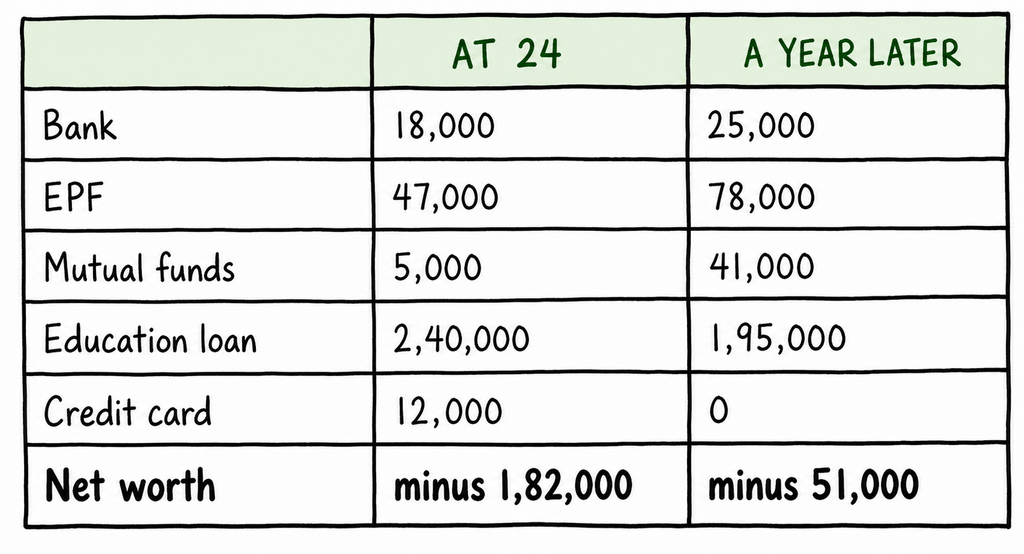
Still negative after a year. Still nothing to boast about. But the number moved by one lakh thirty one thousand in twelve months. Well over half of that came from two things they barely thought about: EPF piling up in the background, and a loan quietly coming down. That is what progress looks like early on. Not a big number. A number that is less bad than last year’s, for reasons you can point at.
4. Your Salary Is Not Your Wealth
This is the shift the whole exercise is really for. We describe people by what they earn. He is on eighteen lakh. She got a package of twelve. Income is what passes through your hands. Net worth is what stopped there. Two people on the same salary can be years apart on this number, and usually are. It comes down to what share of the pay they kept, not what the pay was. Which is why a raise on its own does nothing here. If your spending rises with your pay, this number does not move. Plenty of people earn three times what they did ten years ago and are no further along, and they are not imagining it.
There is a useful test in this. When your pay next rises, look at what happens to this number over the following year. If it moved, the raise reached you. If it did not, the raise reached your spending, and you will have to take the next one more deliberately.
5. Four Things to Do This Week
- Activate your UAN. If you have ever been on a payroll and cannot see your EPF, start here. Everything else is quicker.
- Do the sum once, badly. Rough figures are fine. A number that is ten per cent off is infinitely better than no number.
- Write it down with the date. This is the only step that matters in five years.
- Then leave it alone for a year. Pick a date you will remember. The first of April works, because it lines up with the tax year.
Do not check it monthly. It barely moves, and watching something barely move is how people decide it is not working.
The net worth calculator will do the sum for you and will also show how much of the total you could actually reach in a hurry, which is a separate and slightly uncomfortable question. If the number came out negative, the debt payoff calculator is the better place to start. And the habit that moves this number faster than any other is in pay yourself first.
This article is for learning. It is not personal financial advice. Ways of accessing EPF and other accounts change from time to time, so check the official EPFO site if something here does not match what you see. A net worth figure ignores tax on sale, exit charges and the cost of selling anything. For advice about your own situation, speak to a SEBI-registered investment adviser.