
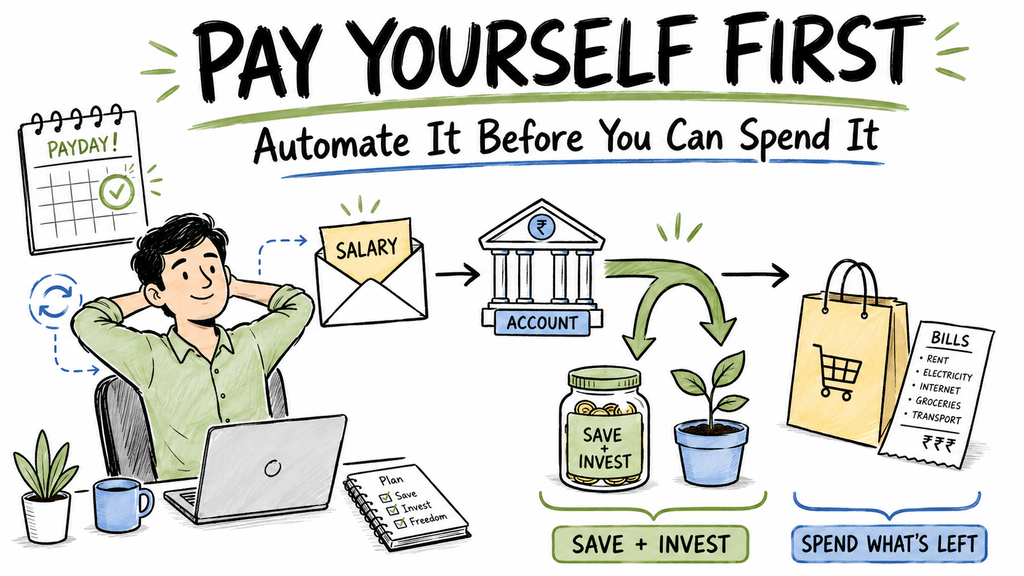
Most people invest what is left at the end of the month. Almost nothing is ever left at the end of the month. That is the whole problem, and the fix is not more discipline. It is changing the order.
1. The Order That Changes Everything
There are only two ways to run a month.
Salary arrives, you spend, and whatever survives gets invested. Or salary arrives, a fixed amount leaves for your investments the same week, and you spend what remains. Same salary. Same person. Completely different result after ten years.
The second way works because spending expands to fill whatever is in the account. Take the investment out first and your spending quietly adjusts around the smaller number. This is not a new idea, and it is not a small one. It is the single habit that separates people who build something from people who earn well and wonder where it went.
Plenty of Indians already run it this way. In March 2026, money going into mutual funds each month through SIPs reached ₹32,087 crore, spread across 9.72 crore active accounts. About a fifth of all mutual fund money in the country now arrives this way. Almost none of that is decided each month. It is standing instructions, running quietly in the background.
Two people, same salary
Ravi and Meera both take home ₹60,000 a month.
Ravi plans to invest ₹6,000, but only once he sees what is left. Some months there is nothing. Some months he spends it on something that came up. Over a year he manages it four times.
Meera has ₹6,000 leaving her account on the 3rd, before she has looked at her balance. She runs it twelve times. She also feels no poorer than Ravi, because she never sees the money.
Same pay. Same intention. Meera puts away three times as much, and she is the one who thinks about money less.
2. Pick the Date, Not Just the Amount
People agonise over the amount and then pick the date at random. The date matters more than they think. Set your instalment for one or two days after your salary usually lands. The reason is simple. On the day your salary arrives, the money is still abstract. By the twentieth it has become rent, a wedding gift, a phone that needed replacing.
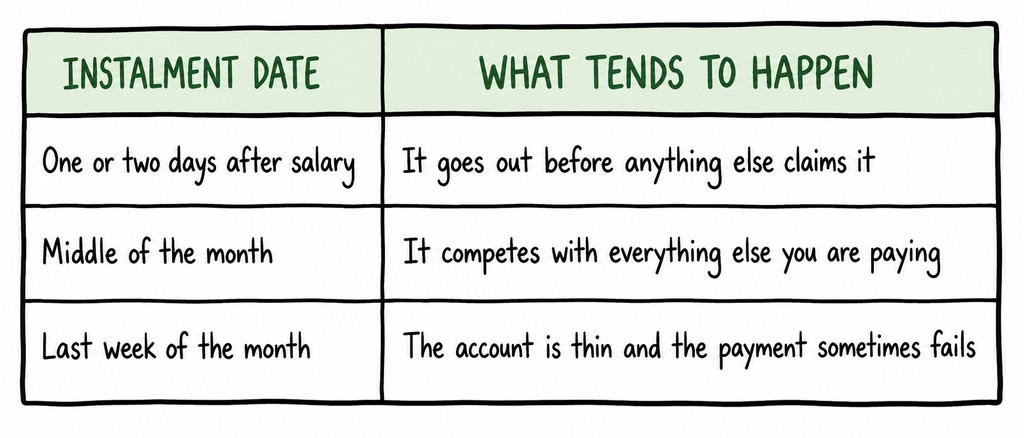
A failed payment is worse than a small one. Your bank may charge you for it. Worse, it breaks the run, and a habit that has stopped once is much easier to stop again.
If your salary date moves around, pick a date a few days after the latest it usually arrives. A day early is a risk. A day late costs you nothing. Two incomes in the house? Put both on the same date. One day a month where money leaves is easier to plan around than two. If your income is irregular, this still works. Pick a small amount you can meet in a poor month, set it for a date after most of your money usually arrives, and add to it by hand in the good months.
3. What to Automate First
Paying yourself first does not mean sending everything to the stock market. There is an order, and getting it wrong is the most common mistake people make when they finally start.
- Clear expensive debt. If you are carrying a credit card balance at around forty per cent a year, no investment beats paying it off. Nothing else on this list matters until that is gone.
- Build a small buffer. One month of essential spending in a savings account or liquid fund, so that a hospital bill does not undo everything.
- Then invest. Once the first two are in place, the monthly amount goes to investments and stays there.
You can run the buffer and the investing at the same time if the amounts are small. What you should not do is invest while an expensive loan is running.
One more thing worth counting. If you are salaried, part of your pay already leaves before you see it as EPF. That is you, paying yourself first, whether you thought of it that way or not.
4. When Money Gets Tight
Some month it will not fit. A wedding, a medical bill, a month between jobs. The instinct is to stop the whole thing. Try very hard not to. Cut it instead. Take ten thousand down to two thousand for as long as you need. The amount barely matters for those few months. What matters is that it is still running when things get better.
Here is why that is not a small point. Starting again after you have stopped takes a decision. You have to log in, pick a fund, pick a date, and choose to part with the money all over again. Most people put it off, and a few months becomes two years. Raising something that never stopped takes only a number.
The same logic works upwards. When a raise arrives, increase the amount that week, before your spending finds the extra money. Waiting until you feel comfortable means waiting forever, because spending always catches up first.
5. Four Things to Set Up This Month
- Find your date. Check when your salary actually credited over the last three months and add two days.
- Pick an amount you will not resent. One you can hold through a bad month is worth more than an ambitious one you abandon in March.
- Automate it properly. A standing instruction, not a reminder on your phone. If the transfer needs you to approve it every month, you have automated nothing.
- Then stop looking. Check it once a year. Watching a monthly investment daily is how people talk themselves into stopping it.
Start smaller than you think you should. Five hundred rupees that runs for five years beats ten thousand that runs for two months, and it is not close.
What that monthly amount could turn into is worth seeing for yourself in the SIP calculator. If you are not sure what you can spare, the budget calculator works it out from your pay and your rent. And on what a monthly habit can and cannot actually do for your returns, SIP investing: what consistency can and cannot do is the honest version.
This article is for learning. It is not personal financial advice. Industry figures quoted are from the Association of Mutual Funds in India monthly note for March 2026 and will have moved since. Money that can grow can also fall in value, and a monthly investment does not protect you from that. For advice about your own situation, speak to a SEBI-registered investment adviser.