
Every financial year, the first ₹1,25,000 of long term profit you make on shares and equity mutual funds is free of tax. Most people never touch it.
Not because they do not know about it. Because using it requires you to sell something, and they have been told, correctly, that selling is usually a mistake. So the limit sits there from April to March, unused, and on the first of April it starts again at zero. Whatever you did not use is gone. It does not carry over.
Tax harvesting is simply the habit of using that limit each year instead of losing it. This article assumes you already know how capital gains work. If you do not, start with capital gains basics for investors and come back.
Two versions of the same idea
People use the word harvesting for two different moves, and mixing them up is where the trouble starts.
- Harvesting a gain. You sell a holding that is in profit, book a profit inside the free limit, pay no tax on it, and buy the same thing back. You still own it. But the price you are recorded as having paid is now higher, so there is less profit left to be taxed later.
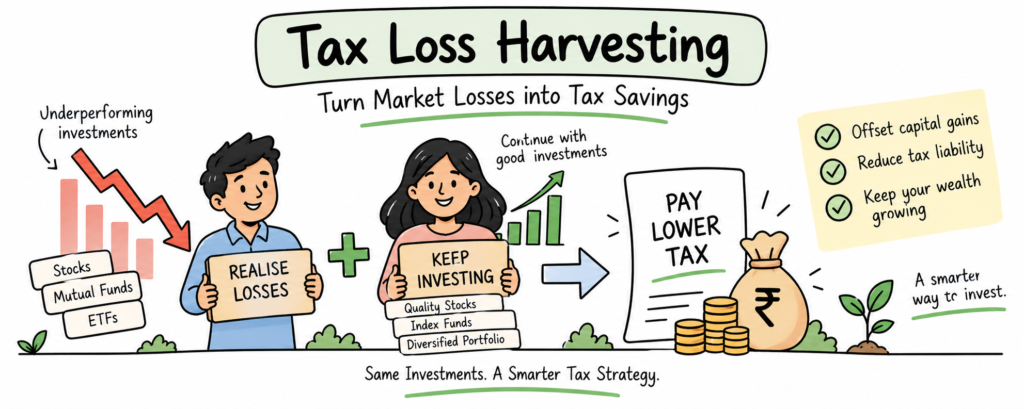
- Harvesting a loss. You sell a holding that is down, make the loss real, and use it to cancel out profits you made elsewhere, so your tax bill for the year is smaller.
Both are legal and both are ordinary. But whether either one helps you depends on a single rule that almost nobody is told.
The rule that decides everything
When your tax is worked out, your losses are subtracted from your profits first. The free limit is applied to whatever is left over.
Read that again, because the order is the whole article. Losses first, free limit second. It sounds like a technicality. It decides whether your two moves make you money or quietly cost you money.
Here is what it means in practice. Your taxable long term profit for the year is your profits, minus your losses, minus ₹1,25,000, and never less than zero.
Harvesting a gain, with real numbers
Say you put ₹10,00,000 into an index fund and it grows at 12% a year for ten years. You never touch it. At the end it is worth ₹31,05,848 and your profit is ₹21,05,848.
You get the free limit once, in the year you sell. So ₹19,80,848 is taxable, and at 12.5% the tax is ₹2,47,606.
Now run the same ten years, but once a year you sell enough units to book a profit inside the free limit, and immediately buy the same fund back. In the first year the fund has only grown by ₹1,20,000, so that is all you can take. After that there is enough profit to take the full ₹1,25,000 every year.
Over nine years you book ₹11,20,000 of profit and pay nothing on any of it. Each time, the price you are recorded as having paid goes up by the amount you booked. When you finally sell in year ten, the profit left to tax is only ₹9,85,848, and the tax is ₹1,07,606.
Same fund. Same 12%. Same money in your hand at the end, apart from the tax. You kept ₹1,40,000 that you would otherwise have paid.
There is no cleverness in that number. It is 12.5% of the ₹11,20,000 you passed through the free limit instead of wasting. That is all harvesting a gain ever does. It converts an allowance you were going to lose into a permanent reduction in a future tax bill.
Harvesting a loss, and when it backfires
Now the other move, and the trap in it.
Suppose you booked ₹80,000 of long term profit this year. That is under ₹1,25,000, so your tax on it is zero already. In December you notice a holding sitting at a ₹60,000 loss, and you remember reading that booking losses saves tax. So you sell it.
Losses come off first. Your ₹80,000 profit becomes ₹20,000, and the free limit covers it. Your tax is zero.
Your tax was zero before you sold anything. The ₹60,000 loss was swallowed by a profit that was never going to be taxed. It is not carried forward, because a loss is only carried forward if it is bigger than the profits available to absorb it. You have destroyed something worth ₹7,500 in future tax relief and received nothing for it.
So the rule for losses is narrow, and it is the opposite of what most year end articles tell you. Only book a loss in a year when your profits are already above ₹1,25,000. Below that line, a booked loss is thrown away.
If you are carrying losses forward, harvest more, not less
This one is worth money and hardly anyone gets it right.
Say a bad year left you carrying ₹2,00,000 of long term losses. A new year starts and you decide to harvest a gain of ₹1,25,000, thinking you are using your free limit.
You are not. Losses come off first, so your ₹1,25,000 profit is cancelled by ₹1,25,000 of your carried losses. Nothing reaches the free limit. It goes unused again.
The answer is to book a bigger gain, not a smaller one. Harvest ₹3,25,000 instead. The first ₹2,00,000 clears your carried losses, the next ₹1,25,000 is covered by the free limit, and your tax is still zero. You have raised your recorded purchase price by ₹3,25,000 rather than ₹1,25,000, and it cost you nothing.
In short, while you are carrying losses forward, the free limit does nothing for you until your booked profits get past those losses. Clear them deliberately, in one year, rather than letting them eat into your allowance for years.
Six things to check before you do it
- Count what you have already booked. The ₹1,25,000 is one limit for the whole year, per person, across every share and equity fund you own. If you already sold something in June, you have less room left in February than you think.
- Your oldest units go first. You do not get to choose which units you are selling. The earliest ones you bought are treated as sold first, and those carry the biggest profit. So to book exactly ₹1,25,000 you usually need to sell a smaller number of units than you would guess. Your fund house or broker will give you a statement showing the profit on each lot.
- The clock restarts on what you buy back. The units you repurchase are brand new. They need twelve months before they qualify for the long term rate again. If you might need that money within the year, harvesting has just moved it into the higher short term rate of 20%.
- You are out of the market for a day or two. Selling a mutual fund and buying it back is not instant. The price can move against you in between, and that movement can easily be larger than the tax you saved. This is the real cost of harvesting, not the fees.
- Tax saving funds are locked. Units bought for the tax deduction cannot be sold before their lock in ends, so they cannot be harvested during it.
- File your return on time. A loss you want to carry forward to future years survives only if you file by the due date. Miss it and the loss is gone. Keep these documents ready before filing covers what you need.
Is selling and buying back allowed?
Yes. Some countries have a rule that ignores a loss if you buy the same thing back within a set number of days. India has no such rule.
You will still find articles warning you to leave a gap between selling and buying back, to avoid breaking the general anti avoidance rule. For an ordinary investor this is noise. That rule is aimed at large arrangements built purely to dodge tax, and it only applies when the tax being avoided runs into crores. Booking ₹1,25,000 of profit saves ₹15,625. The two are nowhere near each other.
The honest reason to leave a gap is not legal. It is that there is no reason to be in a hurry, and none of this works if you get the paperwork wrong.
Who should not bother
If your total equity holdings are small, the profit available to harvest each year will be well under the limit and the effort is not worth it. Come back to this when your investments are large enough that a 12% year produces more than ₹1,25,000 of profit. On a portfolio that is roughly ₹10,00,000 or more, that is when it starts to matter.
If your money is in debt funds rather than equity, check before you assume any of this helps. The free limit applies to listed shares and equity funds only. For most debt funds bought in recent years the profit is added to your income and taxed at your slab rate instead, with no free limit at all. The basics article sets out which is which.
And if using the limit means selling a holding you actually want to keep for reasons that have nothing to do with tax, keep it. A saving of ₹15,625 is not a reason to disturb a plan that is working.
What to actually do
Once a year, well before the end of March so you are not rushing, pull up your capital gains statement and ask four questions.
- How much long term profit have I already booked this year?
- Am I carrying any losses forward from earlier years?
- How much profit can I book to land on those losses plus ₹1,25,000?
- Which holdings have I owned for more than twelve months, so they qualify?
Then sell that much, buy it back, and keep the contract notes. That is the whole exercise. It takes half an hour once a year.
The capital gains calculator answers those four questions for you. Put in what you have already sold this year and any losses you are carrying, and it works out how much more you can book today without paying anything.
The allowance was given to you. The only decision is whether you use it or let it expire on the thirty first of March.
This article is for learning. It is not personal tax advice. It describes the position for tax year 2026-27, when the long term rate on listed shares and equity funds is 12.5% above a free limit of ₹1,25,000 a year, and the short term rate is 20%. Tax rules change with every Budget. The examples are simplified and assume you can buy back at the same price, which real markets do not promise. Your filing software or a qualified tax professional should do the actual calculation. Please check current rules before acting on any of this.