
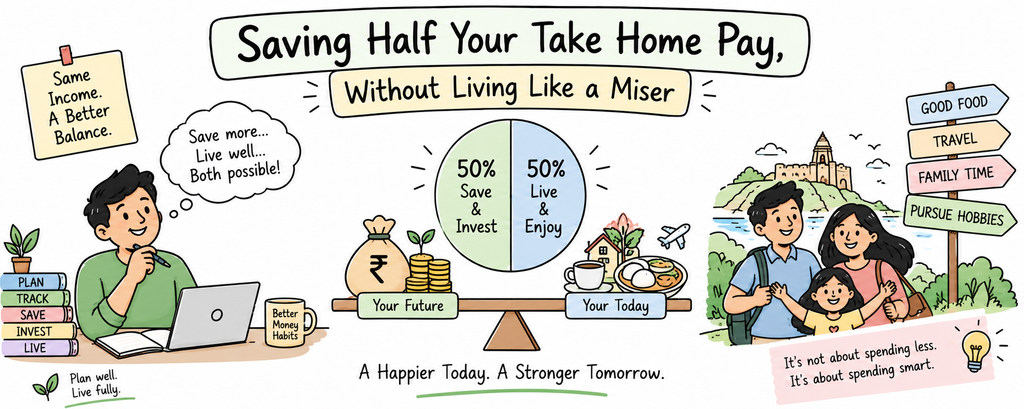
The advice to save 20% was written for someone who is struggling to save anything. If you earn well, it is not a stretch target. It is a ceiling you have accepted without noticing.
Saving half of what you take home sounds severe. For most people on a large salary it is not, and the reason is sums rather than willpower. This article is about what the number really means, why it is easier at your income than at anyone else’s, and what actually stops people doing it.
First, fix the number you are aiming at
“Save 50% of your income” means nothing until you say which income. At a high salary the gap between the two is enormous, because tax takes a bigger bite the more you earn.
Here is what the newer tax regime does to a salary in the 2026-27 tax year, counting the standard deduction, surcharge where it applies, and cess.
- ₹15 lakh becomes about ₹14.03 lakh in your hand. Tax takes 6.5%.
- ₹30 lakh becomes about ₹25.24 lakh. Tax takes 15.9%.
- ₹50 lakh becomes about ₹39 lakh. Tax takes 22%.
- ₹1 crore becomes about ₹70.74 lakh. Tax takes 29.3%.
So if you earn ₹30 lakh and save half of what reaches your bank, you are putting away ₹12.62 lakh. That is 50% of your take home pay and only 42% of your salary. At a crore, saving half your take home is barely 35% of the headline number.
Aim at the take home figure. It is the only one you can actually spend or save, and it is the one the maths below uses.
Why half is realistic for you and brutal for everyone else
Here is the part that gets missed. The cost of a decent life does not rise in step with your salary.
You do not eat three times as much food because you earn three times as much. You do not need three times the electricity, or three times the clothes, or three times the phone. Some costs do climb with income, the home and the school being the obvious ones, but many simply do not.
So as income rises, the share of it you could save rises faster. Take a comfortable standard of living and see what is left over.
- Take home ₹14 lakh, live well on ₹6 lakh, and 57% is available to save.
- Take home ₹25 lakh, live well on ₹9 lakh, and 64% is available.
- Take home ₹39 lakh, live well on ₹12 lakh, and 69% is available.
Those middle figures are not meant to be your figures. The point is the direction. Somebody saving half of a small salary is doing something genuinely hard, cutting into things that matter. At your income, saving half is mostly a decision about four or five large purchases. That is a very different task, and it is worth being honest that your version is the easier one.
What the extra actually gets you
Your savings rate decides how long you have to keep working. Not your salary, the share. Here is roughly how long it takes for work to become optional, starting from nothing, with money growing 6% a year after inflation.
- Saving 20%: about 33.4 years
- Saving 30%: about 25.8 years
- Saving 40%: about 20.2 years
- Saving 50%: about 15.7 years
- Saving 60%: about 11.9 years
Read the first and fourth lines together. Moving from the standard advice to half of your take home pay takes almost eighteen years off your working life. Not eighteen years of a smaller salary. Eighteen years of not having to earn one at all.
The reason the numbers fall so sharply is that the savings rate does two jobs at once. A higher rate puts more money in, and it also means you live on less, so the amount you need at the end is smaller. Both ends move towards each other. Put your own figures into the savings rate calculator and move the number to see it.
The real obstacle is not the money
If you earn well and save 20%, the shortfall is almost never that you cannot afford to save more. It is that your spending is no longer a private decision.
At a certain income, what you spend is visible, and it is read as information about you. The car in the drive, the address on the invitation, the school on the uniform, the photographs from the holiday. Nobody sees your portfolio. Everybody sees the car.
This is why the usual budgeting advice is useless here. Nobody earning ₹30 lakh is going to close the gap by tracking the grocery bill. The gap is in four decisions, and each one is social as much as financial.
The four that decide it
- The home. The largest single decision you will make, and the one most often made on the basis of what you can just about get approved for rather than what you need. A lender telling you what you qualify for is not advice. Buying one notch below what you are offered changes your savings rate for the next twenty years in a way nothing else can.
- The car. The purest example of money spent to be seen. It loses value from the moment you take it home, it costs more to insure and service the more it cost to buy, and if it is on a loan it quietly takes a slice of every month for years.
- The school. The hardest one to talk about, because it feels like you are putting a price on your child. Worth separating two things honestly: what a school actually delivers, and what having your child at that school says about you. Only the first is worth paying for.
- The holidays. The one that has changed most in the last ten years, because it is now shared as it happens. A holiday you would have loved anyway is worth every rupee. One chosen partly for how it will look is an expensive way to buy other people’s approval.
Get those four roughly right and the savings rate follows on its own. Get them wrong and no amount of care about the small things will rescue it.
How to actually do it
- Work out your real rate today. Not what you think it is. What left your account last year against what came in.
- Move it by five points, not thirty. Going from 22% to 27% is a change you will keep. Going to 50% overnight is a diet, and it ends the way diets end.
- Take the whole of the next raise. This is the one that does the work. You were living on the old salary quite happily. Send the increase straight to investing before it arrives in your spending, and your rate climbs without anything feeling worse.
- Automate it on payday. Not month end. There is nothing left at month end, at any income.
- Leave one budget alone deliberately. Pick the thing you genuinely enjoy and do not touch it. A plan with nothing good in it does not survive contact with a bad week.
Two ways this goes wrong
The first is trying to solve it with returns instead. If your savings rate is 20%, no fund selection rescues you. Chasing a better return is how people on good salaries end up in things they do not understand, and it is a slower road than simply saving more. Your savings rate is the one number here that is entirely under your control.
The second is going too far. Saving 70% of a large salary while resenting every month of it is not a plan, it is a punishment, and people abandon it in year three having missed the years they were saving for. The aim is a rate you can hold for fifteen years without thinking about it much.
Half of what you take home, held steadily, is worth more than seventy per cent held angrily for two years.
If you want the mechanics of making it automatic, pay yourself first covers why the date matters more than the amount.
This article is for learning. It is not personal financial advice. The tax figures are for a salaried resident individual under the newer regime in the 2026-27 tax year, including the standard deduction, surcharge where it applies and cess, and they ignore any other income or deductions you may have. The years shown assume money grows 6% a year after inflation and that you can live on what you are spending now, neither of which is a promise. Tax rules change with every Budget. For advice about your own situation, speak to a SEBI-registered investment adviser.