
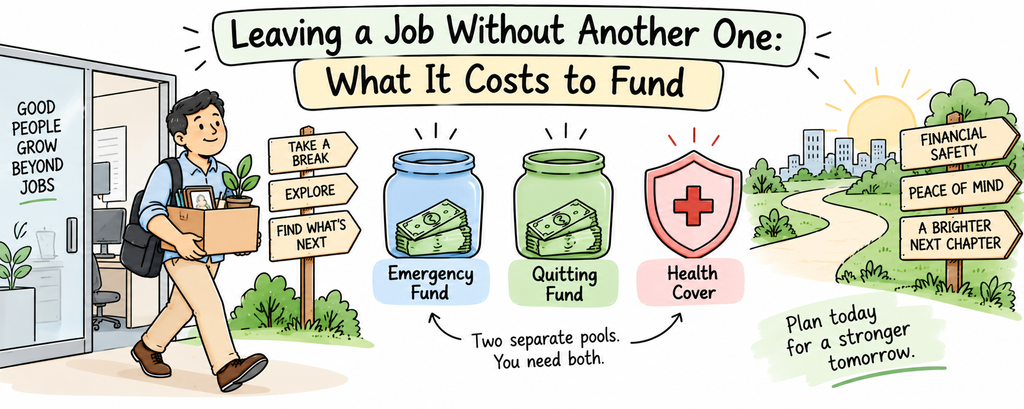
You want to leave, and there is no offer letter. The work has stopped being difficult and started being harmful, and waiting for the next job to appear first has not worked for a year.
Every piece of advice you will find says the same thing. Make sure you have an emergency fund. That advice is not wrong, but it is pointing at the wrong pool of money, and following it is how people end up unemployed with nothing behind them.
Your emergency fund is not your quitting fund
An emergency fund exists for things that are unexpected, urgent and necessary. Leaving a job on purpose is none of those. It is a decision, made by you, on a date you choose.
So if you fund your resignation out of your emergency fund, here is where you stand on the first morning of unemployment. No salary, and no emergency fund either. Then the car needs work, or a parent falls ill, and the only things left are a credit card or your investments at whatever price the market is offering that week.
These are two separate pools and you need both. Say your essential spending is ₹60,000 a month.
- Emergency fund: ₹3,60,000. Six months. This is not spent. It is the thing that stays whole.
- Quitting fund: ₹3,60,000 for a six month search. ₹2,40,000 if you are confident of four months, ₹5,40,000 if you want nine.
- A year of health cover: about ₹25,000, paid before you go. More on this below, because it is the part with a deadline.
Six months of runway therefore needs about ₹3,85,000 saved on top of an emergency fund you do not touch, or roughly ₹7,45,000 in total.
That number is larger than most people expect, and it is the honest one. If you already have the emergency fund, you are halfway there. If you are starting from nothing, build an emergency fund that fits your life covers the first pool before you think about the second.
The thing that expires on your last working day
This is the most time critical item in the whole exercise, and almost nobody plans for it.
Your employer’s health cover ends on your last working day, or at the end of your notice period. Not at the end of the month, not when you find something new. It stops.
You cannot simply buy a policy afterwards and carry on. A new policy starts a new clock. There is a short wait before anything is covered at all, and a much longer one, usually some years, before anything you already have a condition for is covered. Resign first and buy later, and you spend that period uninsured for exactly the things most likely to happen to you, at the one time you have no salary.
There is a way through, and it has to be done before you leave. You can move from the company policy to an individual one with the same insurer, and when there is no gap in cover, the waiting periods you have already served carry across with you. The application has to go in while the company cover is still running.
Two warnings on that. Insurers describe the deadline differently, so ask your HR department for the insurer’s name and ask the insurer directly what their window is, early in your notice period rather than in the last week. And if you take a larger cover than the company gave you, the extra amount usually starts its own fresh clock even though the original part carries over.
The premium is not the problem here. ₹25,000 is small next to ₹3,60,000 of runway. The cost of getting this wrong is not money, it is being uninsured when you can least afford to be. A practical checklist for health insurance covers what to look for in the replacement policy.
What actually arrives when you resign
Less than when you are asked to leave. Somebody made redundant may get notice pay or a settlement. You are resigning, so you get neither.
What you do get is any unused leave encashed, and gratuity if you have been there long enough. Gratuity has a hard edge worth knowing about, because it needs five completed years with the same employer.
- Four years of service, on a basic salary of ₹60,000 a month: nothing.
- Five years: about ₹1,73,000.
- Eight years: about ₹2,77,000.
If you are at four years and eight months, waiting four more months is worth ₹1,73,000. That is a hard thing to hear when you want out now, and it is worth knowing before you write the letter rather than after.
The provident fund is not the answer
Once you have been out of work for a month you are allowed to take 75% of your provident fund. It is sitting there, it is yours, and it will feel like the obvious solution when the runway starts running short.
Look at what it costs first. Say you have ₹10 lakh in it at thirty five, earning 8.25%.
- Left alone until you are fifty eight: about ₹61.9 lakh.
- After taking out 75%: about ₹15.5 lakh.
Taking ₹7.5 lakh out at thirty five costs you about ₹46 lakh of retirement money. It is the most expensive rupee available to you, and it is also the easiest to reach, which is a bad combination when you are three months in and nervous.
Be honest about the gap
Two things people get wrong when they plan this.
The first is the length. A search takes as long as it takes, and the more senior or specialised the role, the fewer of them exist. From three months to six makes the same point about replacing an income, and it applies with more force here because you chose the start date.
The second is that a voluntary gap has to be explained. It is a perfectly respectable thing to have done, but you will be asked about it, and the answer is easier to give when the gap was four months than when it was fourteen and the money ran out in month nine.
The order to do this in
- Work out your essential monthly spending. Not your usual spending. What the month costs with nothing optional in it.
- Build the quitting fund separately, somewhere you can see it, on top of the emergency fund. Two pools, two purposes.
- Sort the health cover while you are still employed. Ask HR who the insurer is, ring them, and start the move to an individual policy during your notice period.
- Check the calendar against five years if you are anywhere near that mark.
- Decide in advance what you will do at month four, while you are still calm. The plan you make now is better than the one you will make when the money is halfway gone.
- Leave the provident fund alone. Put it out of reach in your own mind before you need it.
None of this is a reason to stay somewhere that is harming you. It is what turns leaving from a leap into a plan, and the difference between the two is a few months of saving and one phone call to an insurer.
This article is for learning. It is not personal financial, medical or employment advice. Health insurance rules around moving from an employer policy to an individual one vary between insurers and change, so confirm your own position with your insurer rather than relying on any figure here. Gratuity, provident fund and notice terms depend on your contract and your employer, and premiums depend on your age, city and health. The growth rate used is an example chosen to show how the sums work, not a forecast. For advice about your own situation, speak to a SEBI-registered investment adviser.