
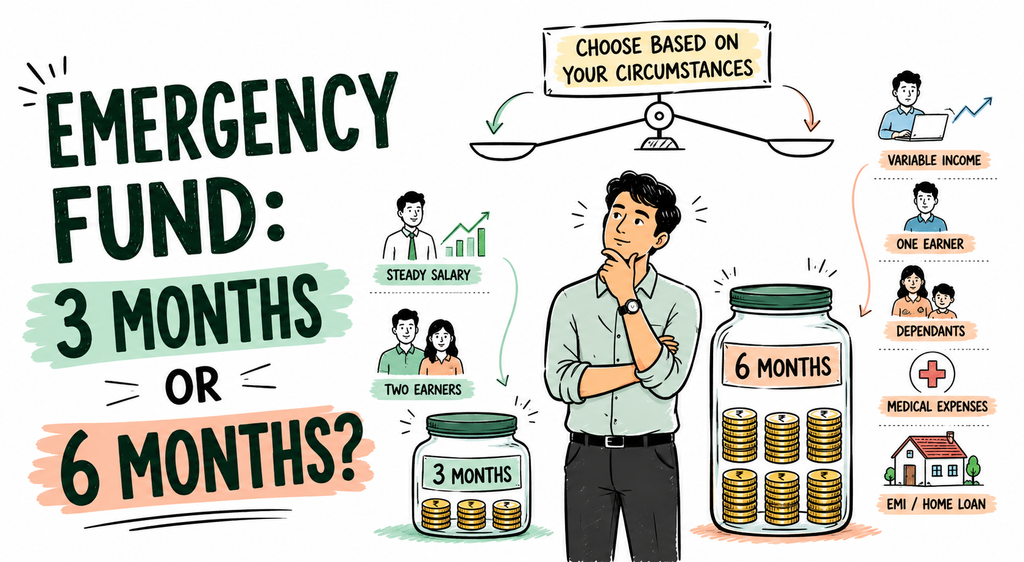
You have three months of expenses put away. The advice says six. Before you spend the next two years getting there, it is worth asking whether you should, because the second three months costs more than the first three did.
1. Three Months Buys Time, Not Safety
Three months of expenses covers most of what goes wrong. A repair, a gap between jobs that resolves quickly, a bill you did not see coming. What it does not cover is anything slow.
Say your essential spending is forty thousand a month. Three months is one lakh twenty. Here is how far that goes.
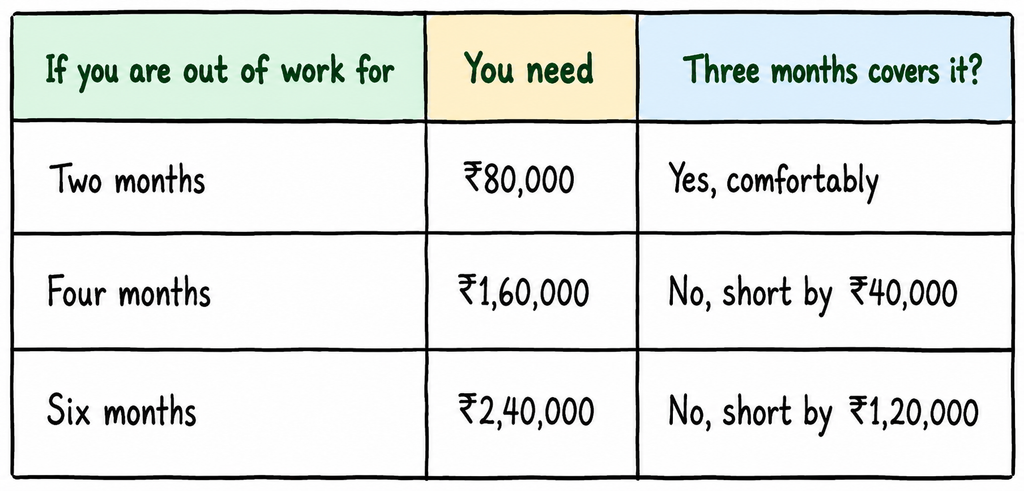
So the real question is not how careful you want to be. It is how long it would take you to be earning again. Somebody with a common skill in a large city can often replace an income in weeks. Somebody senior, or specialised, or in a small industry, cannot. The more particular your job, the fewer of them exist.
2. The Question Nobody Asks at Three Months
Once you have three months, the next rupee has two possible homes. More buffer, or your investments. This is a genuine trade and it is worth seeing the size of it. Going from three months to six, on that forty thousand of spending, means putting aside another one lakh twenty. That money then sits somewhere safe and slow for as long as you keep it. Held for twenty years in a liquid fund it might become about three lakh eighty five. In equity over the same period it might have become about eleven and a half lakh.
The extra safety costs close to eight lakh of growth you will never see. That is the honest price, and most articles do not mention it. Now the other side. If that buffer stops you putting one lakh twenty on a credit card even once, at card rates over two years you avoid paying back about two lakh thirty five. More than a lakh of interest, on one occasion.
So neither answer is obviously right. It depends entirely on how likely the bad month is for you, which is why the next two sections matter more than the sums.
3. Insured, and Still Needing Cash
Here is the thing most people get wrong about health cover. Having insurance does not mean you never pay the hospital. It means you might not have to, if everything lines up. Cashless treatment only works at hospitals inside your insurer’s network. Go anywhere else, and you are on a reimbursement claim instead. Reimbursement means you pay the whole bill yourself, then claim it back. The regulator allows the insurer up to thirty days to settle after you submit the papers.
Read that again. You may need three lakh in your hands today, and get it back next month. And you rarely choose the hospital in an emergency. You go to the nearest one, or the one the ambulance goes to, and whether it is in your network is luck. There is also everything before admission. Scans and tests done while somebody is working out what is wrong get paid by you, at the time, whatever the policy eventually covers.
None of which is an argument against insurance. It is the argument for holding cash alongside it. What your policy actually pays for is a separate question, covered in the health insurance checklist.
4. Who Actually Needs Six
Six months is not better. It is right for some people and wasteful for others.
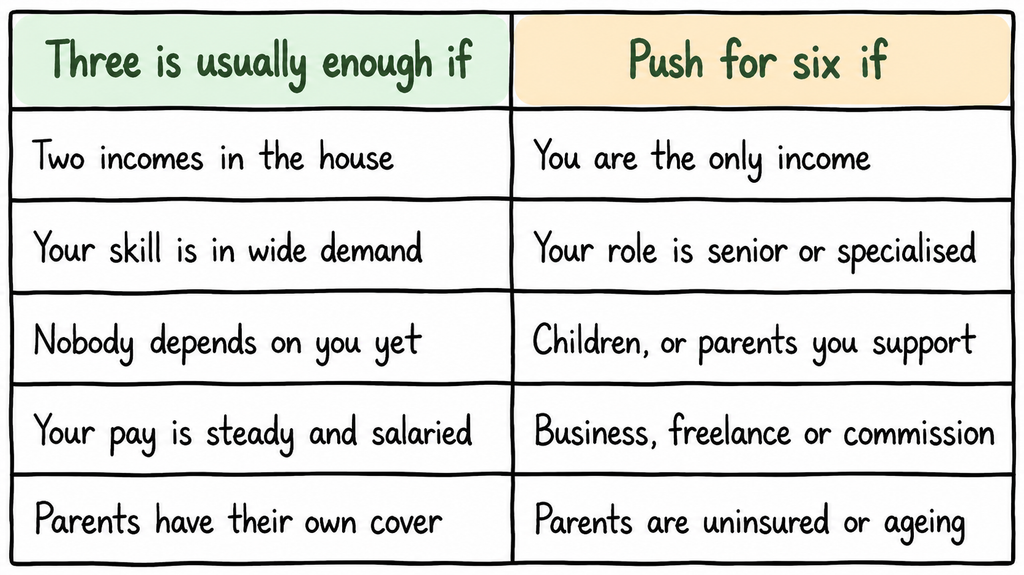
Most people find themselves with rows on both sides. The count matters less than which rows are yours. One line moves more than the others. Ageing parents without their own health cover is the single most common reason an Indian household suddenly needs a large amount of cash it had not planned for. If that is your situation, buying cover for them usually does more good than another three months of buffer, and costs less.
5. Getting There Without Stalling Everything
If you decide six is right for you, do not stop investing to get there. Two years of no investing, to reach a number that may sit untouched for a decade, is a poor trade.
- Split the difference. Send part of your monthly saving to the buffer and part to investing. Slower on both beats stopping one.
- Use money you were not counting on. A bonus or a refund fills the gap in one go without touching your monthly plan.
- Let it drift up on its own. Your target is months of spending, so it grows when your spending does. Topping it up once a year is enough.
- Stop at six. Beyond six months, cash sitting idle is a real cost with very little extra protection bought.
That last one matters. People who have been frightened once tend to keep building, and a year of expenses in a savings account is not caution. It is a large sum quietly losing to inflation.
The emergency fund calculator will size both versions from your own spending and show where to hold each part. If you are still building the first three months, build an emergency fund that fits your life covers choosing the number, and your first index fund is where the money goes once the buffer is done.
This article is for learning. It is not personal financial advice. The growth comparison assumes steady returns that no real investment provides, and is there to show the size of a trade off rather than to predict anything. Insurance claim rules and timelines are as they stood in 2026 and can change, so check your own policy documents. For advice about your own situation, speak to a SEBI-registered investment adviser.