
Someone offers you a slice of a company. A friend’s second venture, a former colleague’s idea, an invitation to an angel network. The pitch is a story, and usually a good one.
The decision is not a story. It is a sum. The sum has an odd shape, and it catches out clever people who have done well at everything else.
The shape of the returns
Most investments cluster around an average. Some funds do a bit better, some a bit worse. Startups do not behave like that at all.
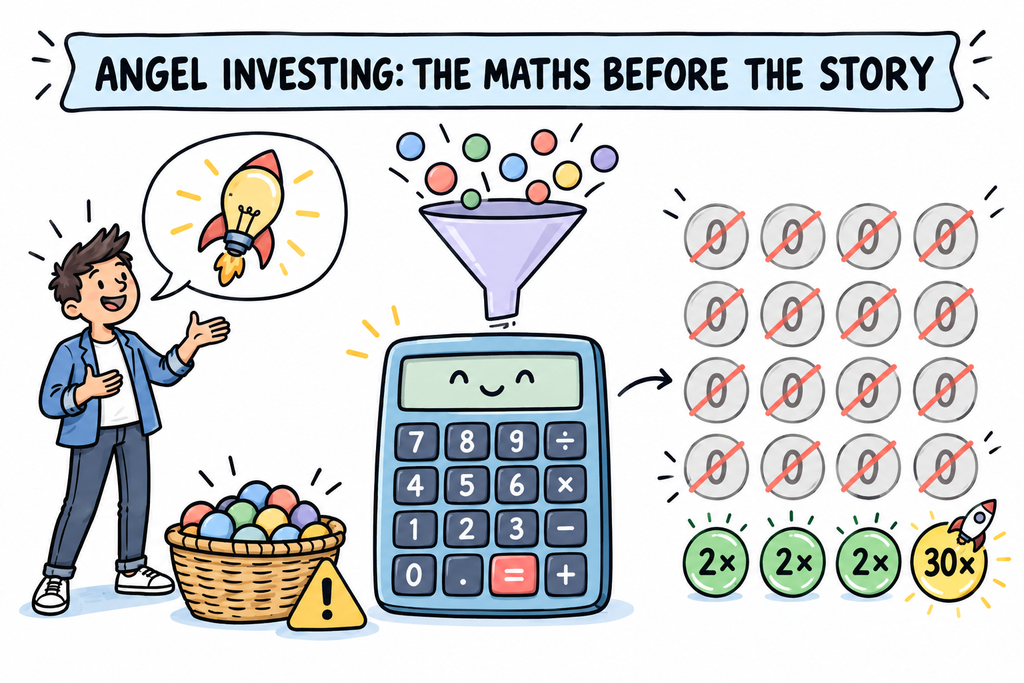
A commonly used shape, and a fairly generous one, looks like this. Out of every twenty companies you back:
- One does something remarkable and returns thirty times your money.
- Three do fairly well and roughly double.
- Sixteen return nothing at all.
Work out the average across all twenty and you get 1.8 times your money. That is a good return. It is also the number you will be quoted when someone explains why this is worth being in.
Now work out the middle outcome of a single bet. It is zero.
The average is real, and almost nobody gets it
This is the part worth slowing down for. The 1.8 times is true of the asset class. It is not true of most of the people in it, because most of them do not make enough bets to meet the winner.
Run that same shape twenty thousand times over portfolios of different sizes and here is what actually happens to people.
- 5 companies: the average is still 1.77 times, but the middle result is 0.4 times, and there is a 75% chance you end up with less than you put in.
- 10 companies: middle result 0.6 times, 60% chance of losing money.
- 20 companies: middle result 1.7 times, 36% chance of losing money.
- 30 companies: middle result 1.4 times, 21% chance of losing money.
Read the first line and the last line together. Same asset class, same odds on every individual company, same generous assumptions. The person who backed five has a three in four chance of losing money. The person who backed thirty has a four in five chance of making it.
Nothing about skill separates those two. Only the number of bets.
So what does it actually cost to enter?
Not the ticket size you are being quoted. The ticket size gets you one bet, and one bet has an 80% chance of returning nothing.
The real entry price is twenty to thirty bets. At ₹5 lakh a company that is ₹1 crore to ₹1.5 crore, committed across several years, in money you can genuinely afford never to see again.
If that sentence made you uneasy, good. Backing three companies for ₹15 lakh is not a small version of angel investing. It is a different activity with worse odds.
The regulator has reached the same conclusion
You do not have to take the maths on faith, because SEBI has quietly acted on it.
Angel funds, the pooled route most individuals use, are being restricted to accredited investors. To count as one you need income above ₹2 crore a year. Or a net worth above ₹7.5 crore, with at least ₹3.75 crore of it in money and investments. The minimum investment into such a fund is ₹25 lakh.
Funds registered more recently already operate on that basis. Older ones have been given until March 2027 to comply, so for a while longer some will still accept ordinary investors.
That transition window is worth naming plainly. If you are offered a place in an angel fund without meeting those limits, you are being let in through a door that is closing. You are not being given a chance others missed.
Four things the pitch will not cover
- You cannot get out. There is no market for these shares. Money goes in and stays in for seven to ten years, or until the company is sold or fails. If things change for you, the money does not come back.
- The valuation is a number in a document. Until somebody actually buys the company, what your stake is “worth” is whatever the last funding round agreed. A statement showing growth is not the same as money you could have.
- Later rounds shrink your share. When the company raises again, your slice gets smaller unless you put in more. Being unable to follow your money is a normal way for early backers to end up with very little of a success.
- The tax treatment is not the friendly one. Unlisted shares need twenty four months to count as long term, not the twelve a listed share needs. The yearly tax free limit on listed shares does not apply here either. The capital gains calculator handles unlisted holdings if you want to see it.
And the odds in India
Roughly nine in ten Indian startups do not survive five years, and more than twenty eight thousand shut down between 2023 and 2025. That is not a criticism of the founders. Building something new is genuinely hard, and most attempts at hard things fail.
It does mean the sixteen in twenty returning nothing is a description of reality rather than pessimism.
Who this is for, and what to do otherwise
It suits someone who can put a crore or more across thirty companies over several years. Someone who will never need that money back on a set date, and who wants to be part of it as much as they want the return. For that person it is a reasonable, if small, corner of a portfolio.
If that is not you, the honest answer is that there is no smaller version worth doing. The thing that makes this work is the number of bets, and the number of bets is the thing you cannot afford.
Perhaps what draws you is the growth of Indian companies rather than the thrill of picking one. You can own a great many of them through an index fund, with none of the lock in and none of the guessing. It is a duller sentence at a dinner table and a much better sum.
One last thought, on the version of this that arrives from a friend. Money put into someone you care about is rarely a clean investment decision. Decide up front whether you are investing or helping. Both are fine. Confusing them costs you the money and the friendship.
This article is for learning. It is not personal financial advice and it is not a recommendation of any company, fund or network. The return shape used above is a common illustration, not data from any one portfolio, and real results vary hugely. The simulation only shows what that shape does across portfolios of different sizes. Accreditation thresholds, fund minimums and compliance deadlines are set by SEBI and change, so verify the current position before acting. For advice about your own situation, speak to a SEBI-registered investment adviser.