
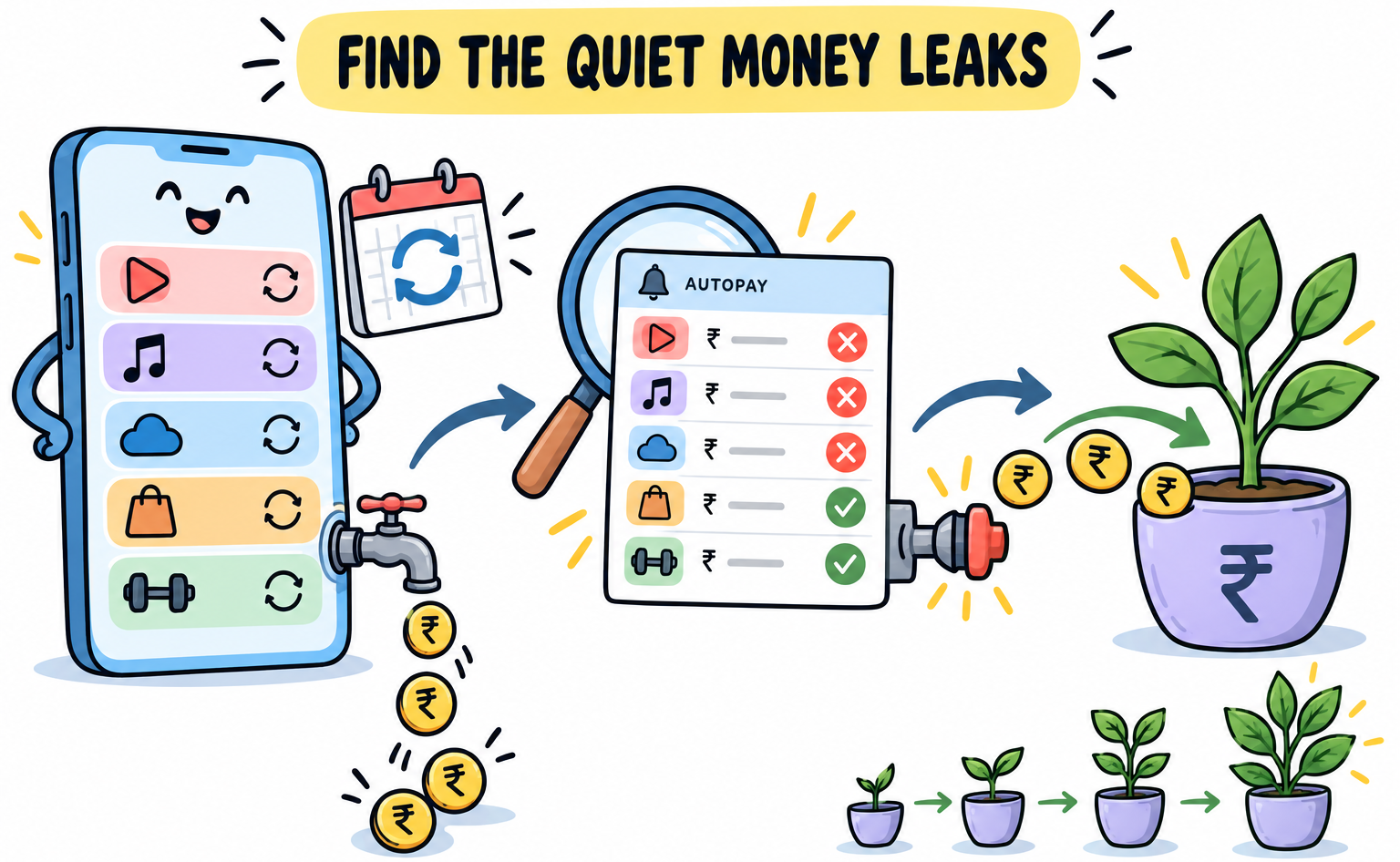
Count the things that take money from your account every month on their own. Video apps. Music. A delivery membership. Phone storage. A gym you meant to go back to.
Most people guess three. Most people are wrong.
What a small amount turns into
Here is an ordinary list. Nothing silly in it.
- Three video services: ₹600
- A music service: ₹120
- A food delivery membership: ₹200
- Phone or photo storage: ₹80
- One thing you have forgotten: ₹200
That is ₹1,200 a month. Or ₹14,400 a year.
Now suppose you put that money into a fund instead, and it grows 11% a year.
- After 10 years: ₹2.6 lakh
- After 20 years: ₹10.5 lakh
- After 30 years: ₹34 lakh
This is not a lecture about cancelling everything
Read those numbers and the obvious reaction is to cancel the lot. Do not.
If you watch a service most weeks, ₹200 a month is fine. That is what money is for. A plan with no joy in it does not last, and you will go back to all of them in three months anyway.
The problem is not the ones you use. It is the ones you forgot.
Say ₹400 of that ₹1,200 goes on things you have not opened in months. Over 20 years that ₹400 is ₹3.5 lakh.
You did not enjoy it. You did not decide to spend it. It simply left.
Why you forget them
This is the clever bit, and it is worth seeing.
You do not pay a subscription each month. You said yes once, maybe two years ago. After that it renews on its own.
Buying a ₹200 shirt makes you stop and think. A ₹200 subscription asks you once, then never asks again. Same money, no decision.
Free trials work the same way. You sign up to watch one thing. The card is already saved. Nothing tells you when the free part ends.
How to find every one of them today
There is now a rule that makes this easy, and almost nobody uses it.
Your bank must warn you at least 24 hours before any automatic payment is taken. The message has to say who is being paid, how much, and when. You can stop it before it goes.
So that list already comes to you. It arrives one message at a time, and most people delete it without reading.
Do these four things. It takes about twenty minutes.
- Open your UPI app and look for the section on standing payments. Different apps call it different things, usually Autopay or Mandates. Every one you have set up is listed there, and you can stop any of them from that screen.
- Log in to your bank and look for standing instructions or e-mandates. Card payments often sit here rather than in your UPI app.
- Read the last three months of your card statement, line by line. Look for the same amount showing up on roughly the same date. That is a subscription, even if you do not recognise the name.
- Search your email for the word “renewed”. Also try “receipt” and “your plan”. Things you forgot will come up.
Write them all down on one page. That page is usually a surprise.
Then ask three questions
Go down your list and ask these about each one.
- When did I last open it? Not last pay for. Last open. If you cannot remember, that is your answer.
- Would I sign up for this today at this price? Prices go up quietly. You agreed to the old one.
- Is someone else in the house already paying for it? Two people often buy the same thing separately. Family plans usually cost less than two singles.
You do not have to cancel on the spot. You can stop the automatic payment and let it run to the end of the month you already paid for. If you miss it, take it back.
One trap with yearly plans
You will be offered a year up front, often with two months free. A ₹199 service costs ₹2,388 a year monthly, or about ₹1,990 paid yearly. You save ₹398.
That is a real saving, but only if you were going to keep it all twelve months.
So pay yearly for the one or two you know you use. Pay monthly for anything you are unsure about. Never pay yearly for something in a free trial.
Do one more thing after
Here is where most people lose the benefit.
You cancel ₹400 a month. The money stays in your account. Within two months it has quietly gone somewhere else, and you are no better off.
So set up a transfer for the same amount on the same day. If ₹400 used to leave on the 5th, let ₹400 go into a fund on the 5th. You have already proved you can live without it.
Pay yourself first explains why the date matters more than the amount. And the compound interest calculator will show you what your own number grows into.
The point is not to live with less. It is to stop paying for things that gave you nothing.
This article is for learning. It is not personal financial advice, and no service or company is named or recommended here. The prices used are ordinary examples, not real plans, and they change often. The rules on automatic payments are set by the Reserve Bank of India and were updated in 2026, so check what your own bank and app show you. The growth rate used is an example to show how the sums work, not a promise. For advice about your own money, speak to a SEBI-registered investment adviser.