
This one is written to you.
If your marriage is ending, or you think it might, there is a legal side and a money side. The legal side needs a lawyer. This page is the money side. But you cannot handle the money side without knowing a few legal words. So we will explain those too, in plain terms. Not so you can argue your own case. So that you can follow what you are being told.
Start with what is already yours
There is an old word for this. Streedhan. It means a woman’s own property. It covers the gifts and money you were given before the wedding, at the wedding, and after it. From your parents, your relatives, or his family. Jewellery is the usual example. It is not the only one. The Supreme Court has said this many times. Streedhan is yours alone. Your husband has no share in it. Nor do his parents. Nor, the Court has said, does your own father.
If someone else is holding it, they hold it for you. Keeping it from you is not a family quarrel. It is a crime. So here is the one job to do early. Write down what you were given. Who gave it. Roughly when. Find any photographs, bills or receipts. Wedding photos count for more than people expect. Do this while you can still get at the papers. That is the whole reason to do it early.
Where you are allowed to live
Many women are told to leave the house. Most believe they have to. You do not. A law from 2005, the Protection of Women from Domestic Violence Act, gives you a right to live in what it calls the shared household. That is section 17 of it. The important part is what it does not ask. It does not ask whose name the house is in. You can have no share in it at all and still have the right to stay. Nobody can put you out except through a court.
In 2021 the Supreme Court went further. A house owned by your in laws can still count, while your husband arranges somewhere else for you. This right has limits, and a lawyer will tell you yours. But do not walk out believing you had no choice. That belief has cost a lot of women their home.
Money to live on
The legal word is maintenance. It just means money for your living costs. There are two kinds, and they run at different times.
- While the case is going on. A case can take years. You are not meant to go without money for those years. The court can order him to pay you every month from early on, and to pay your legal costs.
- After the divorce. This is the one people call alimony. It can be a monthly amount, or one large payment, or both.
For Hindu, Sikh, Jain and Buddhist marriages these are sections 24 and 25 of the Hindu Marriage Act. Other communities have their own law that does much the same thing. Ask which one applies to you. There is also a second road, open to every woman whatever her religion. It used to be called section 125 of the Criminal Procedure Code. That law was replaced on 1 July 2024. The same rule is now section 144 of the Bharatiya Nagarik Suraksha Sanhita.
Only the number changed. If an older website or an older relative says 125, they mean the same thing. A case filed before that date carries on under the old number. One more thing worth knowing. The amount is not fixed forever. Either of you can go back later and ask to change it if life changes.
What Indian law does not give you
This part is unfair, and you should hear it early rather than late. India has no rule that splits everything down the middle. In some countries, what either person earns during the marriage belongs to both. Not here.
Here, things belong to whoever’s name is on them.
- In both your names. You have a claim. The court looks at who paid what, how long you were married, and what each of you needs now.
- In his name only. There is no automatic share for you. If you put money in, you have to show it. Bank records, transfers, your own savings going in.
- In your name only. Yours.
So the money you are likely to end up with comes mostly through maintenance, not through splitting the house. That is why the maintenance figure matters so much, and why it is worth taking seriously rather than accepting the first number offered.
Your years at home were work
If you did not earn, you may have been told you brought nothing in. You will hear it again during the case. The courts no longer see it that way.
In June 2026 the Supreme Court called homemakers nation builders. In accident cases it now puts a floor of ₹30,000 a month on the value of running a home, rising every three years. Indian women spend close to six hours a day on that work.
That ruling is about accident claims, not divorce. So do not expect a judge to hand you that exact figure. What it tells you is how the courts now think. Your years at home count for something, and the idea that they were worth nothing is out of date.
One large payment, or money every month?
You will be told the answer is tax. It usually is not. Here is what is true. One large settlement is not taxed at all. Money paid to you every month is taxed as income. That sounds like it settles the matter. Now look at the actual numbers, for a woman with no other income.
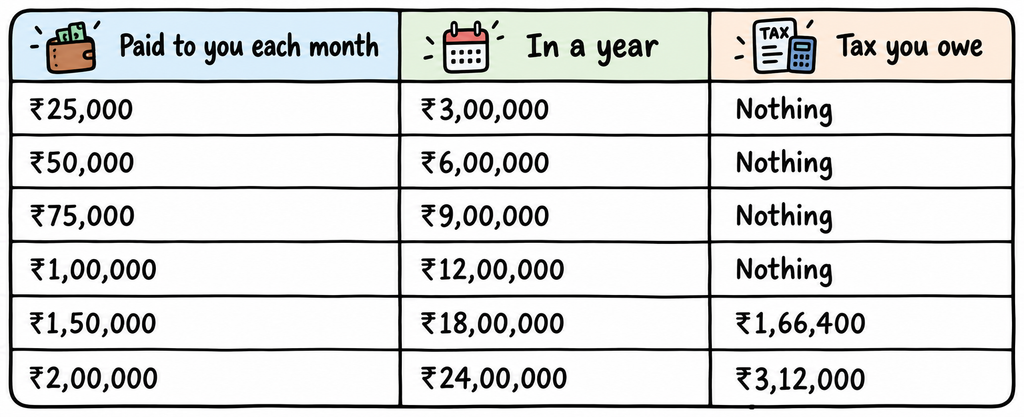
Up to ₹1 lakh a month, you owe nothing. The tax is worked out, and then a rebate wipes it away. The twelve lakh cliff explains that rebate. So for most women the tax point is simply not real. It only starts to bite above ₹1 lakh a month.
One warning. If you have a job, the maintenance sits on top of your pay and both are taxed together. Then tax can start much sooner. On a ₹9 lakh salary, ₹50,000 a month of maintenance costs about ₹97,500 in tax.
Once tax is out of the way, the real question shows up. It is about how safe the money is.
- Monthly can stop. He loses his job. He moves away. He goes back to court to get it cut. Then you are chasing him, perhaps for years.
- One payment ends all that. It is in your hands and nobody can take it back. But it has to last the rest of your life, and that job is now yours.
Neither is the right answer for everyone. Just choose on that question, not on a tax rule that may not even apply to you.
The papers nobody remembers to change
A divorce ends a marriage. It does not touch any form you filled in years ago. He is probably still the person named on your savings, your provident fund and your insurance. If you wrote a will, he is probably still in it. None of that changes by itself. Note the odd gap here. Getting married cancels a provident fund nomination you made before it. Getting divorced cancels nothing at all. So go through them one at a time. Bank accounts. Provident fund, on the member portal. Any insurance. Mutual funds. Your will, which needs a fresh one. And close any joint account you are still on. Either of you can empty it, and either of you can be chased for what it owes.
Starting with nothing in your own name
Some women reading this have never had money of their own. No account only in their name. No card. Nothing a bank has ever seen them do. That is a real problem, and it is a fixable one. To a bank you barely exist yet. Not because of anything you did. Because everything was in his name, so there is no record of you. That is what makes renting a flat or getting a loan hard later. It builds back faster than you would think. A year of a salary landing in your own account changes the picture. So does a card you use for small things and clear in full every month.
The only three accounts you actually need is the shortest way to set the basics up.
What to do, in order
- Open an account in your name alone. At a bank he does not use. Everything else needs this first.
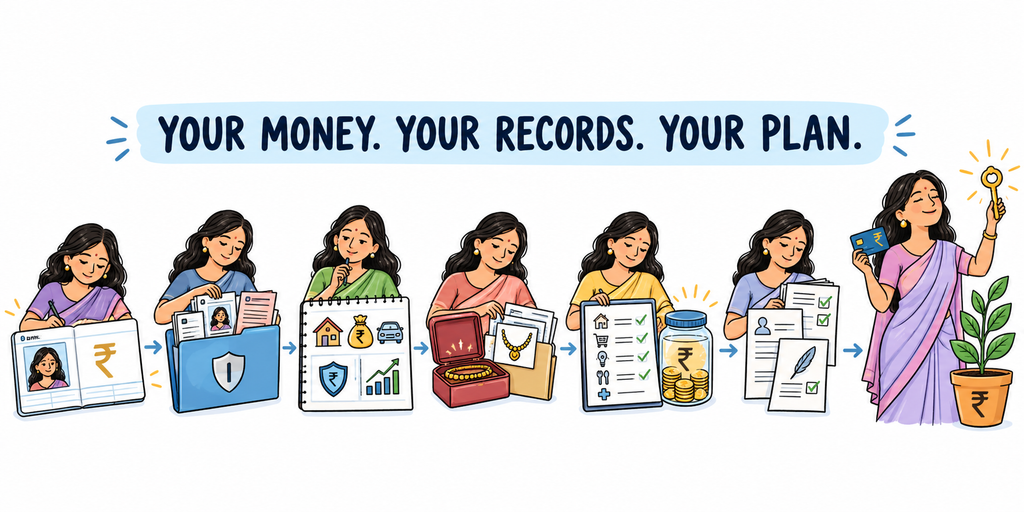
- Find your own papers. Aadhaar, PAN, your qualifications, your bank papers, the marriage certificate. Keep copies somewhere else as well.
- Write down what the household owns. House, loans, cars, savings, his provident fund, his insurance, his shares. Whatever you can see. Nobody can ask for a share of what they cannot name. Working out a net worth shows the way to lay it out.
- List your streedhan, with whatever proof exists. Do it now, not later.
- Work out what a month actually costs you. Rent, food, school fees, medicines, travel. This becomes the number you ask for. Guessing low here is the most common and most expensive mistake.
- Build a small cushion, however small. Even a few months of costs buys you the ability to say no. An emergency fund that fits your life covers it.
- Change every nomination, and write a will.
- Then start saving a share of whatever comes in. The savings rate calculator shows what that share does over time.
Steps one to five can be done before anything is decided. None of them commits you to leaving. They are simply things a person should know about their own life.
The part that is actually hard
Money knowledge in most Indian marriages sits with one person. Often that is not the wife. So the day it ends, she is learning two things at once. How her money works, and how to live differently. That is a lot. It is also why the first steps here are small ones. An account with your name on it. A list of what exists. A number for what a month costs.
None of that is dramatic. But each one moves a little of the knowing from his side to yours. And that, far more than any settlement figure, is what having money of your own actually means.
This article is for learning. It is not legal advice and it is not personal financial advice. Family law in India depends on your religion, your state and the facts of your own case, and only a lawyer can tell you where you stand. Court decisions on maintenance, residence and property vary from case to case. The tax figures are for a resident individual on the newer regime in tax year 2026-27, assume no other income unless stated, and tax rules change with every Budget. The law on maintenance was renumbered on 1 July 2024, so check which number applies to your case. For advice about your own situation, speak to a lawyer and to a SEBI-registered investment adviser.