Open a banking app and it will offer you a dozen things. Trading account, gold account, credit line, insurance, a card with points.
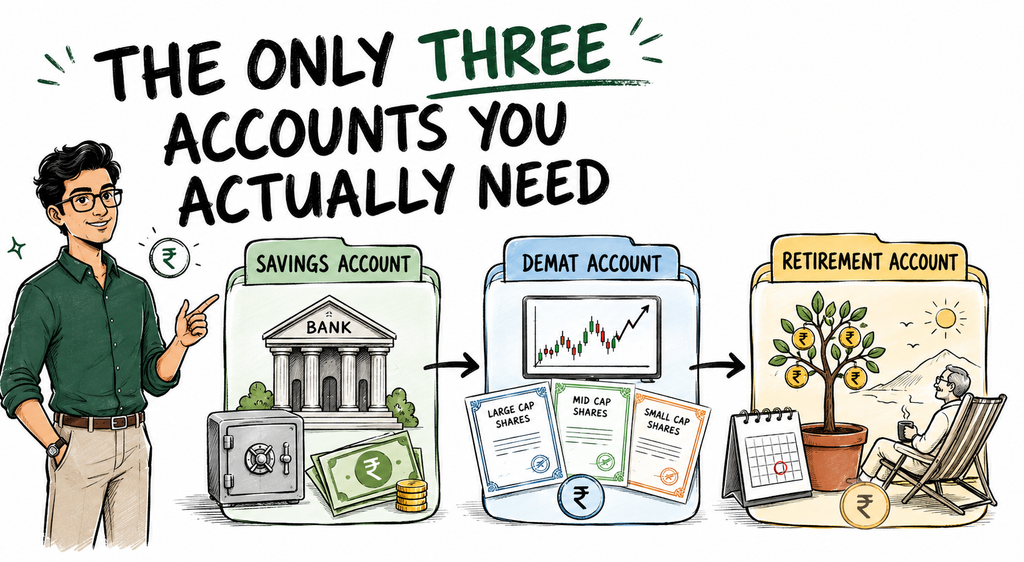
You need three accounts. Possibly two.
1. Fewer Than You Think
Money does three jobs, so you need one place for each. One place it lands and gets spent. One place it grows. One place it waits until you are old. Everything else being sold to you is a version of one of those three. Usually a costlier version. The order matters too. Get the first two working before you think about the third, because the third one locks your money away for decades.
Opening all three in one weekend feels productive. It is usually how people end up with a pension they cannot reach and no buffer for the month the fridge dies.
2. Where Money Arrives
A savings account. Your pay lands here. Your rent leaves from here. So does the money you invest, on a fixed date each month. If your employer gives you a salary account, that is the simplest option. Those tend to have no minimum balance while you work there. If you are opening one yourself, every bank must offer a basic zero balance account. There is a catch worth knowing before you ask. You cannot hold any other savings account at the same bank. If you already have one there, it has to be closed within thirty days of opening the basic account.
So it suits a first account, not a second one at a bank you already use. One account is enough. Two at most, if you want the buffer out of sight. Any more and you are just making balances to forget about.
3. Where Money Grows
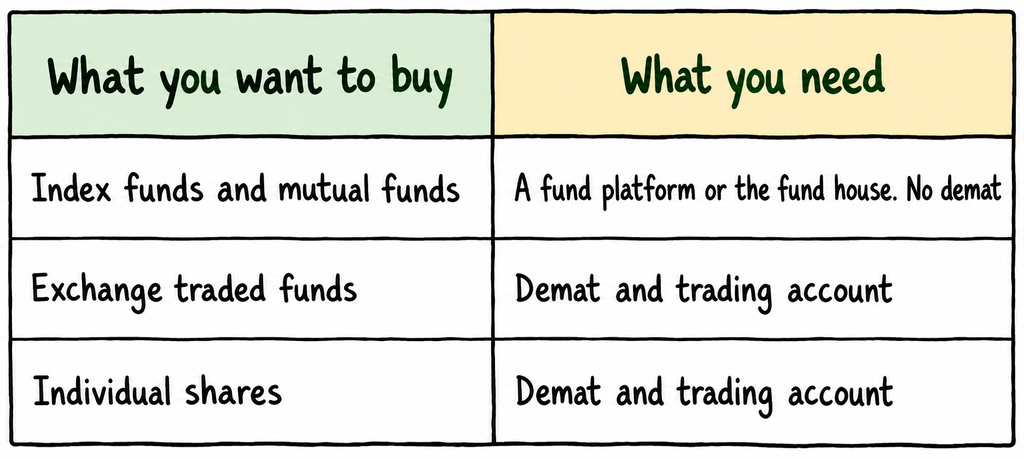
This is the one people get wrong, and it costs them money. To buy mutual funds you do not need a demat account. Units can be held as a statement of account, through the fund house itself or through a platform. A demat account is for holding shares, and for exchange traded funds bought on the market. If you are starting with an index fund, you do not need one.
This matters because the apps offering a free demat and trading account are not doing it out of kindness. They earn when you trade, so the whole thing is built to encourage trading. A beginner handed a trading screen tends to use it. None of which makes these apps bad. Several of them are the cheapest way to buy funds. Just open the part you need and leave the rest alone.
Here is what each thing actually requires.
Whatever you use, check that it offers direct plans. Same fund, lower annual cost, because nobody is being paid a commission out of it. The difference is covered in your first index fund.
4. Where Money Waits Until Sixty
The National Pension System is the retirement account, and it needs an honest description rather than the usual one. There are two kinds. Tier 1 is the real one, locked until you turn sixty. Tier 2 has no lock in and no tax break at all. It is not a tax saving product, whatever you are told when somebody opens one for you. Now the part that has changed and that a lot of advice has not caught up with.
| NPS Tier 1 contributions | Old regime | New regime |
|---|---|---|
| Money you put in yourself | Deductible, with an extra ₹50,000 above the ₹1.5 lakh ceiling | Nothing |
| Money your employer puts in | Up to 10% of basic salary | Up to 14% of basic salary |
The new regime is the default. Most people are on it. So for most people, putting your own money into NPS now gets you no deduction at all. What survives is the money your employer puts in. That part is well worth having. On a basic pay of five lakh, fourteen per cent is seventy thousand a year going in untaxed. Take the same money as pay on the thirty per cent slab and forty nine thousand reaches you. That is twenty one thousand a year, for filling in a form. So if your employer offers it, take it.
Adding your own money on top is a different question. What you are buying is a good low cost pension fund, locked until sixty, and on the new regime no tax break to make up for the lock. That can still be the right call, especially if not being able to touch it is the whole point. Just choose it for that reason, and not for a tax break you may not be getting.
Which regime you are on is covered in old regime or new regime.
5. What You Do Not Need
- A trading account, unless you are buying shares. Free is not free when the business model is your trading.
- Four savings accounts. Old salary accounts from previous jobs quietly start charging you once you leave. Close them.
- A policy that insures and invests at once. Products doing both tend to do neither well. Keep the two apart.
- A credit card in month one. Get the salary, the rent and the monthly investment working first. The card can wait a year.
Two of those catch almost everyone. The forgotten salary account that starts charging you a penalty, and the policy bought from a relative that turns out to run for fifteen years.
Set the monthly transfer up once the first two accounts exist. Pay yourself first covers why the date matters more than the amount. The savings rate calculator shows what the share you keep does to the year you could stop working.
This article is for learning. It is not personal financial advice and it is not a recommendation of any provider or product. Tax treatment described is for the tax year 2026-27 under the Income Tax Act 2025, and both regimes and limits change with Budgets, so check the current position before deciding anything. Account rules differ between banks and platforms. For advice about your own situation, speak to a SEBI-registered investment adviser.