
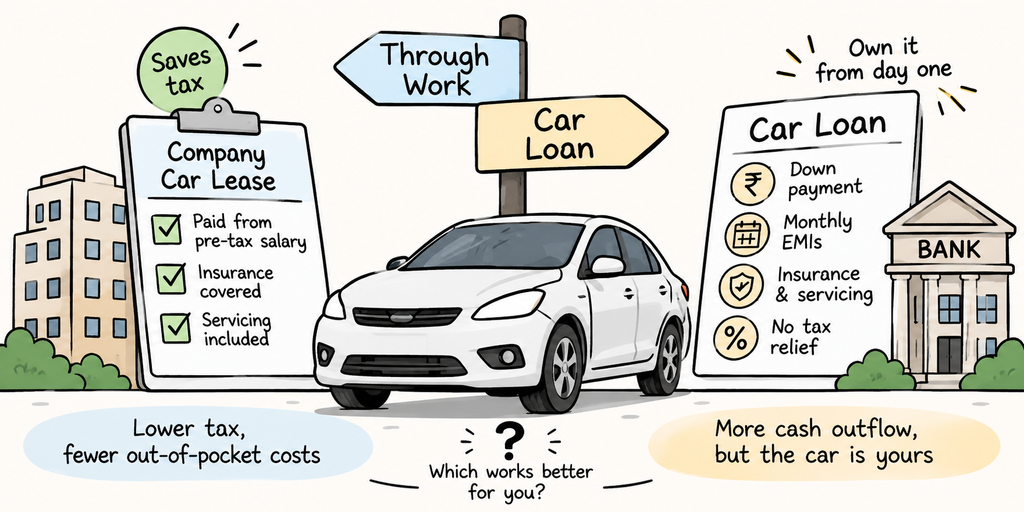
If your employer offers a car lease, you have probably been told it saves tax. It does. But the rules changed this year, and the saving is smaller than it was. This page works the whole thing out, line by line, so you can do it with your own numbers.
How a car through work actually works
The car is not yours. A leasing firm owns it. Your employer rents it and hands you the keys. The rent comes out of your pay package before tax is worked out. That is the whole trick. Money that would have been salary, and taxed, becomes rent instead. You do not get away with nothing, though. Because you drive a car your employer pays for, a fixed amount is added back to your taxable pay. That added amount is the bit that changed.
What you are taxed on now
New values were notified in March 2026 and apply from 1 April 2026. They are not a proposal. They are in force.

Small means an engine up to 1.6 litres. Electric cars are treated as small, whatever their power.
Two things to note. The values roughly tripled. And they apply to leases already running, not just new ones. So your tax went up this April on a car you signed for years ago. For a small car where the employer pays running costs, that is ₹11,981 a year of extra tax in the 30% bracket. On a bigger car with a driver, more.
The workings: leasing
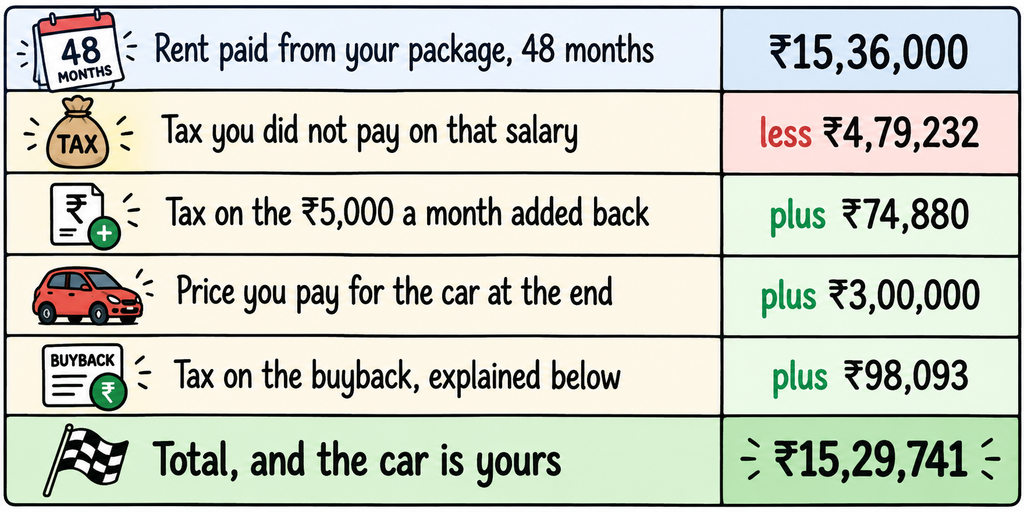
Take a car costing ₹15,00,000. A four year lease at ₹32,000 a month, covering insurance and servicing. You are in the 30% bracket, so with cess your rate is 31.2%. At the end you buy the car for 20% of its price.
The workings: buying it yourself
Same car. You put 20% down and borrow ₹12,00,000 at 9% over four years. You pay for insurance and servicing yourself, say ₹45,000 a year.
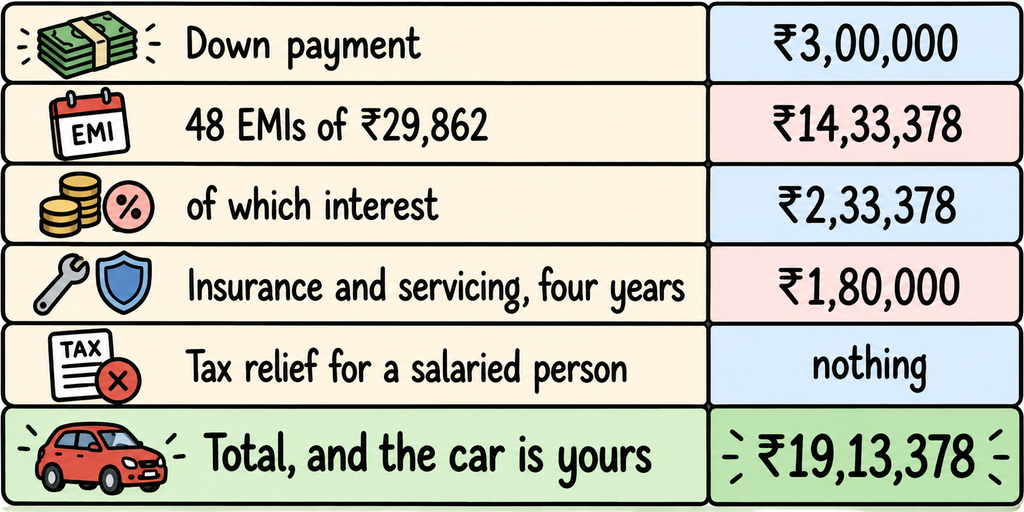
On these numbers the lease is ₹3,83,638 cheaper. Note that last line in the buying table. A salaried person gets no relief at all on a car loan. None on the interest, none on the price. That surprises people.
Be careful with that ₹3.83 lakh
It is not all tax. A good part of it is simply that ₹32,000 a month was a cheap quote. A leasing firm buys in bulk and can claim things an individual cannot. So its rent can be lower than your cost of owning, before tax enters into it. Change the rent and the answer changes. So do not use anyone’s example, including this one. Use the one number that matters.
The number to actually use
Ask for the monthly rent on the car you want. Then check it against this.
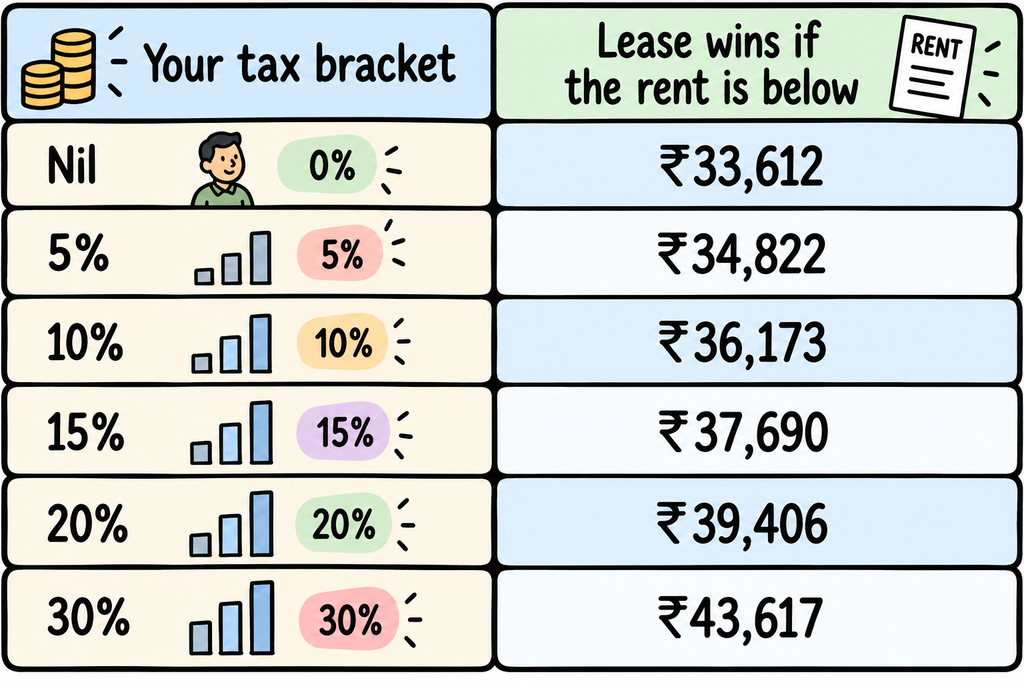
That is for this ₹15,00,000 car over four years. Your car will give different figures, but the shape holds. The higher your bracket, the more rent you can afford to pay and still come out ahead.
Strip out the cheap quote and look at what the tax rules alone are worth, on the same ₹32,000 rent over four years.
- 30% bracket: ₹3,06,259
- 20% bracket: ₹2,04,173
- 10% bracket: ₹1,02,086
It is a straight line. A lease is worth roughly three times as much to someone in the top bracket as to someone in the 10% band. If your pay is modest, this is not really for you.
The sting at the end
This is the part nobody is told, and it is worth lakhs. At the end you buy the car cheaply. That looks like a gift. The tax rules treat it as one. They have their own idea of what the car is worth. Take the price when new and knock off 20% for each full year, each time from what is left. They do not care what the car would fetch in the market.
After four years, a ₹15,00,000 car is worth ₹6,14,400 by that method. If you buy it for ₹3,00,000, the gap of ₹3,14,400 is added to your pay and taxed.
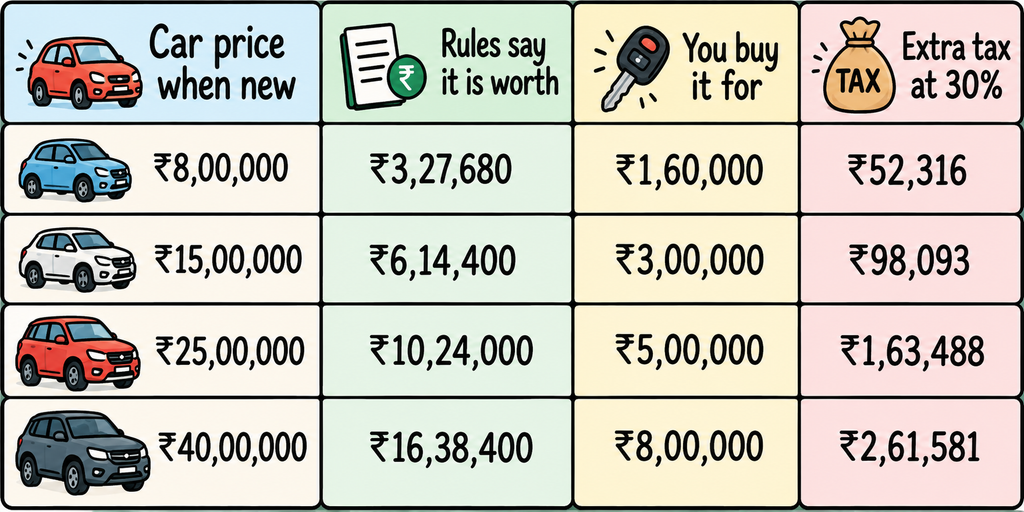
It arrives as a lump in one month’s payslip, four years after you agreed to any of it. Ask about it before you sign, not after.
What happens if you leave the job
The lease sits between your employer and the leasing firm. You are not really a party to it. So when the job ends, so does the arrangement.
What usually happens is one of these.
- You close it early and pay to do so. Many firms want this settled before your last working day, and every cost is yours.
- You buy the car out. Often at a price set by the lease, not by the market.
- Your new employer takes it over. This needs all three sides to agree, so do not count on it.
- You hand the car back. If you do not, your old employer can come after you for it.
So a four year lease is a quiet bet that you will stay four years. If you are the sort of person who moves every two, price that in. Leaving a job on purpose is much harder with a lease running.
If you work for yourself, ignore all of the above
Different rules, and better ones. If the car is used for your business, you can claim the loss in its value each year against your profit. The rate is 15% a year for a normal car, and 40% for an electric one, which is a large difference. You can also claim the loan interest and the running costs. If the car is used partly at home, you claim only the business share, and you should be able to show how you worked that share out.
None of that is open to a salaried person. It is the single biggest difference between the two situations.
One benefit that has quietly closed
You will still find pages offering a special deduction for interest on an electric car loan, worth up to ₹1,50,000 a year. It is shut. It only ever applied to loans approved up to 31 March 2023. A loan taken today does not qualify. And even for those who still have it, it works only on the older tax regime. The newer one is the default now. If a salesman brings this up, they are working from old notes.
What to do
- Ask payroll which amount they will add to your pay. ₹2,000 or ₹5,000 makes a real difference, and it depends on who pays for fuel and servicing. Get it in writing.
- Ask for the buyback price, and work out the tax on it now. Price when new, less 20% a year, less what you will pay. That gap gets taxed.
- Ask what happens if you resign. Get the early closing charges before you sign, not when you are holding an offer letter.
- Compare the rent to the table above. Below the line for your bracket, the lease wins. Above it, it does not, whatever you are told.
- Check your bracket first. In the 10% band this saves a fraction of what it saves at 30%, and comes with the same lock in.
- Do not let the tax saving choose the car. A saving on a car you would not otherwise have bought is not a saving. What will people say covers how that happens.
A work lease is a real benefit for someone in the top bracket who will stay put and who wanted the car anyway. For everyone else it is a long contract wrapped around a modest saving.
Both of those can be true at once. Which one you are looking at depends on your bracket, your car, and how sure you are about the next four years.
This article is for learning. It is not personal tax advice, and no bank, leasing firm, car maker or company is named or backed here. The worked example uses a ₹15,00,000 car, a four year lease at ₹32,000 a month covering insurance and servicing, a buyback at 20%, a car loan at 9% with 20% down, and upkeep of ₹45,000 a year when buying. Every one of those is an assumption, and changing any of them changes the answer, which is why the article gives you the break even rent instead of a verdict. Figures use a 30% bracket with 4% cess unless stated, and ignore surcharge, which applies at higher incomes. The values added to taxable pay are those notified in March 2026 and in force from 1 April 2026, and they apply to leases already running. Lease terms, buyback prices and early closing charges differ by employer and by leasing firm, so read your own policy. Tax rules change with every Budget. For advice about your own situation, speak to a qualified tax professional.