
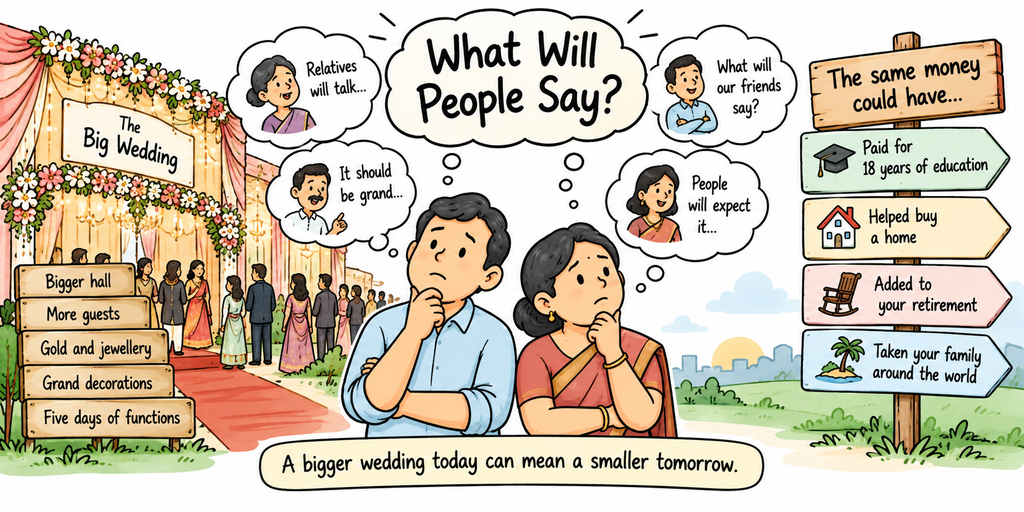
Four words decide more money in India than any calculator ever will.
What will people say.
They set the size of the hall. The number of guests. The gold. Whether you spend one year of savings or ten. This page will not tell you to spend less on a wedding. It shows you what the spending costs. Then you can choose it, instead of drifting into it.
The size of it
One study looked at what Indian homes spend. It found something hard to forget. Most spend about twice as much on one wedding as on eighteen years of a child’s schooling. Eighteen years of fees, books, clothes and tuition. Beaten twice over by five days.
You will also see a figure quoted for the cost of a typical Indian wedding. Do not trust it. Those come from wedding firms asking their own clients, who are people set on big weddings. Your number is your own.
What the money would have become
Money spent is not just gone. It is also not growing. Here is what a sum would have turned into, left alone, growing at 10% a year.
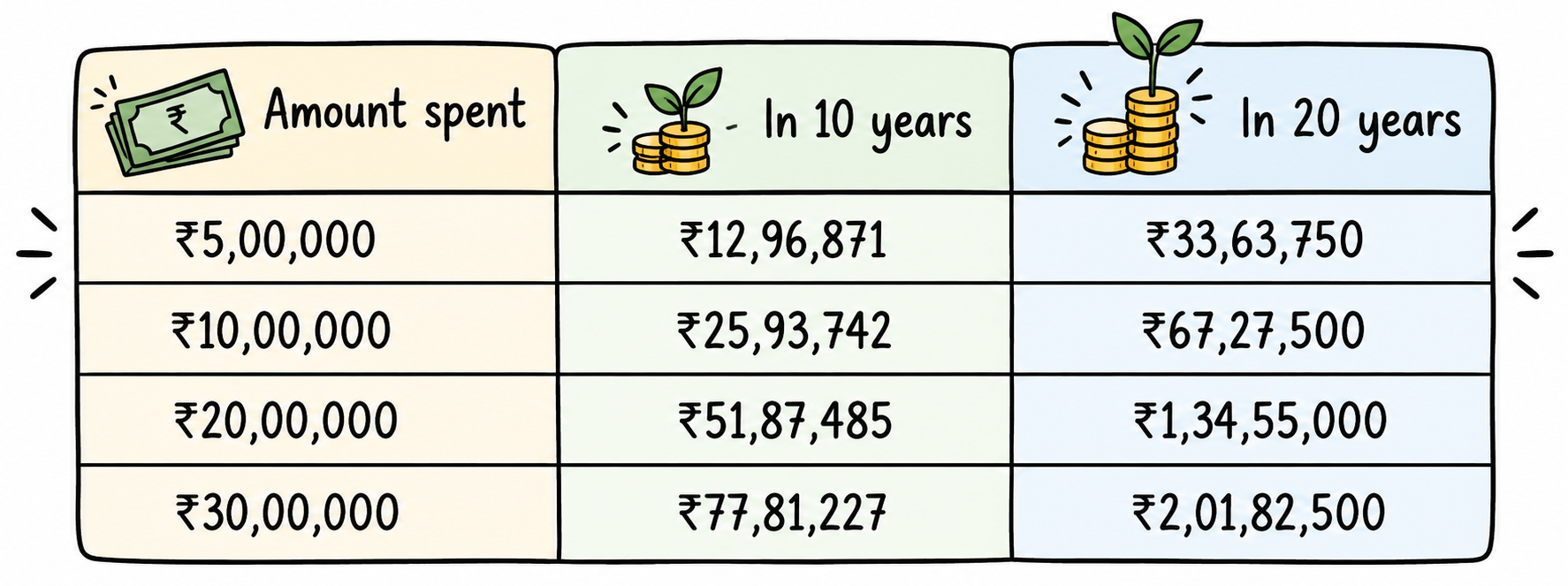
That is the true price. Not what you paid. What you gave up.
The case that goes wrong most often
A parent of 52 spends ₹20 lakh on a child’s wedding. It comes out of the old age fund, because that is where the money is. They plan to stop work at 62. So that ₹20 lakh had ten years left to grow. It would have been ₹51,87,485. Now turn that into monthly money. Drawn at a safe rate, it would have paid them about ₹15,130 a month, for life. That is what was spent. Not ₹20 lakh. Fifteen thousand a month, for good.
There is a second half that no one says out loud. Ten years on, the parents run short. The child then sends money home each month. So the wedding was paid for twice, by the same people, in the wrong order. No one plans this. It happens because the sum above is never done.
Please do not take a loan for it
A wedding loan is a plain personal loan with a nicer name. The rate is often 14% to 16%.
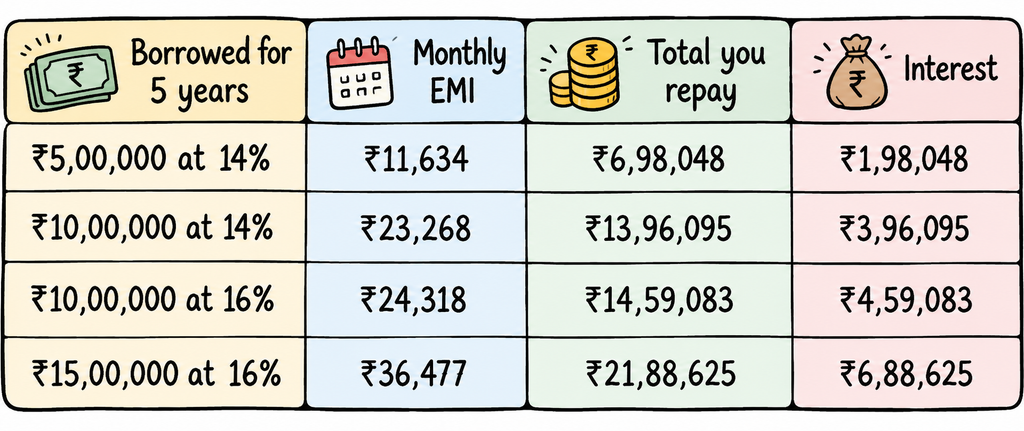
Take ₹10 lakh and you hand back nearly ₹14 lakh. The couple starts married life owing ₹23,268 a month for five years. For a party that ended long ago. A house or a degree can be worth a loan. Both leave something behind. A day does not.
The one lever that works
People try to cut costs by arguing over flowers. It never works. It just makes everyone cross. Only one number moves the whole bill. The guest list. Guests do not just eat. They set the size of the hall, the staff, the flowers and the rest. Cut guests and each of those falls too.
Take a plate at ₹1,200, across three events.
- 500 guests: ₹18,00,000 on food alone.
- 300 guests: ₹10,80,000.
- 200 guests: ₹7,20,000.
Each 100 guests you leave off saves ₹3,60,000 of food. And more again on all the things the food sits inside. Now ask the hard question. How many of those 500 do you speak to in a normal year?
Another way to spend it
Say you have ₹20 lakh set aside for a child’s wedding. There are two ways to use it. Spend it on the day, and 500 people eat well. Or hold a smaller wedding for ₹6 lakh. Give the couple the other ₹14 lakh. Left to grow for 25 years, that turns into about ₹1.51 crore. It is their house deposit, or most of their old age, handed over on day one. No one will praise you for the second one. That is the whole problem, and it is worth naming.
Why the pressure works
It helps to see how this works. The people you spend to impress are mostly doing the same thing back at you. Each home looks at the last wedding it went to and adds a little. So the number climbs each year. No single person ever chose it. Ask what you recall of a wedding you went to three years ago. Almost surely nothing about the flowers. That is how much anyone will recall of yours. The judging is real. It is just smaller and shorter than it feels while you decide.
What to do
- Set the number in private, before anyone else is asked. Once relatives are in the room, it only goes up. A number set in advance behaves nothing like one set in a meeting.
- Never take it from your old age fund. You cannot take a loan for old age. Your child can borrow for almost anything else. A study loan against your retirement works through the same trap.
- Save for it as a goal, years ahead. A wedding you have known about for a decade is not a shock. Turning a distant goal into a monthly number does the sum.
- Cut the guest list first. Everything else second. It is the only cut that shrinks every other cost with it.
- Give some of it to the couple instead. They will thank you in twenty years. No one thanks anyone for a stage.
- Give the family line its own budget. Weddings, gifts and festivals are a real cost in Indian life. When your money is also the family’s money plans for it, instead of being caught out. The budget calculator shows what your pay can free up.
None of this says have a small wedding. A wedding is one of the few days a family gets. Spending on it is a fair choice.
It only has to be a choice. Made with the real price in front of you. By the people paying. Before anybody asks what the neighbours will think.
This article is for learning. It is not personal financial advice, and no company is named or backed here. The 10% growth used is an example to show how compounding works, not a promise, and money in shares can fall. Loan rates on personal borrowing vary by lender and by borrower. Plate costs and guest numbers are examples, and yours will differ. The comparison between wedding and schooling spending comes from published research on Indian household spending, and it is an average across very different homes. For advice about your own money, speak to a SEBI-registered investment adviser.