
Most money advice ends with the same line. Check it once a year.
Almost nobody says what checking actually means. So it never happens, and things quietly drift for a decade.
This article is that missing list. It takes about two hours, once a year, and it covers everything.
1. Pick a Date and Keep It
Once a year is the right frequency. Checking every month makes you fiddle with things that need to be left alone. Checking never means you find out too late. Pick a date you will remember. Your birthday works. So does the first weekend of April, when the financial year begins. The date matters less than repeating it.
Before you sit down, gather these.
- Bank statements for the year
- Investment statements, including EPF and PPF
- Loan statements, showing what is still owed
- Every insurance policy you hold
Two hours with all of that in front of you is worth more than a year of worrying without it.
2. Start With What Changed
Do not open a single statement yet. First ask a simpler question. What changed in my life this year? Life events are what make old plans wrong. The numbers are only following along behind.
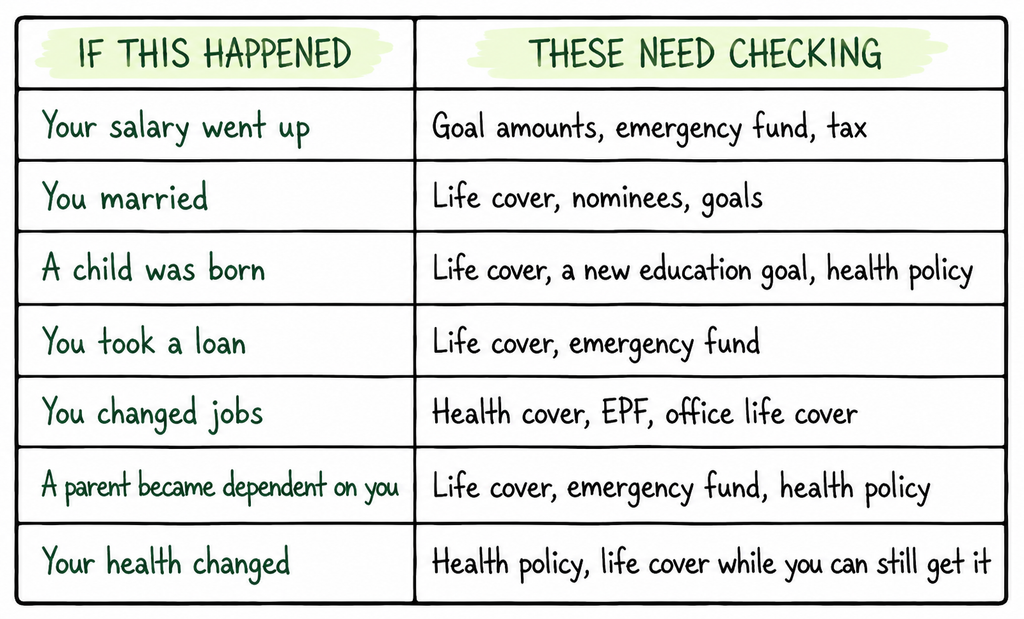
If nothing on that list happened, your review will be short. That is a good year, not a wasted one.
3. Check the Money
Four things, in this order.
Write down what you own and what you owe. One page. Bank balances, investments, EPF and PPF on one side. Home loan, car loan, credit card and personal loans on the other. Subtract the second from the first. That single number is the honest picture. Keep the page, and compare it next year. Watching it grow is the best encouragement there is.
Check the emergency fund. Is it still the right size for your life now? Did you use any of it this year? If so, refill it before doing anything else. The right amount changes when your life does, as covered in building an emergency fund that fits your life.
Look at your mix of investments. After a good year in the market, you will be holding more equity than you chose to. After a bad one, less. Bring it back to the mix you decided on, which is the whole idea behind how asset allocation keeps a plan balanced.
Revisit your goals. Has the cost of anything changed? Is a goal now closer than it was, so the money should be moving somewhere safer? And if your salary rose this year, raise the monthly amounts to match. Working out those amounts is covered in turning a distant goal into a monthly number.
That last point is where most progress comes from. A raise that goes entirely into spending is a raise you will not notice in ten years.
4. Check the Protection
This part takes twenty minutes and is the part people skip.
Is your life cover still enough? A new loan or a new child raises the amount your family would need. Run the sum again using how much life cover may be enough. If you are short, you can hold a second policy alongside the first.
Renew the health policy before it lapses. Put a reminder two weeks before the date. A gap of even a few days can send you back to the start of every waiting period, which is explained in the practical checklist for health insurance.
Check your nominees. This one is worth more than it sounds. A nominee is the person who receives the money if you die. You name one on each account and policy, and then you forget about it for twenty years.
Go through all of them. Bank accounts. Life insurance. Health insurance. Mutual funds. Your EPF, which is the one most people have never touched since the day they joined. People marry, and the nominee is still a parent. People have children, and nobody was added. Families have spent years in offices and courtrooms over this, for money that was always meant for them.
It takes an hour to fix, once.
5. The Boring Admin That Matters
Five small jobs to finish with.
- Cancel what you no longer use. Look through a year of bank statements for standing instructions and subscriptions. Most people find something they stopped using long ago and never stopped paying for.
- Close old accounts. Dormant bank accounts from previous jobs charge fees and are one more thing your family would have to find.
- Look at your credit report. You can get one free each year. Check that every loan and card listed is actually yours, and that nothing shows as unpaid when you have paid it.
- Put your tax papers in one place. Investment proofs, interest certificates, rent receipts, insurance premium receipts. Filing is far easier when you are not hunting in July for a document from last April.
- Write down where everything is. One page listing your accounts, policies and investments, and where the documents are kept. Tell your husband or wife where that page lives.
That last one is the single kindest thing on this list. A family that knows what exists can act. A family that does not spends months finding out, at the worst possible time.
What not to do in a review
There is a way to get this badly wrong, and it is worth naming. A review is for correcting drift. It is not for redesigning everything you own. Sitting down with all your papers puts you in a mood to take action, and that mood is not always your friend.
So a few things to leave alone.
- Do not switch funds because of one bad year. A single year tells you very little. Judge over several years, and against similar funds, not against the best performer you happened to read about.
- Do not act on something you read last week. If an idea is sound in April, it will still be sound in June. Waiting costs you almost nothing and filters out most bad decisions.
- Do not abandon a goal because the number looks hard. Make it smaller or give it more time. Those are honest adjustments. Quietly dropping it is not.
A simple test for any change you are about to make. Could you explain the reason to yourself in a year, without feeling foolish? If not, leave it where it is.
What you keep at the end
When you finish, you should have one page with five things on it.
- What you own, what you owe, and the difference
- Your emergency fund target, and where it stands today
- Your investment mix, and whether you corrected it
- Your goals, with the monthly amount for each
- Your cover amounts, and the renewal dates
File it. Next year, put the new page beside the old one. After three or four years you will have something quite rare. A clear record of your own progress, in your own handwriting, showing that the slow and boring approach was working the whole time.
Put a date in your calendar now, before you close this page.
This article is for learning. It is not personal advice about your money. Your own situation depends on your income, your family and your commitments. For advice about your own situation, speak to a SEBI-registered investment adviser.