
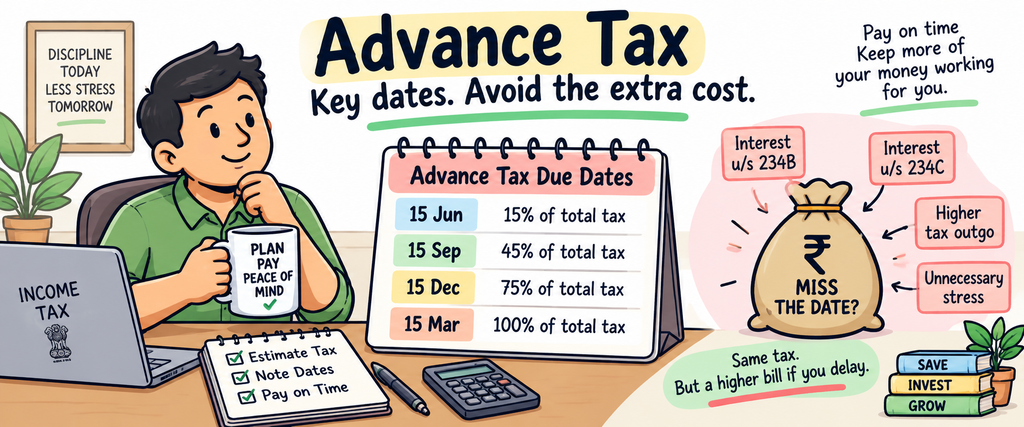
Four dates a year. Each one wants money you may not have yet. That is the part people dread. Income arrives when a client pays. The tax dates do not care. Here is the thing nobody tells you. The four dates are not equal. One of them matters a great deal. The other three hardly matter at all.
Whether this is even your problem
You owe tax in advance if your bill for the year comes to ₹10,000 or more after the tax already cut from your payments. That last bit saves most salaried people. Your employer already cuts tax every month, so there is usually nothing left to pay in advance.
The people who get caught are the ones who are paid in full, with no tax taken out first.
- Anyone working for themselves. You bill a client, and the whole sum lands in your bank.
- Landlords. Rent usually arrives with nothing cut from it.
- Anyone who sold something big. A flat, shares, gold.
- Salaried people who also earn from other things. Bank interest, rent, gains. Your office only cuts tax on the pay it gives you.
Are you 60 or older, living in India, with no business or professional income? Then you are let off completely. Pension and interest do not count against you. But take up a bit of consulting in retirement and that goes away. The whole exemption, not part of it. People find this out late.
The four dates
Take a consultant earning ₹18 lakh. The tax for the year is ₹1,66,400.
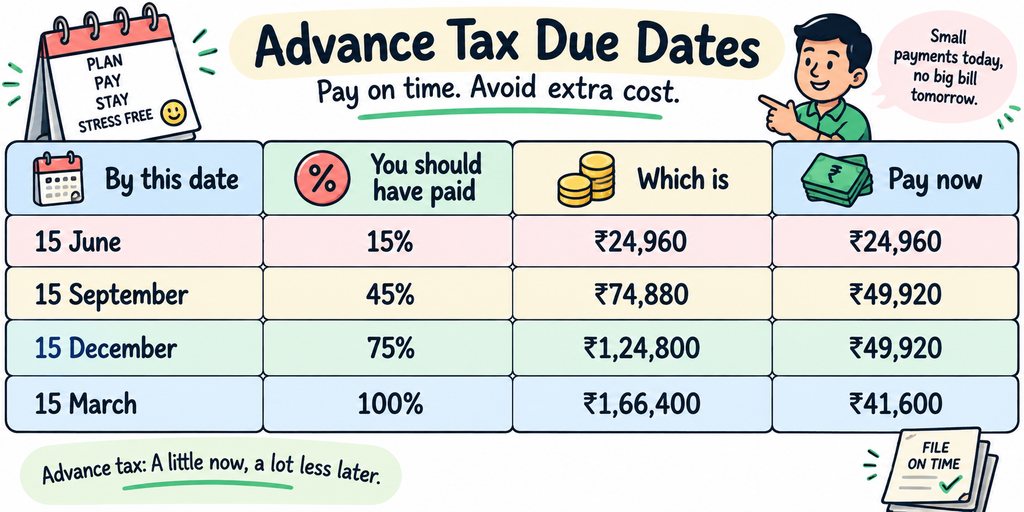
The figures build on each other. By September you need 45% in all, not a second 45%.
A gap in the rule
The first two dates ask for less than they look like they do, and almost nobody knows it. June asks for 15%. Pay 12% and you are charged nothing. September asks for 45%. Pay 36% and you are charged nothing. Nothing at all, not a smaller amount. You are charged only if you pay less than 12% in June, or less than 36% in September. For our consultant that is ₹4,992 less to find in June, and ₹14,976 less in September. You keep that money, and it costs you nothing.
What missing one actually costs
Now the numbers that change how you feel about all this.
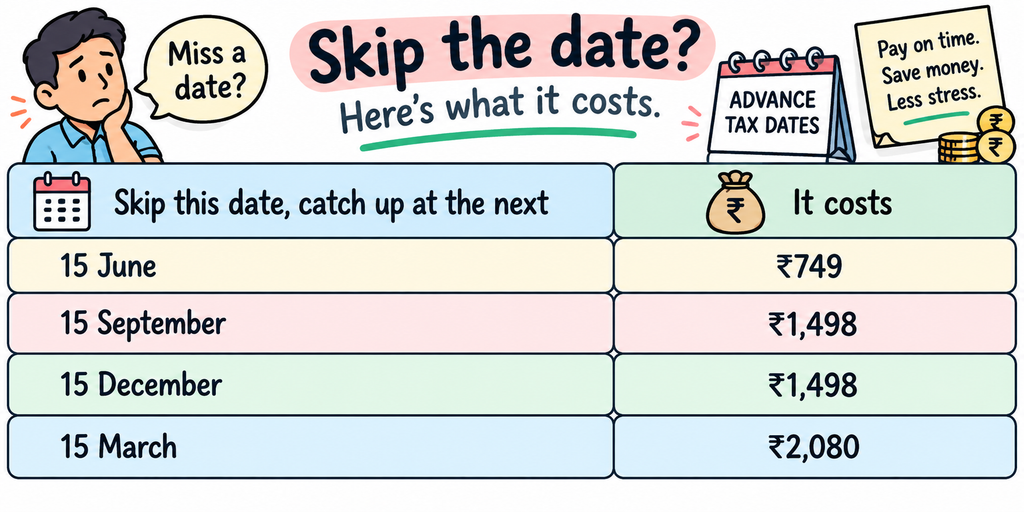
Seven hundred and forty nine rupees. That is what it costs to miss June completely, on a bill of over a lakh and a half. June is the cheapest date to miss, and it is the one people worry about most.
The date that does matter
Pay nothing all year and settle the whole thing on 15 March. Cost: ₹6,739, about 4% of the bill. That is the worst the four dates can do to you. Miss 15 March as well and something else starts. A second charge begins on 1 April and runs every month until you pay. It does not stop at the end of the year. It does not stop when you file. It stops when the money reaches the government.
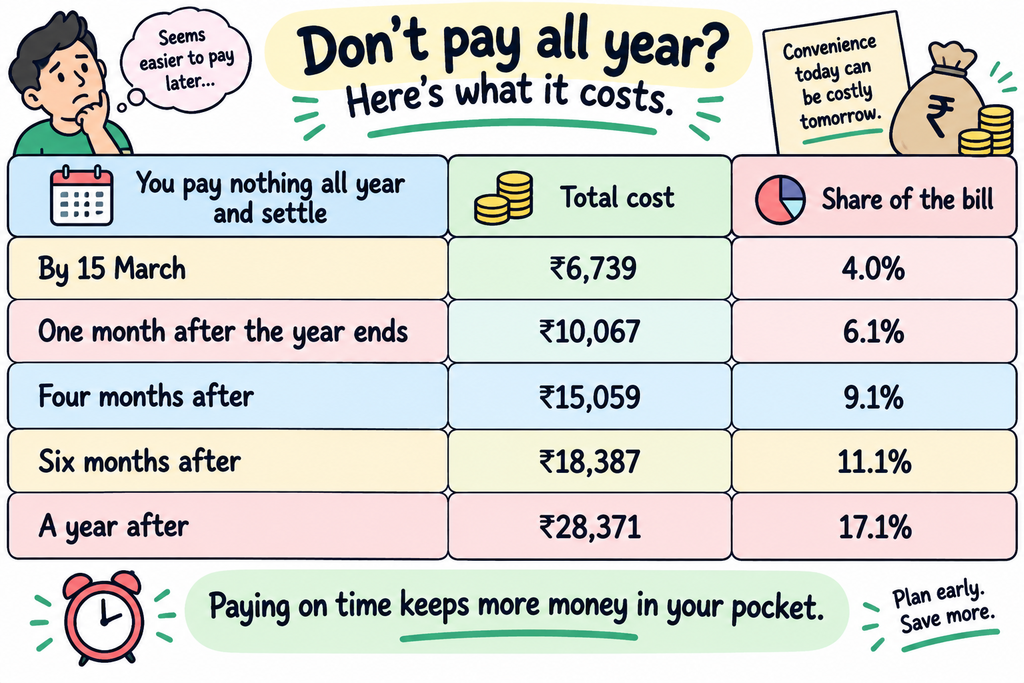
So the rule is short. Get to the full amount by 15 March. How you got there matters very little. Whether you got there matters a lot. On your tax working these two charges appear as section 425 for the dates you missed, and section 424 for the amount still unpaid after March.
It is a price, not a punishment
Both charges run at 1% a month. Nothing is added on top of what has built up, so that is 12% a year. Once you see it as a rate, the decision gets easier. You are borrowing from the government at 12%.
- Would you otherwise put it on a card? Those run near 40%. Delay the tax instead.
- Would you take a personal loan at 18%? Delay the tax instead.
- Would you break a deposit earning 7%? Break it. Paying on time wins.
- Is the money simply sitting there? Then pay. There is nothing to gain by waiting.
This is the part the dread hides. It is one of the cheapest ways to borrow that most self employed people have.
You do not have to predict a sale
A common worry. How was I meant to know in June that I would sell a flat in January?
You were not, and the rule accepts that. Money from selling something, or from winnings, is left out of the dates that have already passed. You pay the tax on it at the next date instead. Sell a flat in January with a gain of ₹40 lakh and the tax is about ₹5,20,000. Pay it by 15 March and the missed dates cost you nothing. Leave it until you file, four months later, and it costs ₹20,800. The same money, just slower. To work out the gain itself, see capital gains basics.
What could go wrong
- Guessing your income too low. The charge is worked out on what you finally owed, not on what you expected in June. A hopeful guess in June becomes a real bill in July.
- Counting tax that was never cut. Check the statement of tax deducted on your behalf before you rely on it. A client who deducted but never deposited leaves you short.
- The simplified scheme has one date, not four. If you declare a flat share of your receipts as profit, the whole amount is due by 15 March in one go. Easier, but a single large demand.
- Treating tax money as yours. It was never your money. A salary that changes every month covers living on income that arrives in lumps.
- Borrowing to pay on time. At 12% a year, the tax is often the cheaper lender. Work out both before you borrow.
What to do with this
- Put one date in your diary, not four. 15 March. The rest are worth a few hundred rupees each.
- Move a share of every payment the day it lands. Put it in a separate account and leave it there. This is the only thing that really works when income arrives in lumps.
- Redo your guess in December. By then you know most of the year. There is still time to fix it cheaply.
- Sold something? Deal with it at the next date. Do not wait for filing. That is where the second charge begins.
- Short of cash in March? Pay what you can. The charge only applies to what is still owed. Half now is half the cost.
The quarterly dread is mostly misplaced. Three of the dates are cheap, and the rule is kinder than it looks.
One date is not. Everything you owe, by the fifteenth of March. Miss that and the second charge begins, and it grows every month until you pay.
This article is for learning. It is not personal tax advice, and no bank, company or filing service is named or backed here. The figures use the newer tax regime for the tax year 2026-27 and a consultant earning ₹18 lakh with no tax cut at source. Your own income, deductions and tax already paid will give other answers. Both charges run at 1% for every month or part of a month, so a single day late counts as a whole month. Rules change with every Budget. Work the real figures out with your filing software or a chartered accountant before you pay anything.