
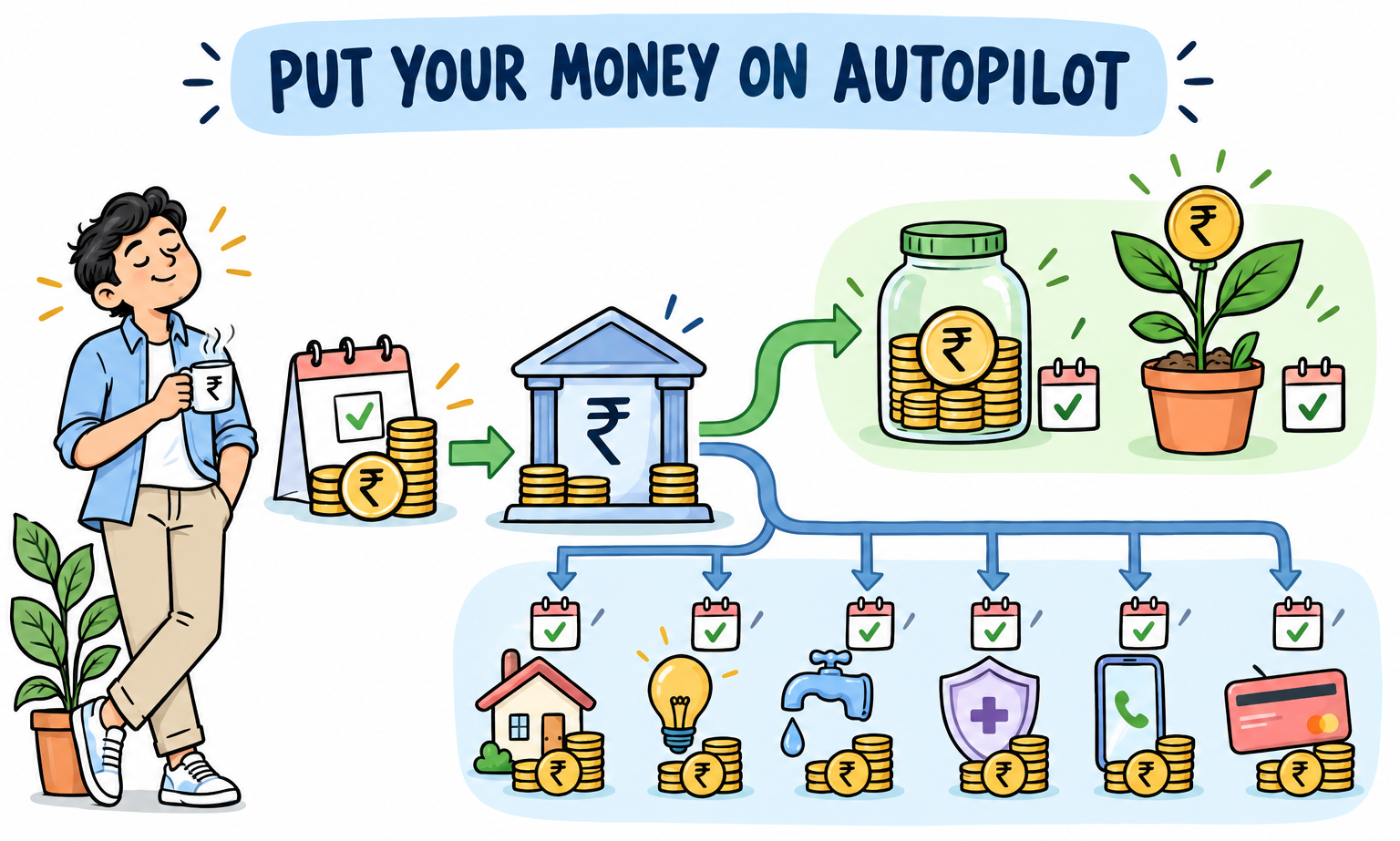
You already know you should save before you spend. The useful question is how to actually set it up, and what goes wrong when you do it badly.
That is what this is about. The buttons, not the reasons.
There are two kinds, and they work in opposite directions
Every automatic payment is one of two things. Nobody explains this, and it decides a lot.
- Someone pulls money from you. You give a company permission once. After that it takes the money on the agreed date. Your fund house does this for a SIP. Your bank does it for a loan payment.
- You push money out. You tell your own bank to send a fixed amount somewhere on a fixed date. Nobody else is involved. This is what you use for rent, or to move money to your own second account.
The difference matters when something changes. To stop a pull, you go to the app or bank screen where the permission lives. To stop a push, you just change the instruction at your own bank.
Which one to use
For pulls, you have two choices. One runs through your UPI app. The other is set up directly with your bank.
The UPI one is quicker. You approve it on your phone in about a minute. It suits most people for most things.
The bank one takes longer to set up and is used for bigger amounts. Home loan payments usually run this way.
Some amount limits decide this for you.
- Ordinary monthly payments go through without you approving each one, up to ₹15,000.
- For a mutual fund SIP, an insurance premium or a credit card bill, that limit is ₹1,00,000.
- Above that, you need the bank kind.
So a ₹20,000 SIP is fine on UPI. A ₹20,000 payment to anything else is not, and you will be asked to approve it every month, which defeats the point.
The mistake that costs real money
Here is the part almost nobody knows until it happens.
If the money is not there when a payment is due, the payment fails. Your bank then charges you a fee. It is usually ₹250 to ₹750, plus 18% tax on top. So about ₹295 to ₹885 each time.
Now read this next line twice.
The fee is charged for each payment, not for each day.
Say you have five SIPs, all set to the 1st. One month your salary is late. All five fail on the same morning, for the same reason, because of the same shortfall.
You are charged five times. At ₹590 each that is ₹2,950 gone in a day.
Let that happen three times in a year and it is ₹8,850. You got nothing for it. Put that same money into a fund each month instead and over twenty years it is about ₹6.4 lakh.
So spread the dates
This is the whole fix, and it costs nothing.
Do not put everything on the same day. If one payment fails you want one fee, not five.
And do not put anything on the 1st. Salary dates move. A holiday, a weekend, a payroll delay, and the money has not landed yet.
Pick a date two or three days after you normally get paid. If your salary comes on the 1st, use the 4th or 5th. You lose nothing by waiting three days. You avoid a fee that arrives for no reason.
How to set it up, in order
- Work out what leaves every month no matter what. Rent, loan payments, insurance, school fees. These are not choices.
- Decide what you will save. Put this next in the queue, not last. That is the whole idea.
- Give each one its own date, a few days apart. Saving on the 4th. Two SIPs on the 6th and the 9th. Card bill after that.
- Keep about one month of these payments sitting in the account. This is your cushion for the month your salary is late. It is not savings. It just lives there.
- Write down what you have set up. One page. Date, amount, who gets it. You will want this in two years when you cannot remember.
Three things that will come up later
- You cannot usually change the amount. To raise a SIP from ₹5,000 to ₹8,000, most places want a new instruction. The old one does not simply move. So start a second one for the extra ₹3,000 and leave the first alone. Two instructions are easier than one argument.
- Stopping the payment is not the same as closing the account. Stopping a SIP payment stops new money going in. The money already invested stays invested. That is usually what you want, and people often sell everything when they only meant to pause.
- Your bank must warn you before each payment. At least 24 hours ahead, with the name and the amount. Read those messages. They are the only list of your automatic payments that arrives without you asking.
If you have never checked what is already running, do that first. The subscriptions you forgot you were paying for shows you the four places to look.
And pay yourself first covers why the date matters more than the amount.
Set this up once, on a quiet evening. Then it works every month whether you feel like saving or not. That is the point of it.
This article is for learning. It is not personal financial advice, and no bank, app or company is named or recommended here. Failure fees differ by bank and change, so check what your own bank charges. The payment limits are set by the Reserve Bank of India and were updated in 2026. The growth rate used is an example to show how the sums work, not a promise. For advice about your own money, speak to a SEBI-registered investment adviser.