
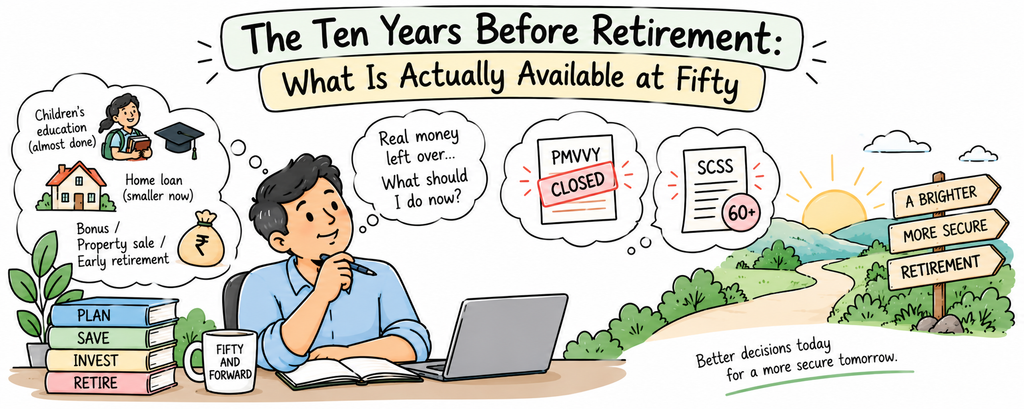
You are fifty something. The children’s fees are nearly done, the home loan is smaller than it was, and for the first time there is real money left over each month. Or a lump sum has arrived, from a property sale, a bonus, or an early retirement package.
Search for what to do with it and you will be told to move heavily into safe, fixed return products, and pointed at two government schemes. One of them no longer exists. The other one you are almost certainly not allowed to use yet.
The two schemes you keep being shown
The Pradhan Mantri Vaya Vandana Yojana closed to new subscribers on 31 March 2023. You cannot buy it. People who already hold it keep receiving their pension, but nobody new can join. A great deal of advice online has not caught up, so if a page or an agent offers it to you, that tells you how current the rest of their information is.
The Senior Citizens Savings Scheme is a plan for sixty, not fifty. It pays 8.2% a year, which is better than any bank deposit, and you can put in up to ₹30 lakh. The rules on who may open one are narrower than most articles mention.
- Anyone aged sixty or above.
- Between fifty five and sixty, only if you have retired on superannuation or under a voluntary retirement scheme. The account has to be opened within one month of receiving your retirement money, and you cannot put in more than those benefits came to.
- Retired defence personnel from fifty, on similar conditions.
That one month window is the part worth writing down. If you take voluntary retirement at fifty seven and let the paperwork drift for six weeks, you have lost the right to use the scheme at all until you turn sixty.
What you can actually use at fifty
Here is what the realistic choices pay, and what they pay after tax at a 30% slab, which is where most people in this position sit.
- Extra provident fund, within the limit: 8.25%, and you keep all of it.
- Extra provident fund above the limit: 8.25% becomes 5.68%.
- The Senior Citizens Savings Scheme, once you qualify: 8.2% becomes 5.64%.
- RBI floating rate savings bonds: 8.05% becomes 5.54%. Seven year lock in, and you cannot exit early unless you are sixty.
- A bank deposit: 7% becomes 4.82%.
The first line is not close. If you are still employed, putting extra into your provident fund is the best fixed return available to you in India, by a wide margin, because the interest is not taxed while everything else on that list is.
The catch in the provident fund
That tax free interest stops at ₹2.5 lakh of your own contributions in a year, and the limit counts the ordinary provident fund deduction already coming out of your salary, not just the extra you add.
Your normal contribution is 12% of basic pay. So the room left for extra contributions shrinks fast as basic pay rises.
- Basic pay of ₹10 lakh a year: about ₹1.3 lakh of room.
- Basic pay of ₹15 lakh: about ₹70,000 of room.
- Basic pay of around ₹20.8 lakh: no room at all. Your ordinary contribution has already used the whole allowance.
So the answer is not “put everything into the provident fund”. It is to fill the room you have, then stop, because above that line it pays 5.68% and there are better places for the rest.
The bigger mistake
All of the above is about where the safe part of your money goes. The more expensive error is deciding at fifty that most of your money should be safe.
You are not investing for ten years. You are fifty, and you may well be alive at eighty five. That is a thirty five year horizon, most of it after you stop earning.
Take ₹50 lakh at fifty. At a steady 7%, which is roughly what safe products give you before tax, it becomes ₹5.34 crore by eighty five. With half of it in equity, at a blended 9.5%, it becomes ₹11.98 crore.
Now put those in today’s money, because that is what they will actually buy. At 6% inflation the safe version is worth about ₹69.5 lakh and the balanced one about ₹1.56 crore. The cautious choice more than halves what you end up with.
This is the same conclusion the three bucket approach reaches from the other direction. Even a retiree drawing an income holds around 72% in equity, because the money has to last decades. At fifty you are further from that day, not closer.
What to do, in order
- Work out what you are aiming at first. Catching up implies a target. The retirement calculator gives you the number before you start choosing products.
- Fill your provident fund room, then stop. Best fixed return you can get, up to the limit. Work out your own room rather than guessing.
- Keep most of the rest growing. The safe part is there to cover the first several years after you stop working, not to hold your whole retirement.
- Diarise your sixtieth birthday. That is when the Senior Citizens Savings Scheme opens up at ₹30 lakh each, for you and your spouse separately. If early retirement is on the cards, remember the one month window.
- With a large lump sum, decide whether to put it in at once or spread it. The lump sum calculator works out what the waiting actually costs.
Fifty is not late. It is the decade when most people finally have money to work with and the shortest remaining time to waste on products that do not pay.
This article is for learning. It is not personal financial advice. Scheme rates and rules are those in force in India at the time of writing and change regularly, including every quarter for the small savings schemes, so check the current position before acting. The after tax figures assume a 30% slab with cess and will differ for you. The growth rates used in the comparison are illustrations chosen to show how the sums work, not forecasts, and money in equity can fall as well as rise. For advice about your own retirement, speak to a SEBI-registered investment adviser.