
The retirement withdrawal calculator tells you whether your money lasts. It also carries a warning that it does not solve: a few bad years right at the start do far more damage than the same years later on.
This is why that happens, and the simple arrangement most retirees use to survive it.
The thing that ruins retirements
Take someone retiring with ₹2.5 crore who draws ₹15 lakh in the first year and raises it 6% a year to keep up with prices.
Now give them twenty years of market returns averaging about 10%. The same twenty returns every time. The only thing that changes is the order they arrive in.
- Best years first: they finish with ₹7.57 crore.
- A jumbled, ordinary order: ₹4.82 crore.
- Worst years first: they run out of money.
Same returns. Same average. Same spending. One retirement ends comfortable and one ends broke, purely because of when the bad years landed.
Here is the part that proves what is really going on. Run those same three orders again with nobody taking any money out, and every one of them finishes at exactly ₹14.81 crore. Identical. Multiplication does not care what order you do it in.
So the order is not the problem by itself. The problem is selling while prices are down. In a bad year you are not just watching the value fall, you are handing over units to pay for groceries, and those units never come back to enjoy the recovery. Do that for three years running at the start and the recovery arrives too late.
The three buckets
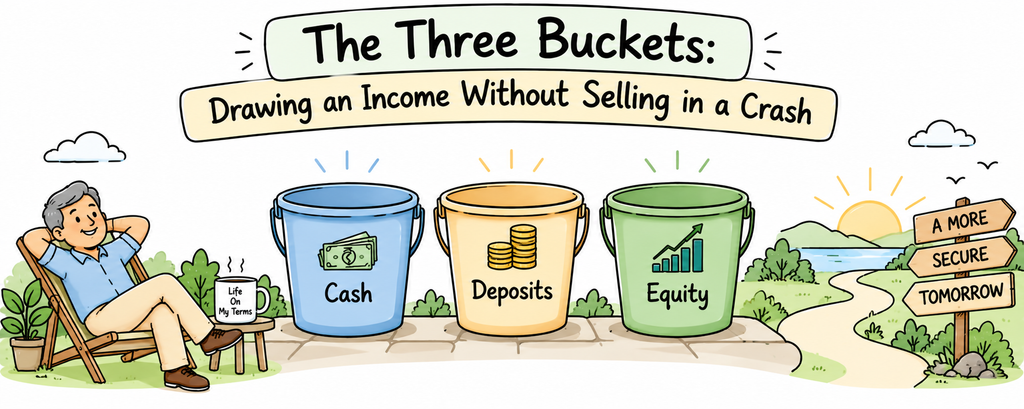
The fix is not clever. It is to make sure you never have to sell equity to eat.
You split your savings into three piles by when you will need them.
- Two years of spending, in cash. A savings account or a liquid fund. It earns very little and that is fine. This is the money you actually live on.
- Five more years, in deposits. Fixed deposits and the Senior Citizens Savings Scheme. Safe, boring, predictable. This refills bucket one.
- Everything else, in equity. You will not touch this for seven years. It is the only part with any real chance of beating rising prices over a long retirement.
On ₹1 crore with ₹4 lakh a year of spending, that is roughly ₹8 lakh in cash, ₹20 lakh in deposits and ₹72 lakh in equity. On ₹2.5 crore with ₹10 lakh of spending, it is ₹20 lakh, ₹50 lakh and ₹1.8 crore. Either way equity is around 72%, which surprises people who expect a retiree to hold mostly deposits.
It surprises them because they are thinking about one year. You are planning for thirty.
Go back to the retiree who ran out of money. Give them seven years of spending sitting safely in the first two buckets, so the crash at the start never touches their equity, and instead of running out they finish with about ₹1.18 crore. Nothing else changed.
What goes in bucket two
- The Senior Citizens Savings Scheme pays 8.2% a year at the moment, which is better than any bank deposit. You can put in up to ₹30 lakh, it runs five years and can be extended by three, and the rate is fixed on the day you open it. Anyone over sixty can use it, and so can some people over fifty five who have taken early retirement. If you are a couple, that is ₹30 lakh each.
- Bank deposits for the rest. Senior citizens get about half a per cent more than everyone else, which puts the large banks near 7% and some smaller banks higher. Spread them across a few maturity dates so something matures every year.
Refilling, which is where people go wrong
Once a year, look at what equity did.
If it had a good year, sell a slice and top the other two buckets back up. If it had a bad year, leave it completely alone and let bucket two do the work. That is the whole discipline, and it is the entire point of the arrangement. You are buying yourself permission to do nothing in a crash.
The mistake is refilling mechanically every year regardless. That quietly turns the whole thing back into selling in a downturn, which is exactly what you built the buckets to avoid.
The tax part, which is not what you will be told
You will read that drawing from equity is more tax efficient than living on interest, because only the gain is taxed and at a gentler rate. For most retirees that is simply wrong, and it is worth seeing why.
On the newer tax regime there is no tax at all up to ₹12 lakh of income. So a retiree with ₹1 crore in deposits earning ₹7.5 lakh of interest pays nothing. Drawing the same money out of an equity fund instead would cost about ₹22,750, because the gains are taxable from the first rupee above the yearly free limit.
At ₹1 crore, deposits win on tax.
The advice becomes right only once the portfolio is large. At ₹2.5 crore, ₹18.8 lakh of interest attracts about ₹1.82 lakh of tax, while drawing ₹15 lakh from equity costs about ₹81,250. Now equity saves you a lakh a year.
One more thing worth knowing. There is a deduction that lets senior citizens take ₹50,000 of interest free of tax, and it exists only on the older tax regime. If you are on the newer one, which is the default, you do not get it.
None of this changes the buckets. You hold deposits because they let you survive a bad decade, not because of tax. But it does mean you should work out your own position rather than accepting a rule of thumb built for a portfolio much larger than yours.
Four ways this fails
- Too much in the safe buckets. The most common mistake. Ten years of spending in deposits feels responsible and guarantees you lose to rising prices over a thirty year retirement. Seven years is enough.
- Refilling in a bad year. Covered above, and it undoes everything.
- Forgetting the ₹30 lakh limit. The Senior Citizens Savings Scheme caps out, so a large bucket two needs bank deposits alongside it.
- Treating the buckets as three separate plans. They are one portfolio in three parts. What matters is the total and whether the safe part covers the next seven years.
If you are still working out how large the whole thing needs to be, the retirement calculator does that. If some of your money is going into an NPS annuity, what you are actually buying covers that decision, which follows very similar logic.
This article is for learning. It is not personal financial advice. The return sequences above are illustrations chosen to show how the order of returns interacts with withdrawals, not forecasts of any market. Deposit and scheme rates are those available in India at the time of writing and change regularly. Tax figures are for a resident senior citizen on the newer regime in the 2026-27 tax year and ignore any other income, and the split between capital and gain in a withdrawal depends entirely on your own purchase history. Tax rules change with every Budget. For advice about your own retirement, speak to a SEBI-registered investment adviser.